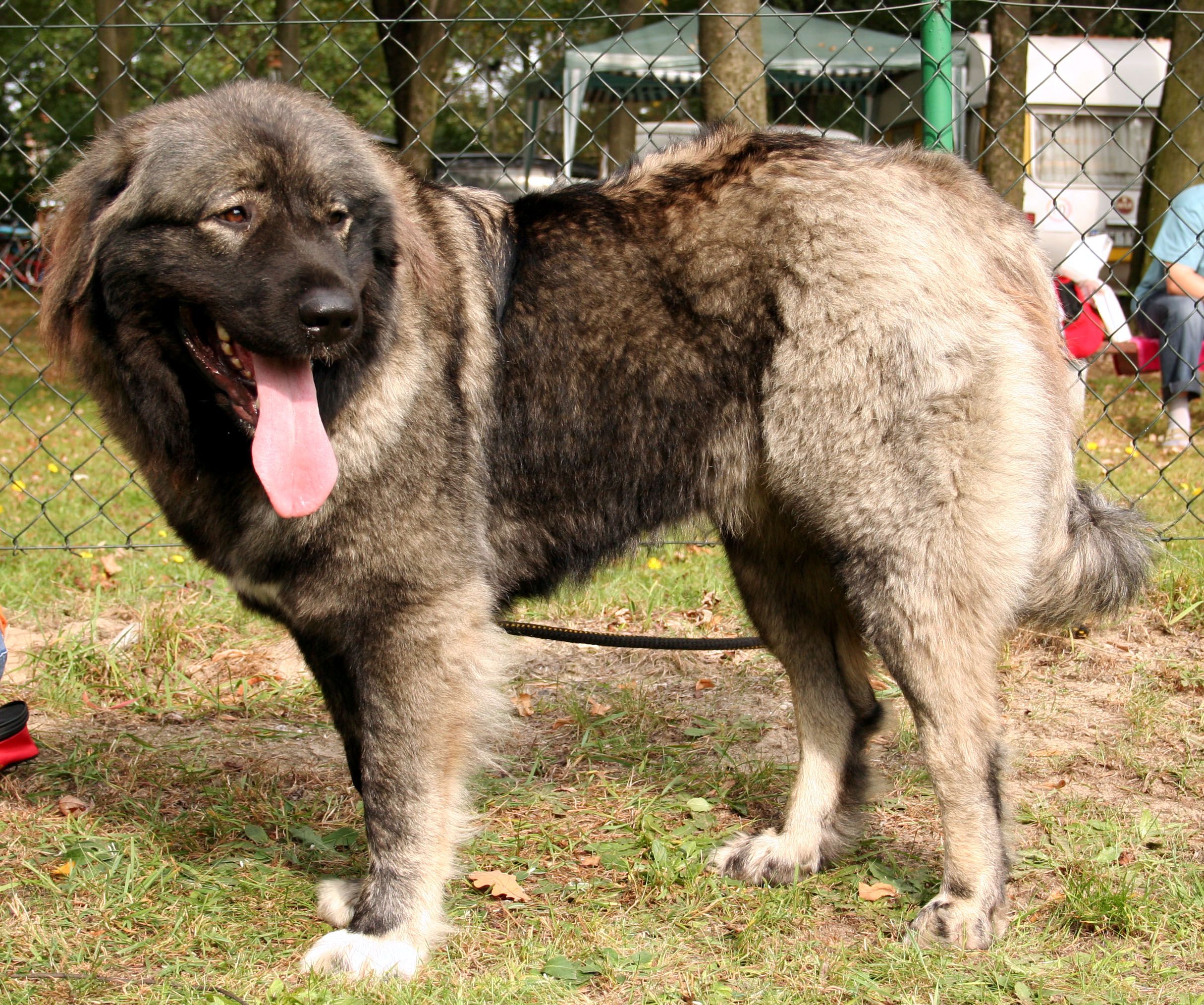
I saw him yesterday morning: the Caucasian shepherd. I don’t mean the human, I mean his monster dog covered with what looks like ten layers of hair, and standing as high as the man’s waist. This dog exists to work in the wilds of the Caucasus, which Venice resembles in not even one way, though I guess if the city were really serious about limiting tourists they could station one at each vaporetto stop.
Dogs abound in Venice, but you might never have thought of adding this behemoth to the canine collection. I wasn’t quick or close enough to get a photo of the local pup, so this image is here temporarily to show what I’m talking about. The term “shepherd” is misleading, though, in that this breed is a guardian dog, not a herding one. His purpose in life is to defend his flock from famished wolves and other predators, not to wander aimlessly along via Garibaldi. I suppose things might get lively if a famished tourist were to make a wrong step. (Photo by Owczarek_kaukaski_65556 Wikipedia)
But no matter. Venetians are crazy about dogs, and they have been this way for centuries. One of my favorite minor entertainments is looking at Venetian paintings and finding the dogs. They’re really easy to spot and they’re almost always more interesting than whoever or whatever is the official subject of the scene.
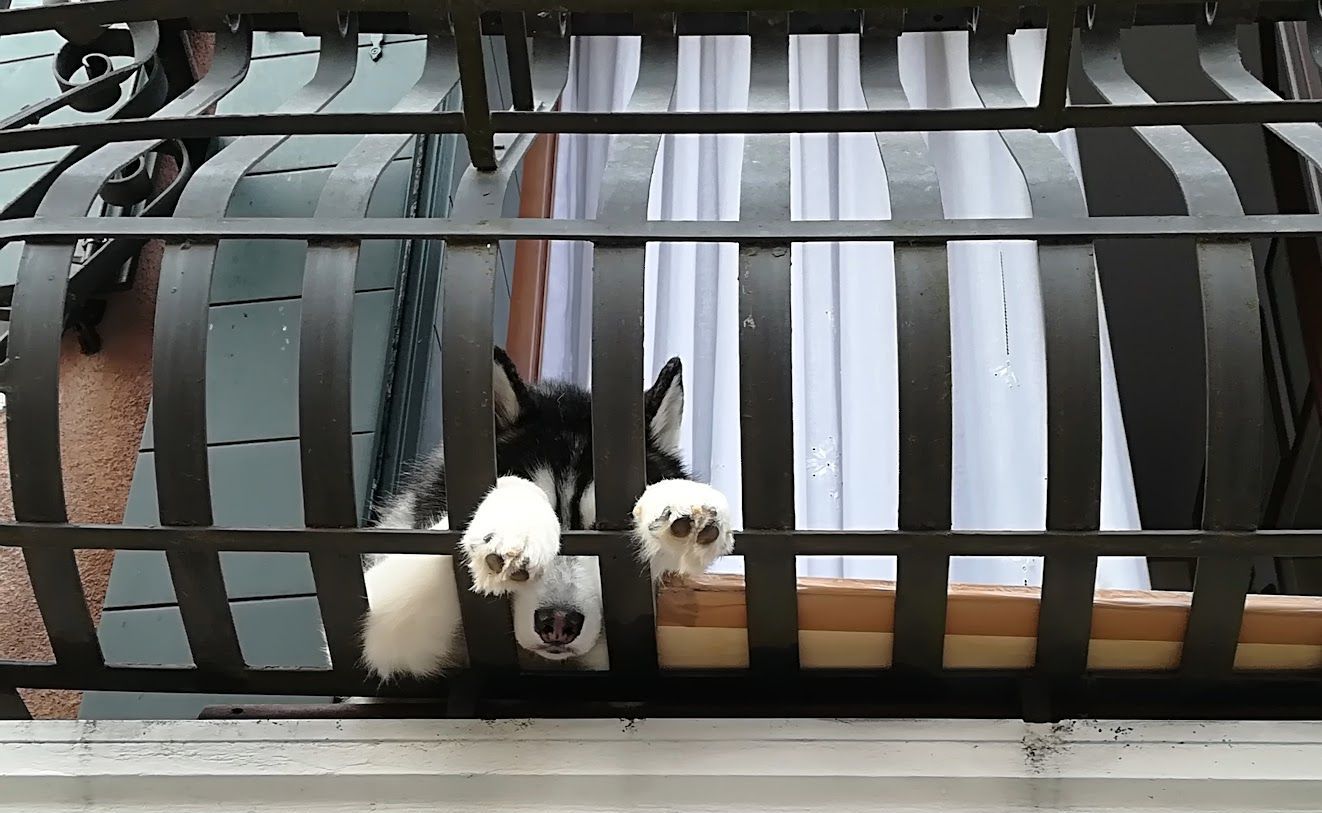
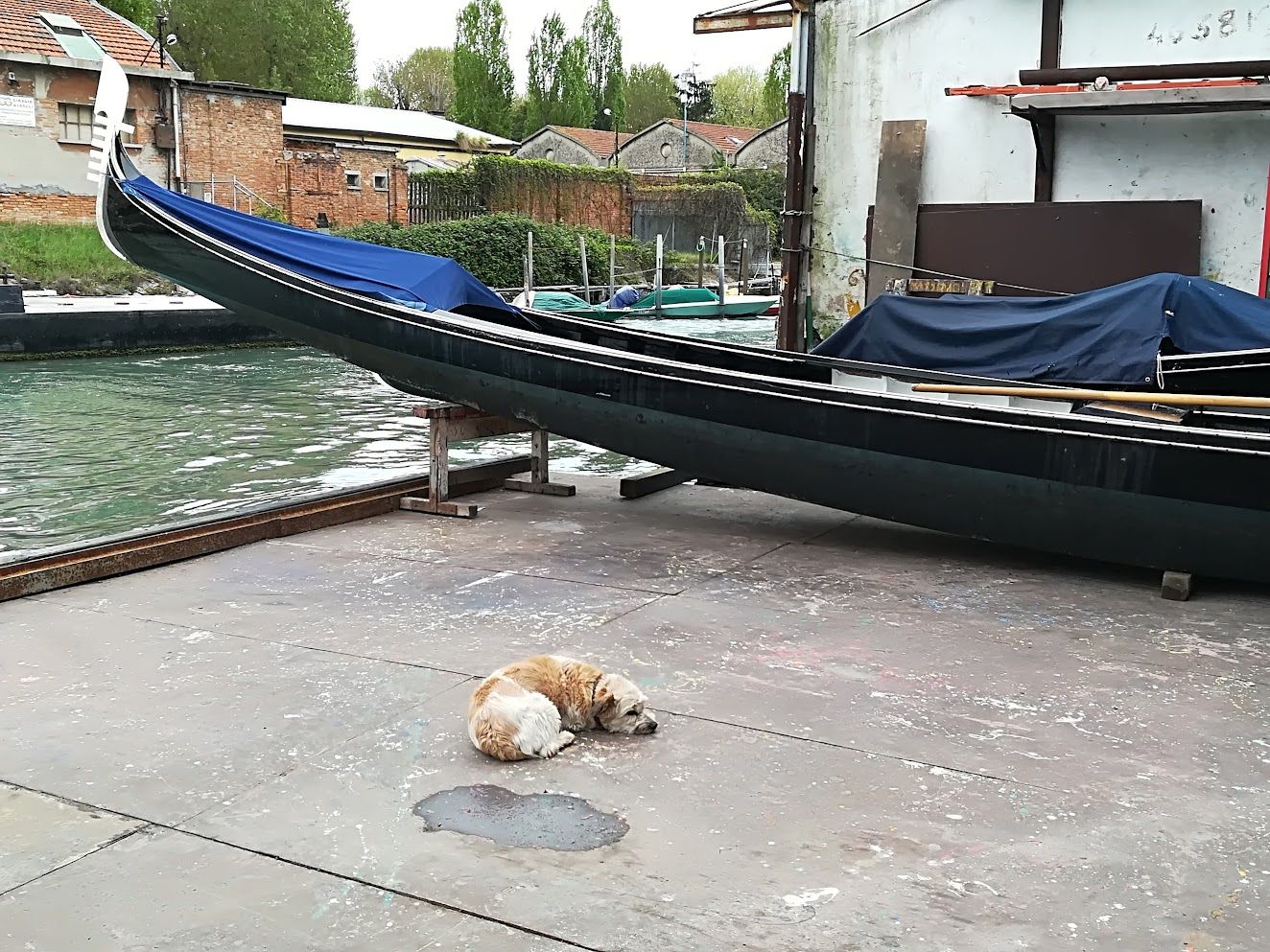
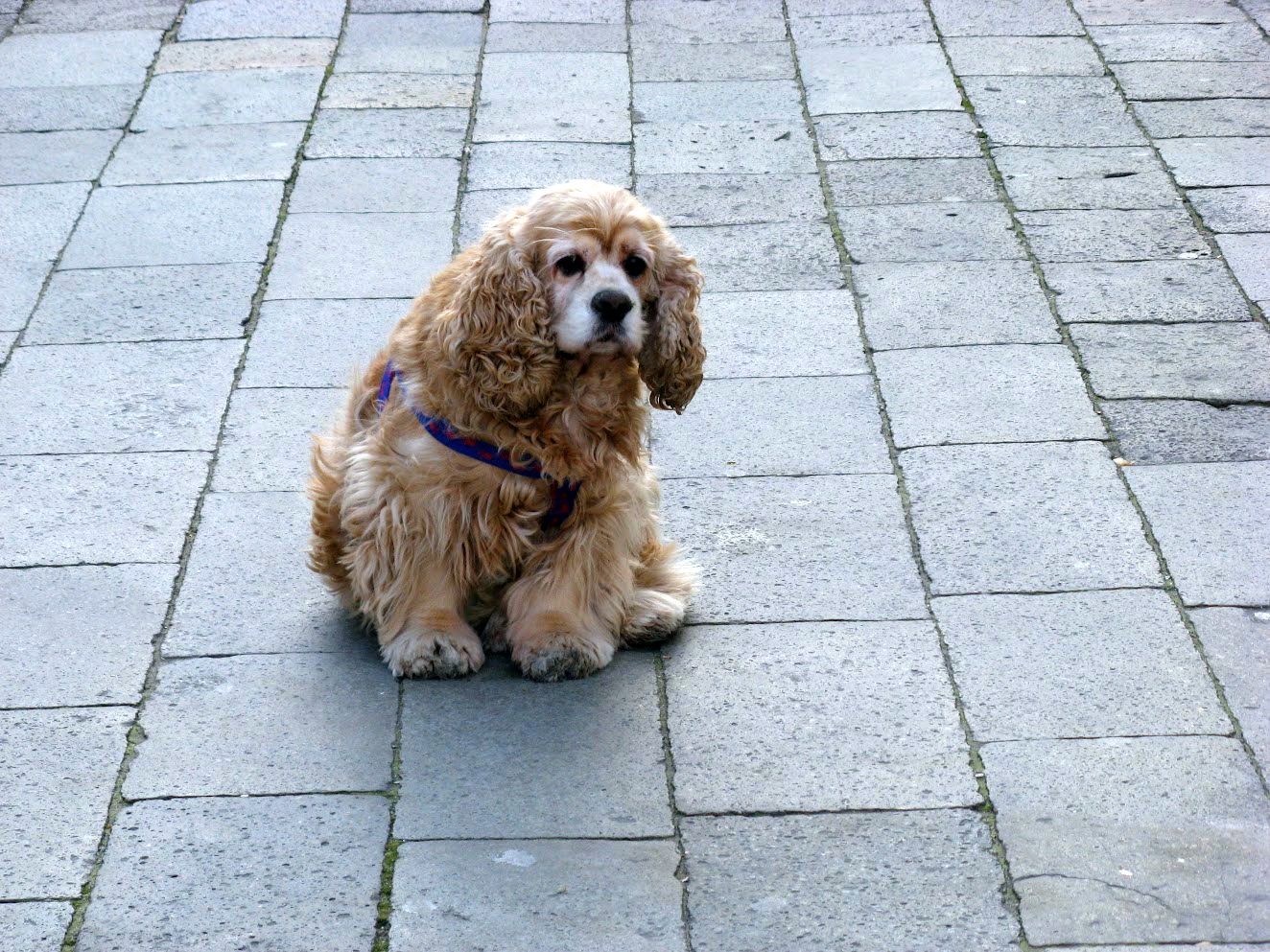
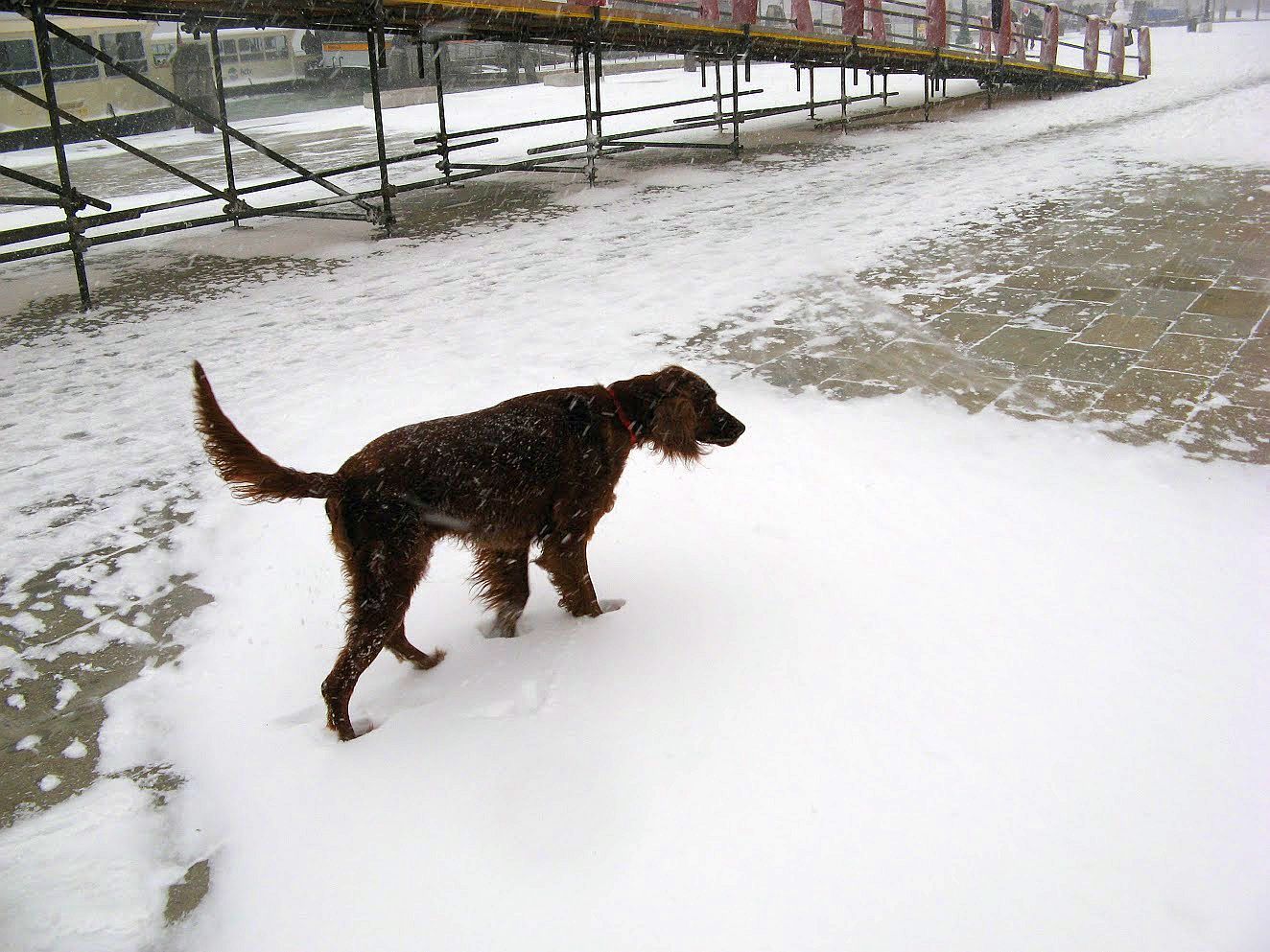
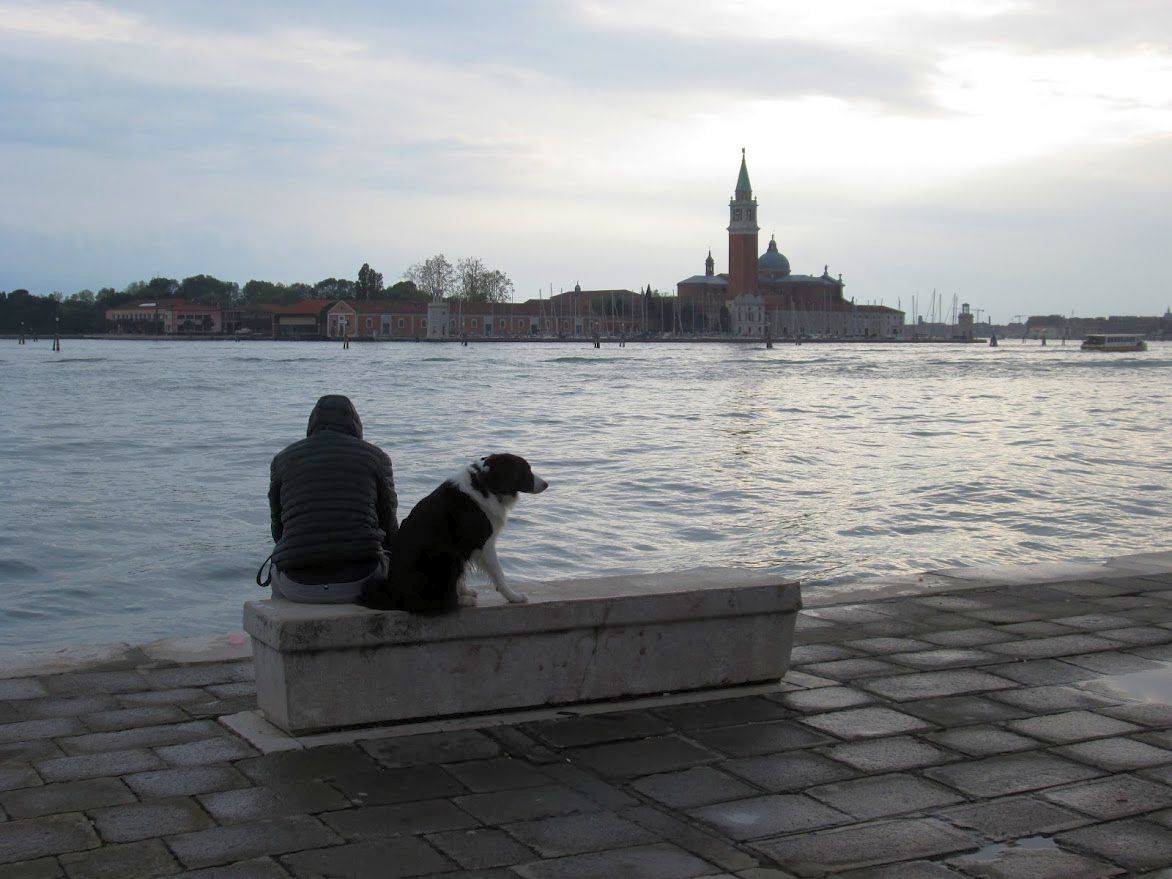
In 2019 the Comune of Venice listed 7,023 registered dogs in the “historic center and the islands,” and 16,387 in the mainland municipality. So dog-lovers have come to the right place. When you get tired of museums and canals, you’ve got plenty of dogs to watch. Here are a few from our little precinct:
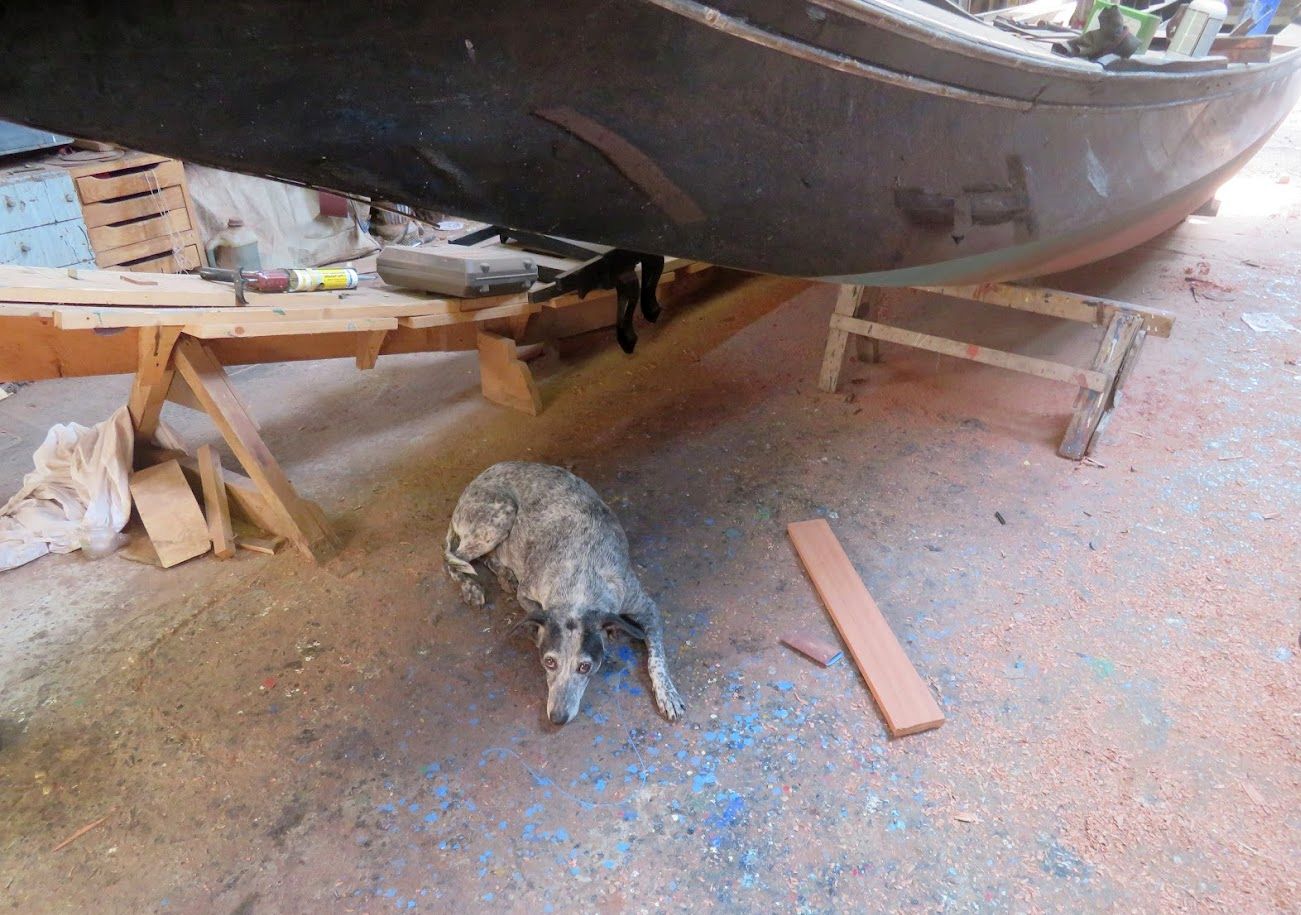
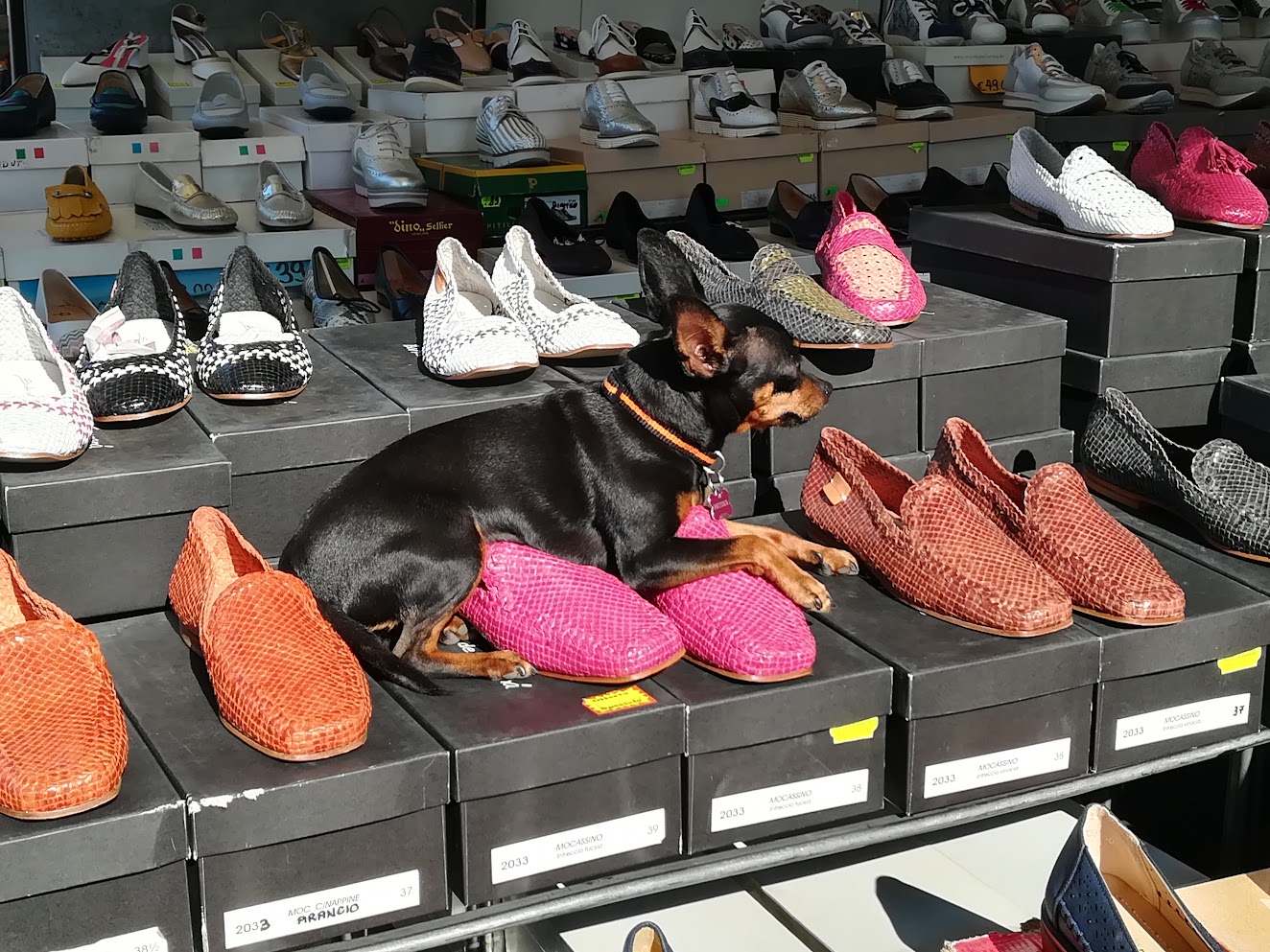
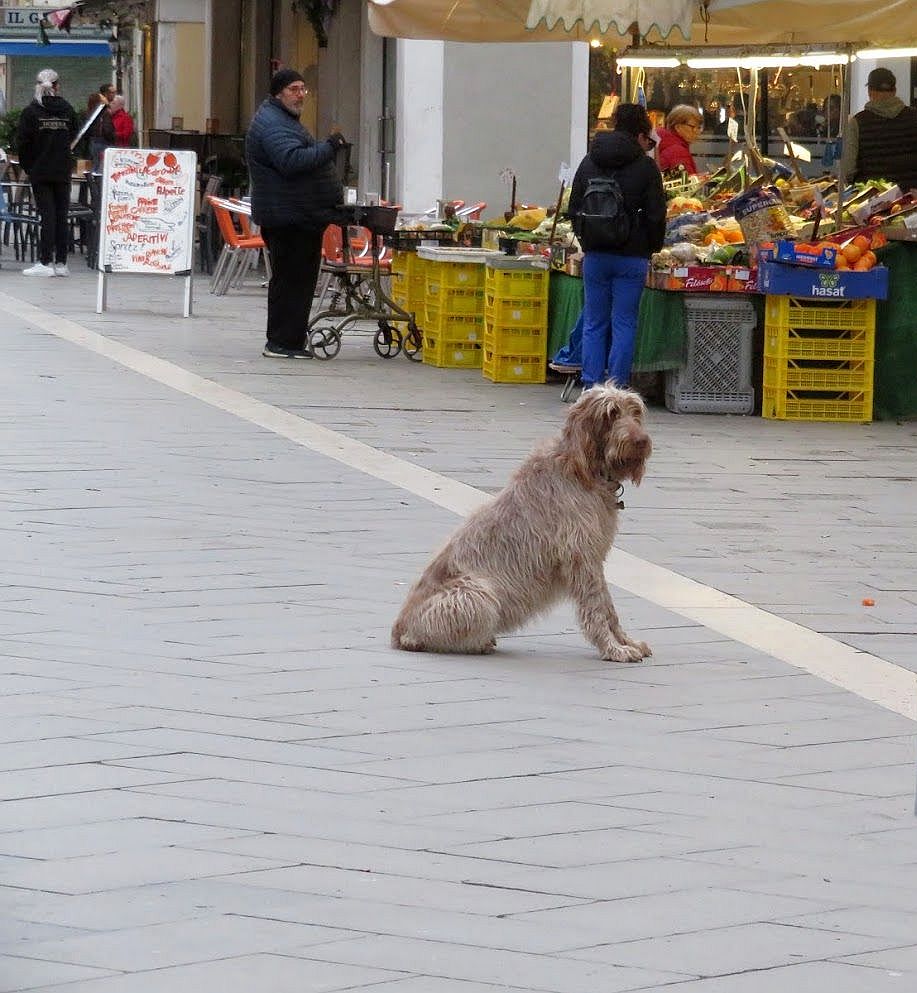
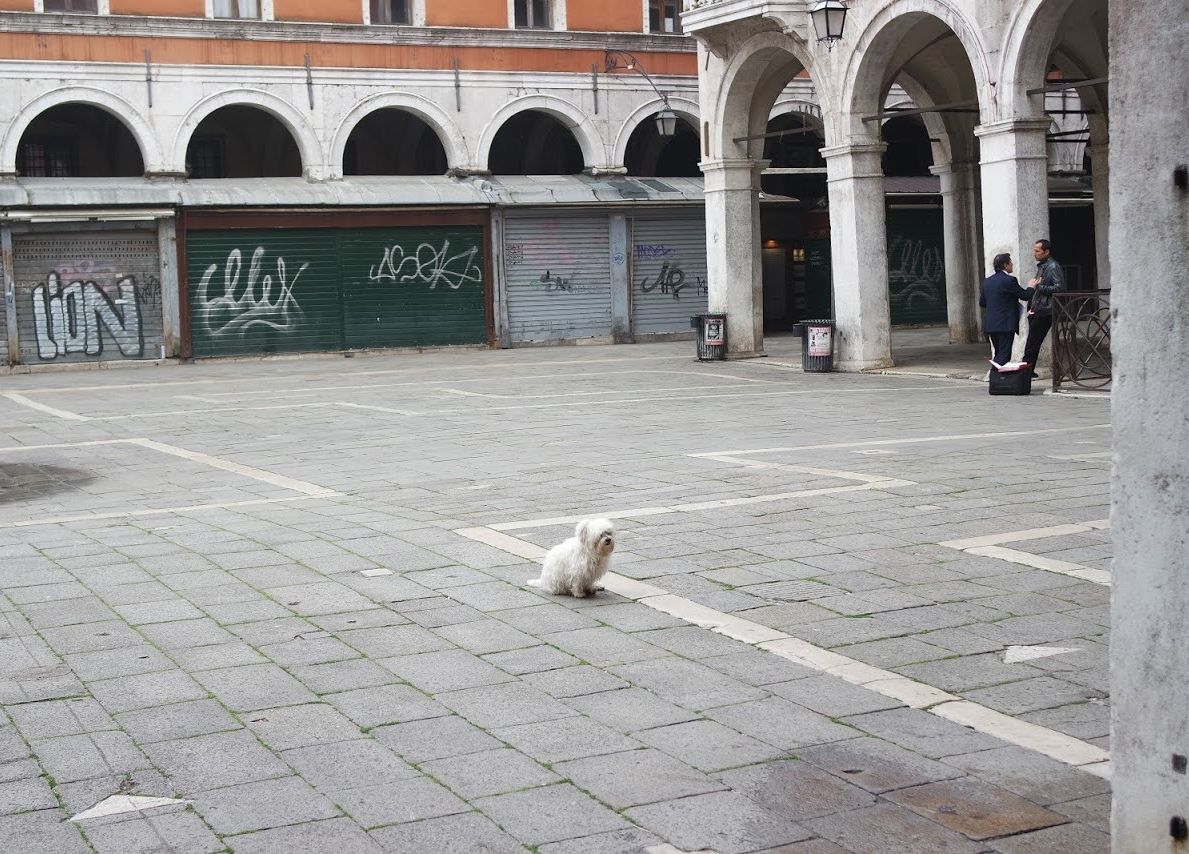
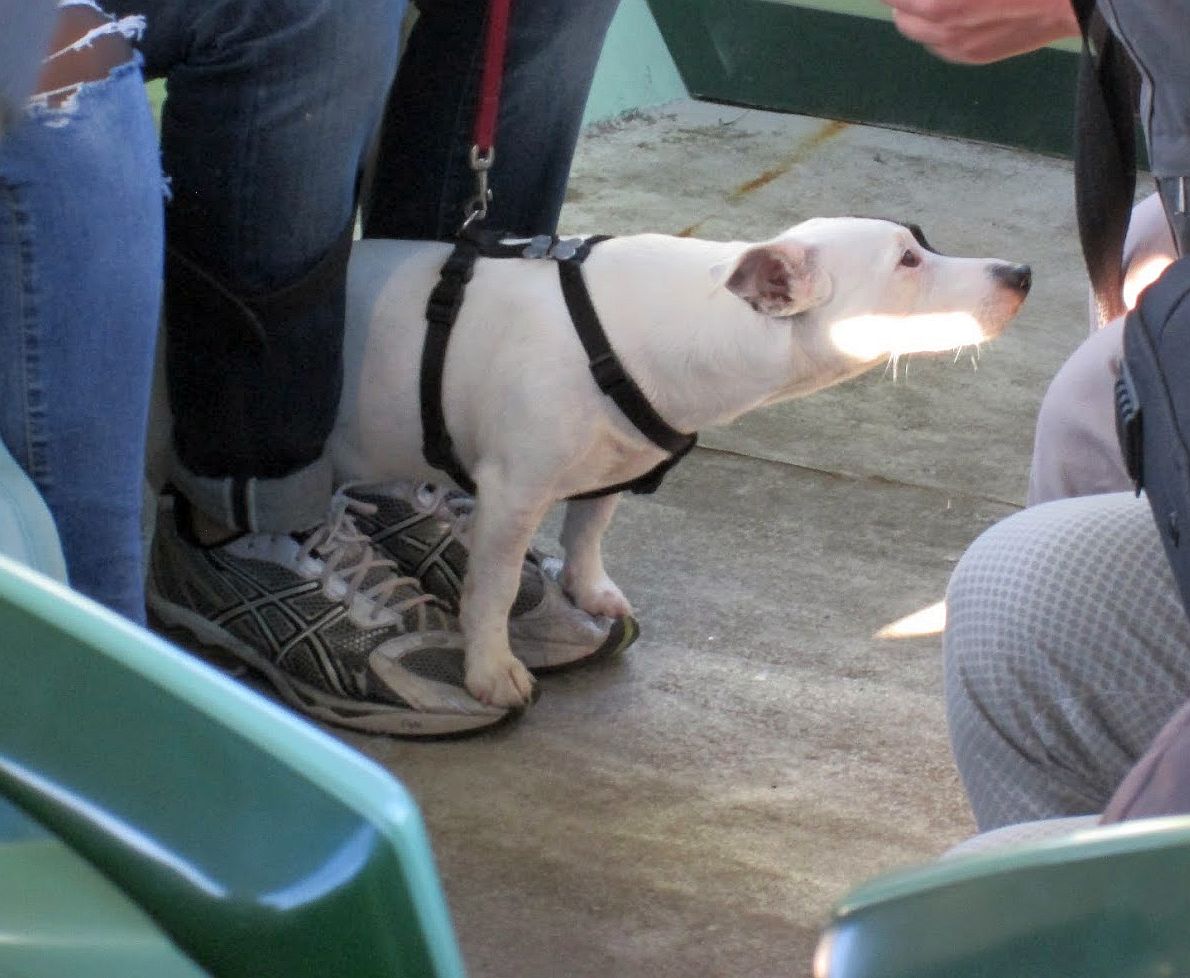
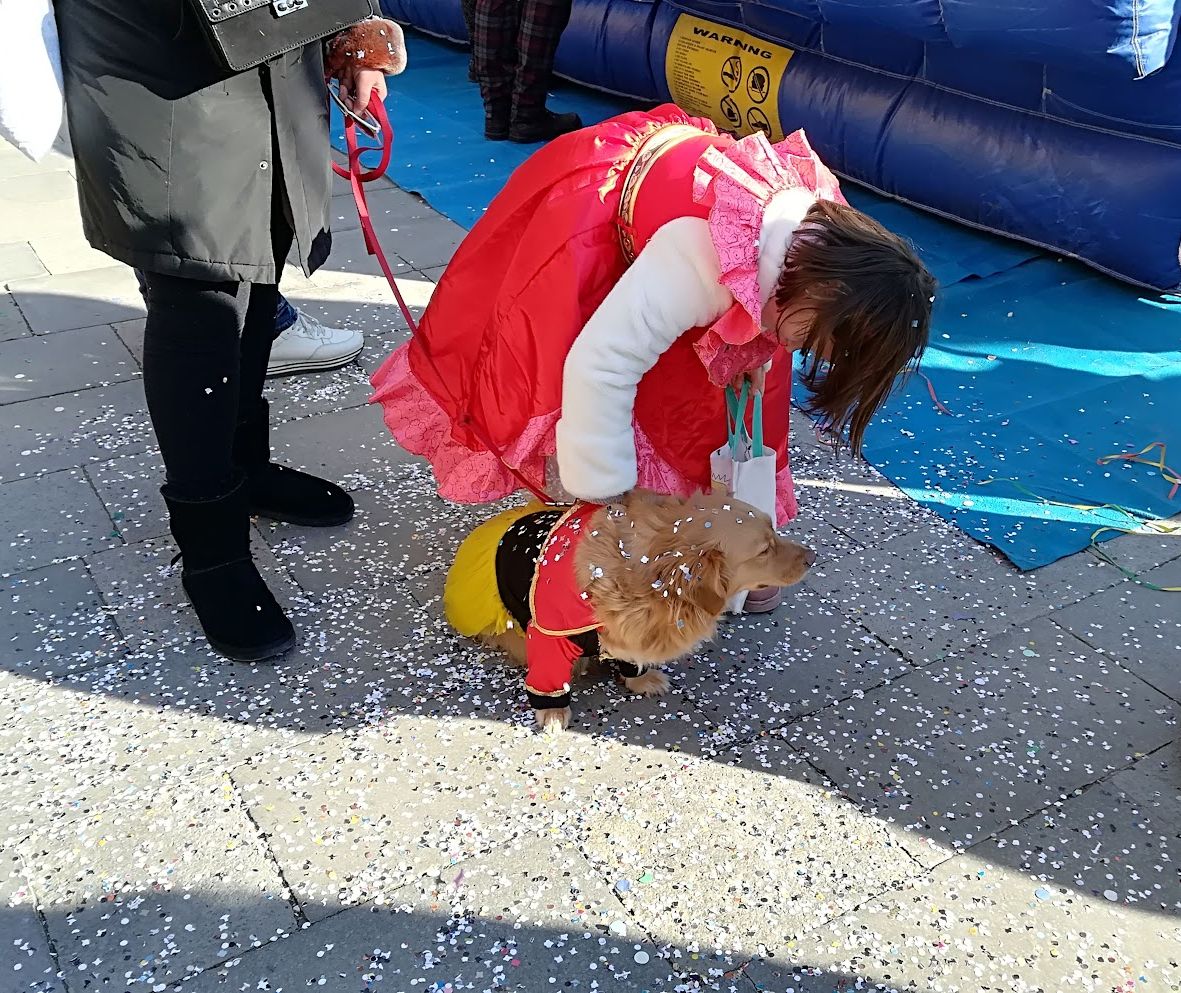
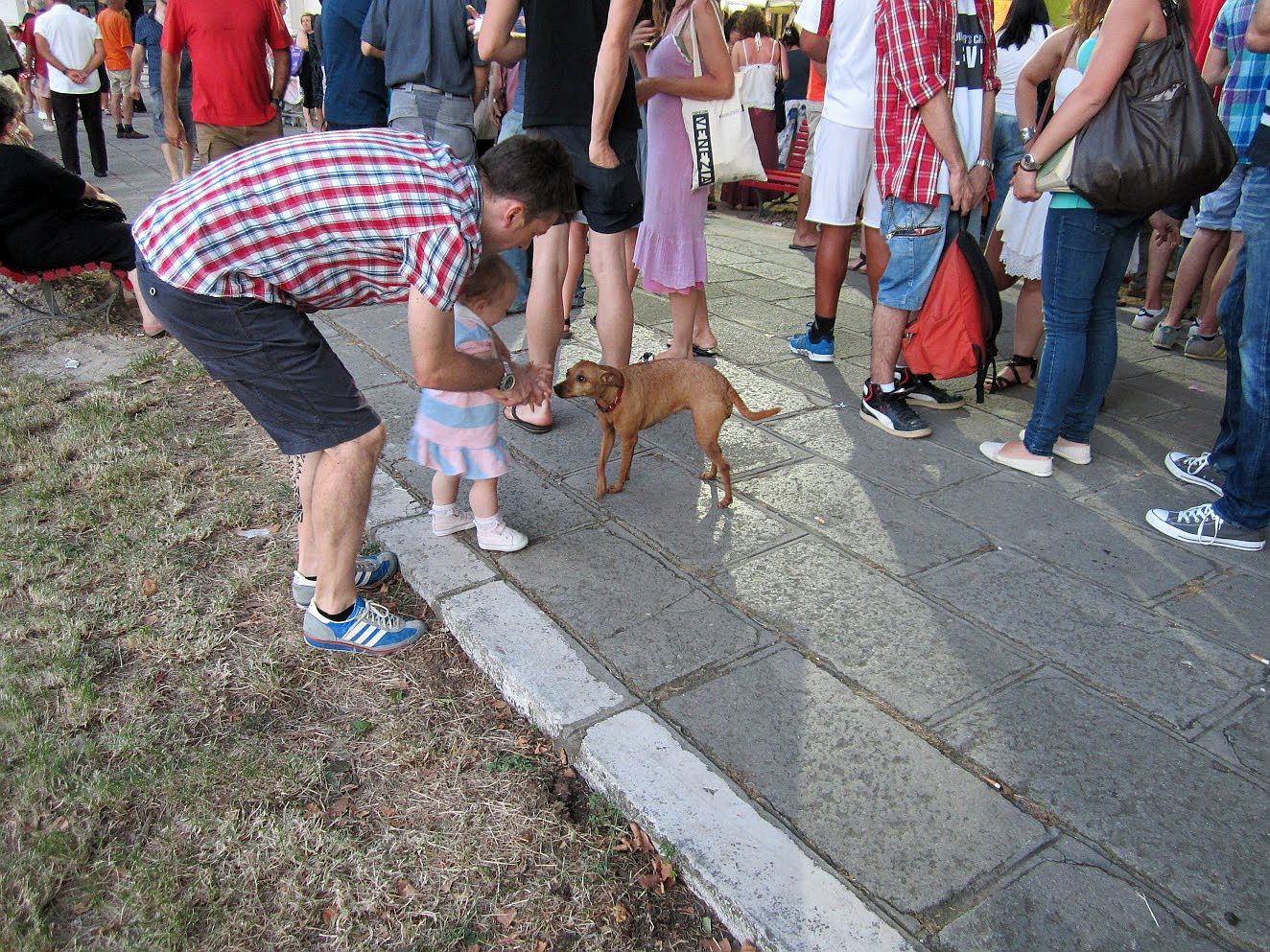
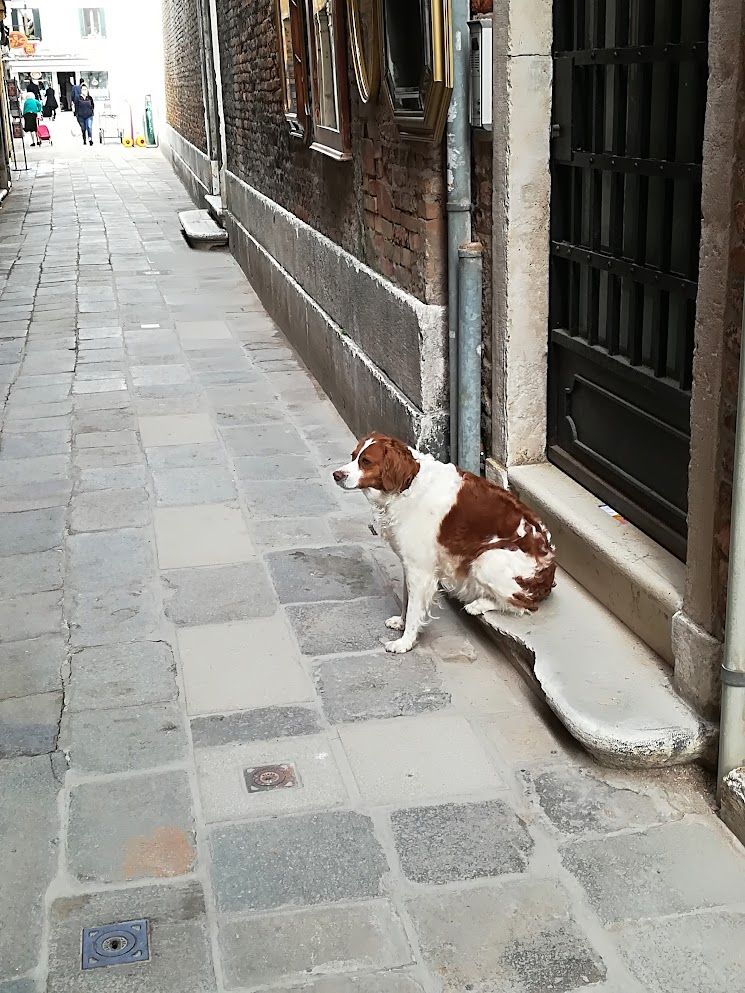
Like the Caucasian shepherd, the husky is another breed I wouldn’t have thought would be particularly adapted to the Venetian climate, but evidently people don’t choose their dogs according to the weather.He’s saving his strength but is ready to work when called upon. His job description is “Bark at doorbell,” and he takes it very seriously.This is the “Do not even think of asking me to do something” look. The correct response is “Nope, thanks, I’m good.”We have nothing in your size.Whoever he may be waiting for seems to be late, and his eyes hint that it’s not the first time.His human probably told him “I’m just going for a pack of cigarettes, I’ll be right back.” That never ends well.His owner was nowhere to be seen. Somebody please explain this thing to me.He seemed perfectly happy in his own freezing world. No humans need apply.
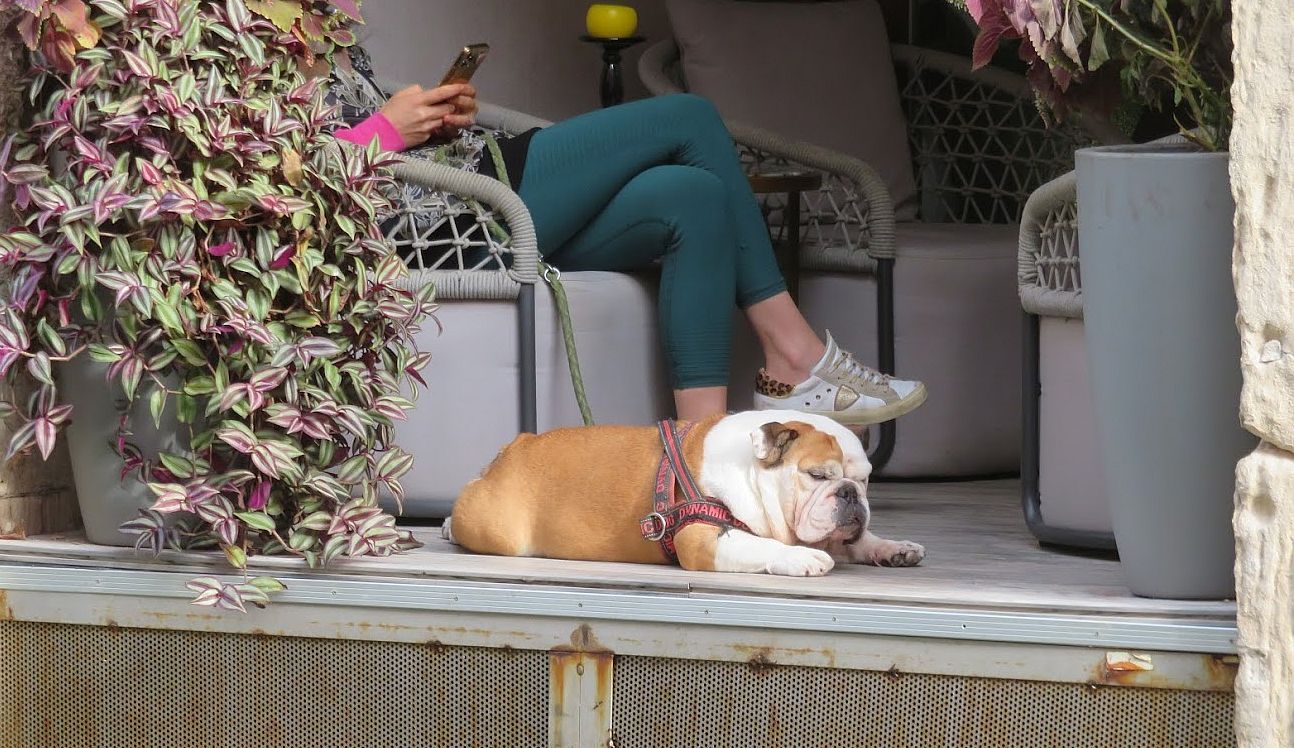
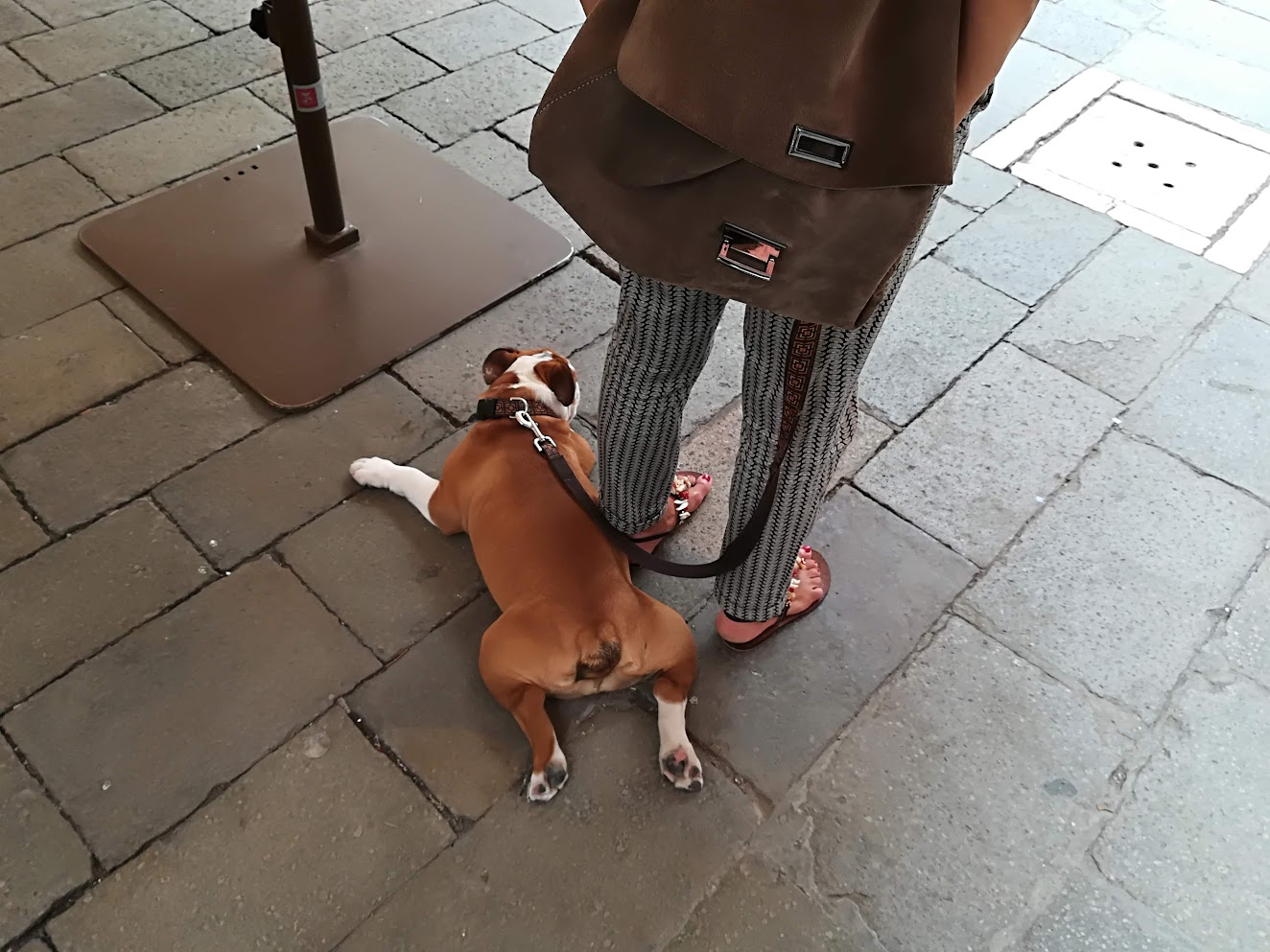
Dogs look good with people too:
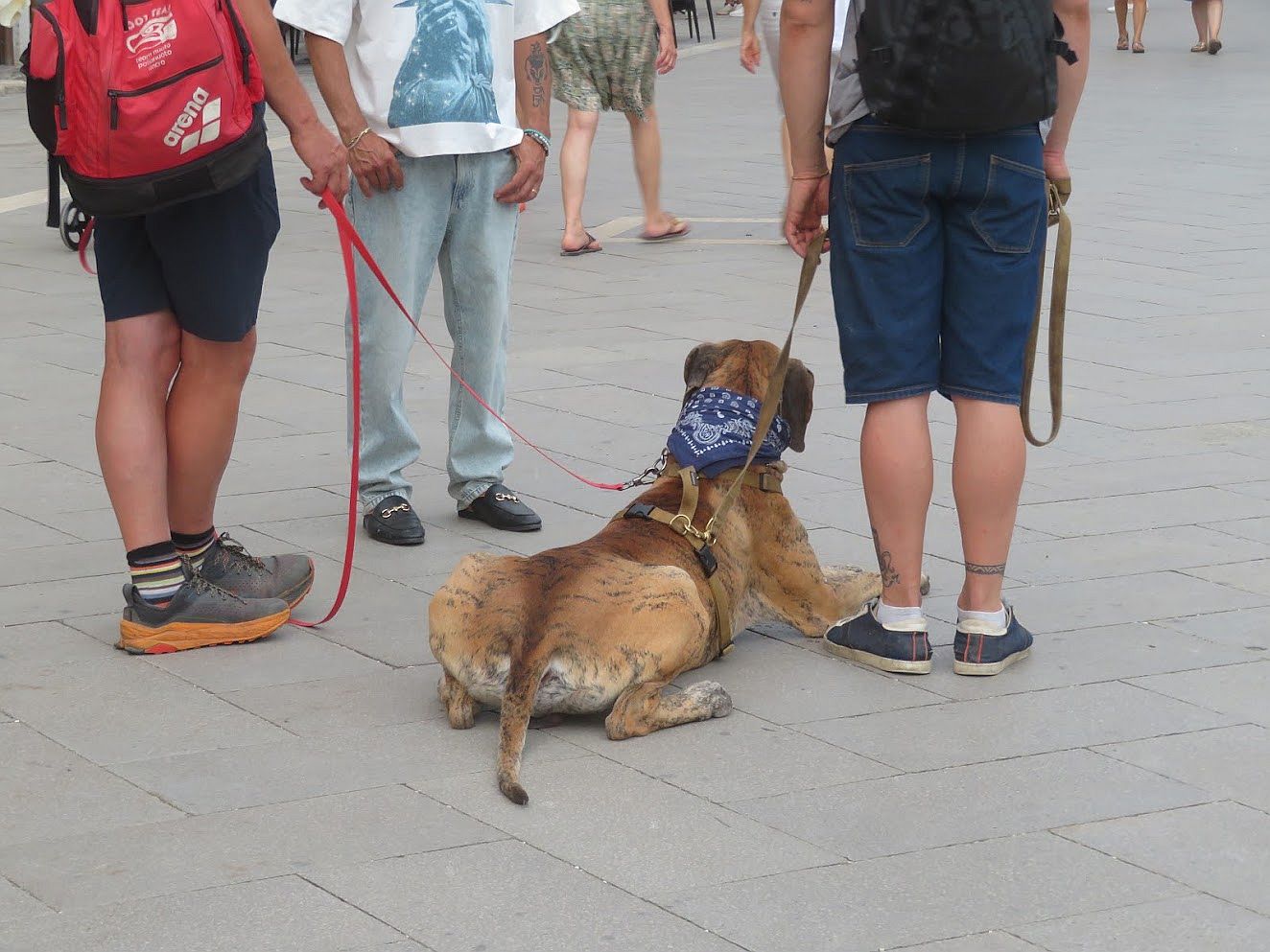
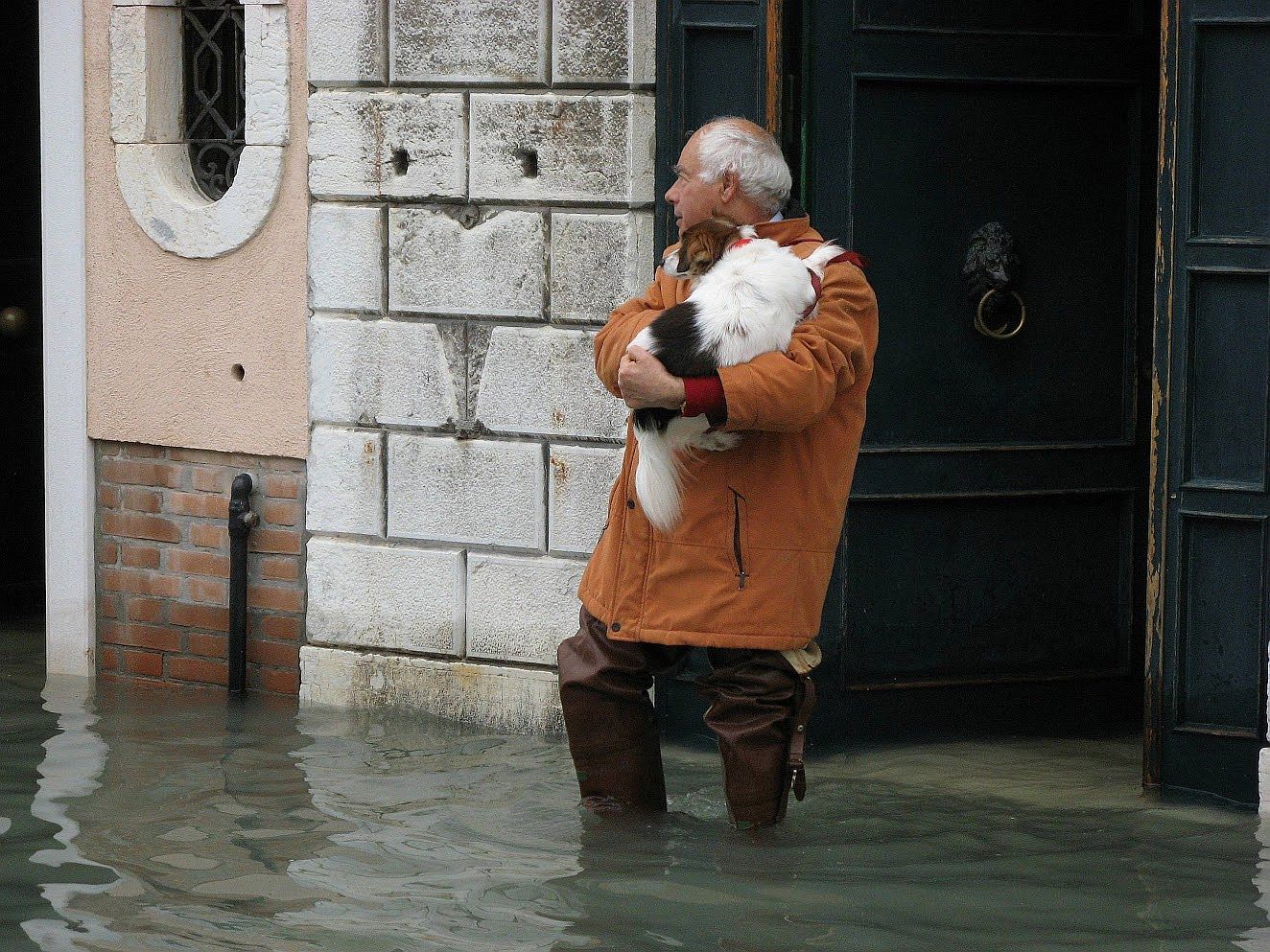
Not sleeping. Just resting his eyes.Soak up that cool wherever you can find it.I was so overwhelmed by this dog’s hindquarters that I never bothered to examine its face, or ask his owner anything about it. So this simply the “haunch dog,” champion of either the long or the high jump events. And wait a minute: Two leashes? Are these guys friends who decided each could have literally one half of this dog?
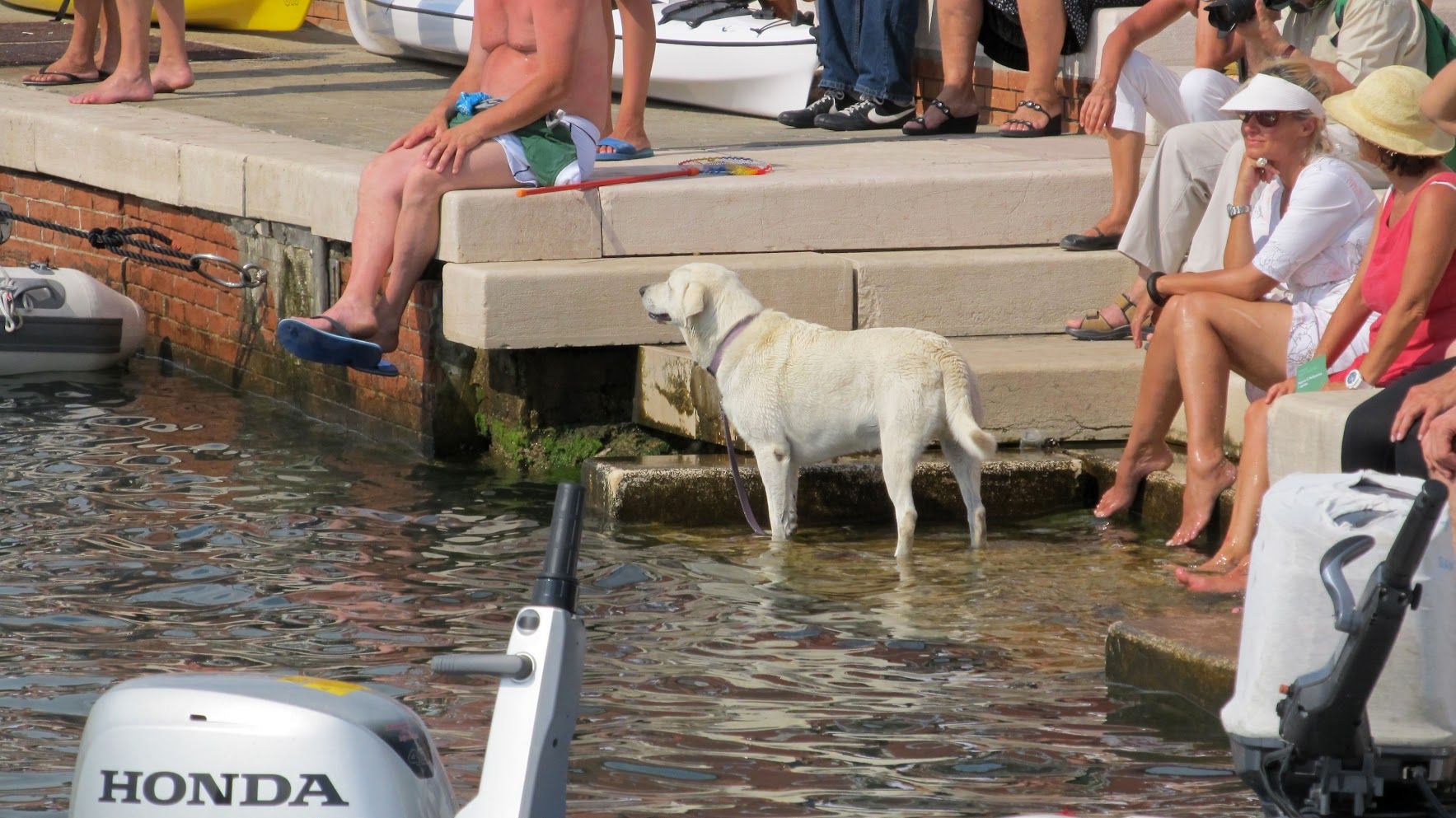
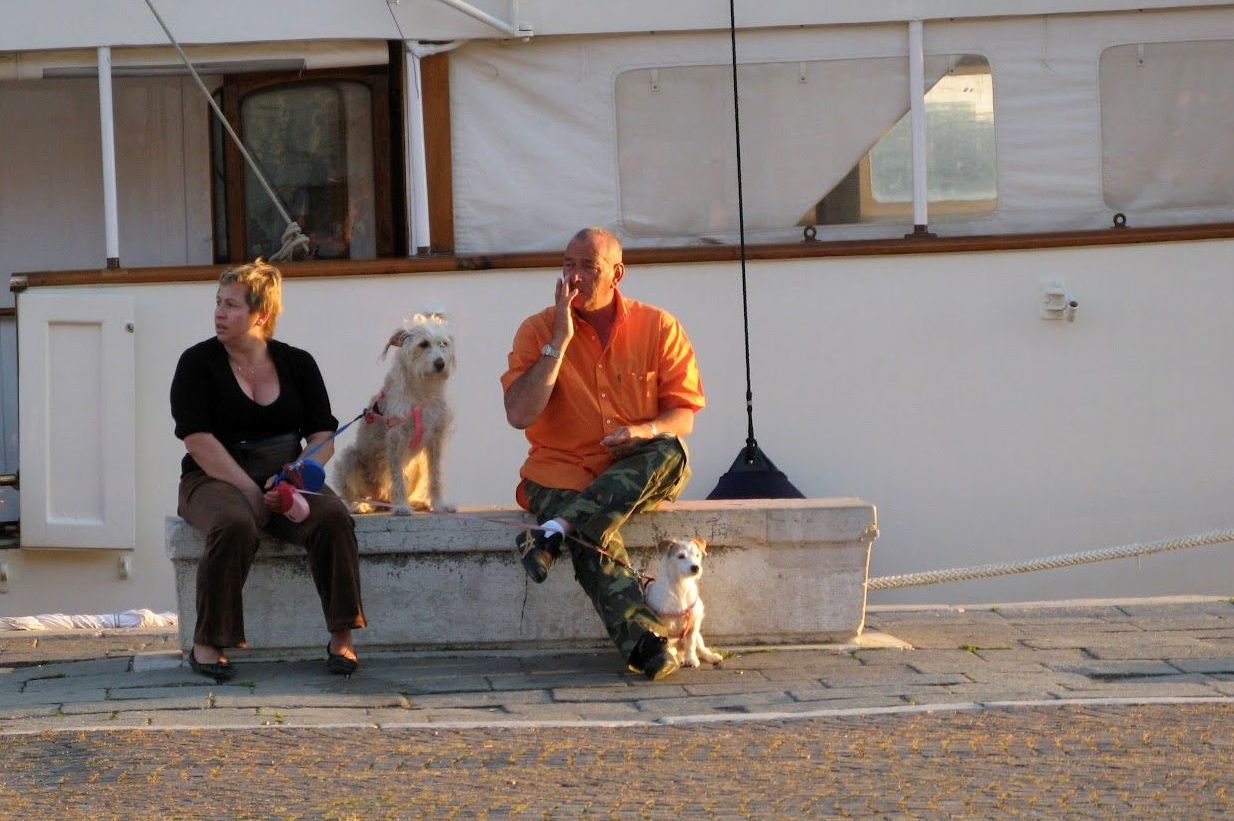
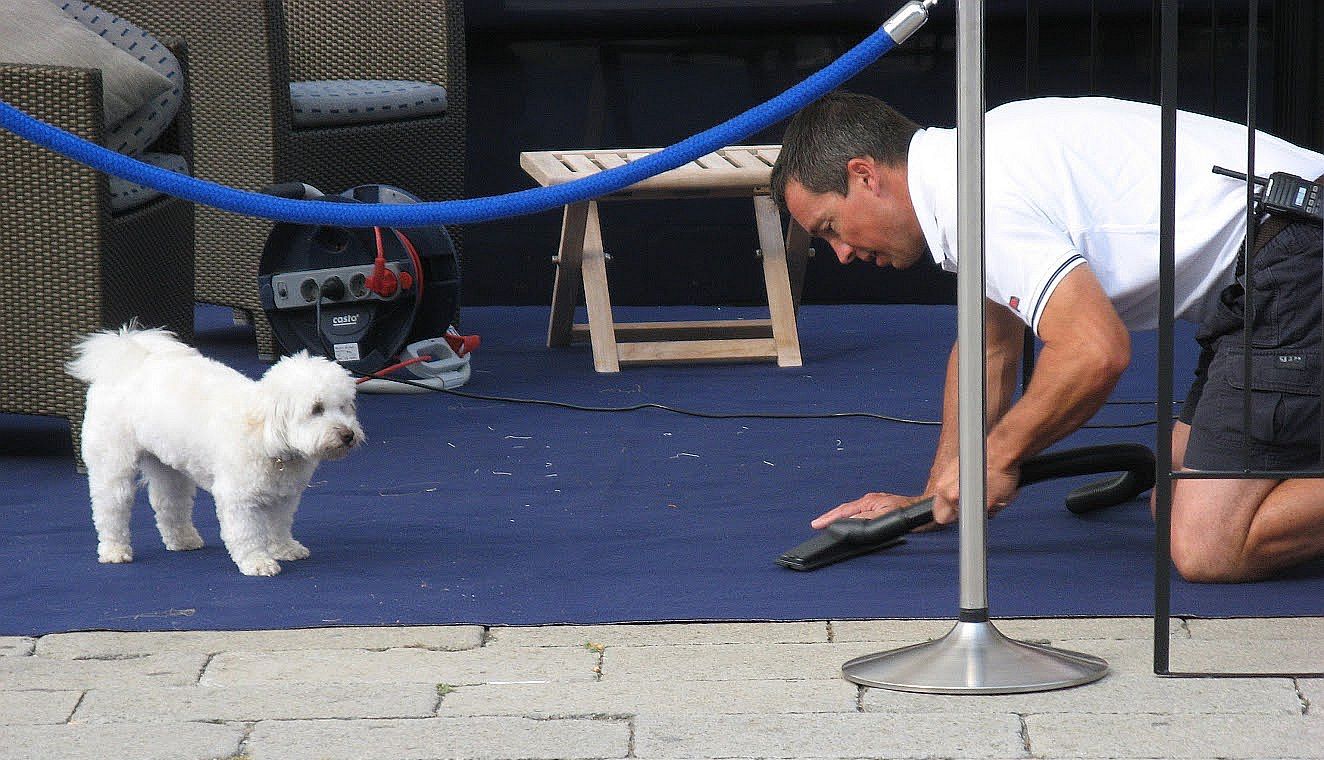
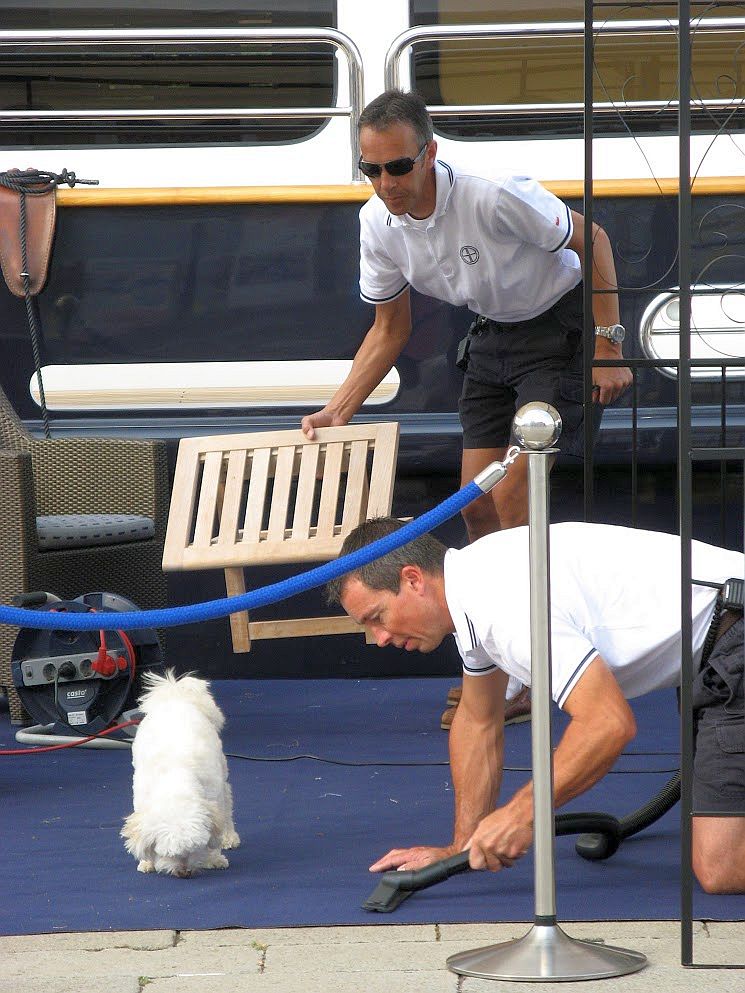
Is it possible that both of them have just broken up with their girlfriend?We’ll never know how much the pooch was wishing he’d get dropped in the water.Quality Control supervisor hard at work before the clients show up on the chartered yacht.You missed a spot.
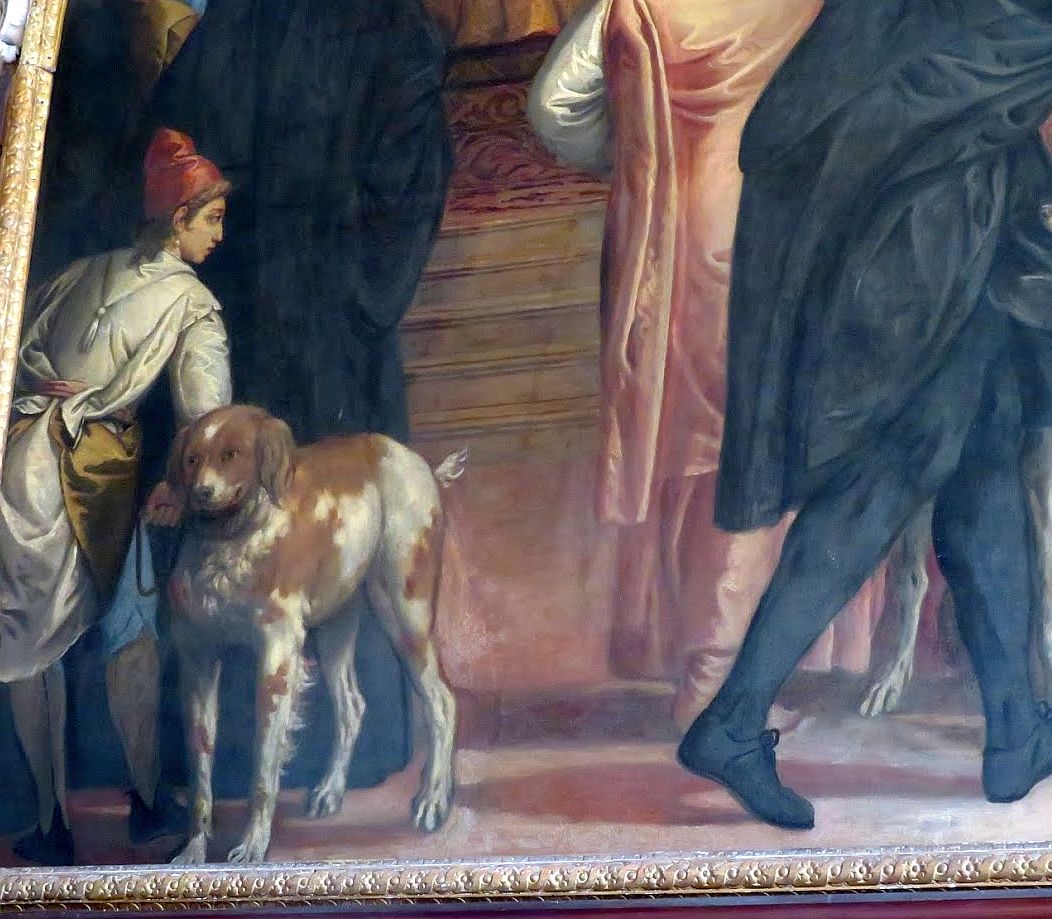
This is one of several dogs being bored by an elaborate ceremony depicted by Gabriele Caliari, the son of the more famous artist better known by the nickname “Veronese.” I deduce that this is some version of an English springer spaniel, but the legs seem unnaturally long. (“Doge Marino Grimani receives the gifts of the Persian Ambassadors,” Gabriele Caliari 1603 – 1605, in the Doge’s Palace.)Clearly this breed fits right into the Venetian world. Like other spaniels, retrievers, and basically almost every dog.The dinner party went on for hours, but one friend’s spaniel never gave up hope of snacks.
Unhappily, while dogs are almost always great, some of their owners absolutely are not. Because dogs produce residue and not every owner feels obligated to deal with it. In fact, too many freaking owners pretend it somehow doesn’t exist.
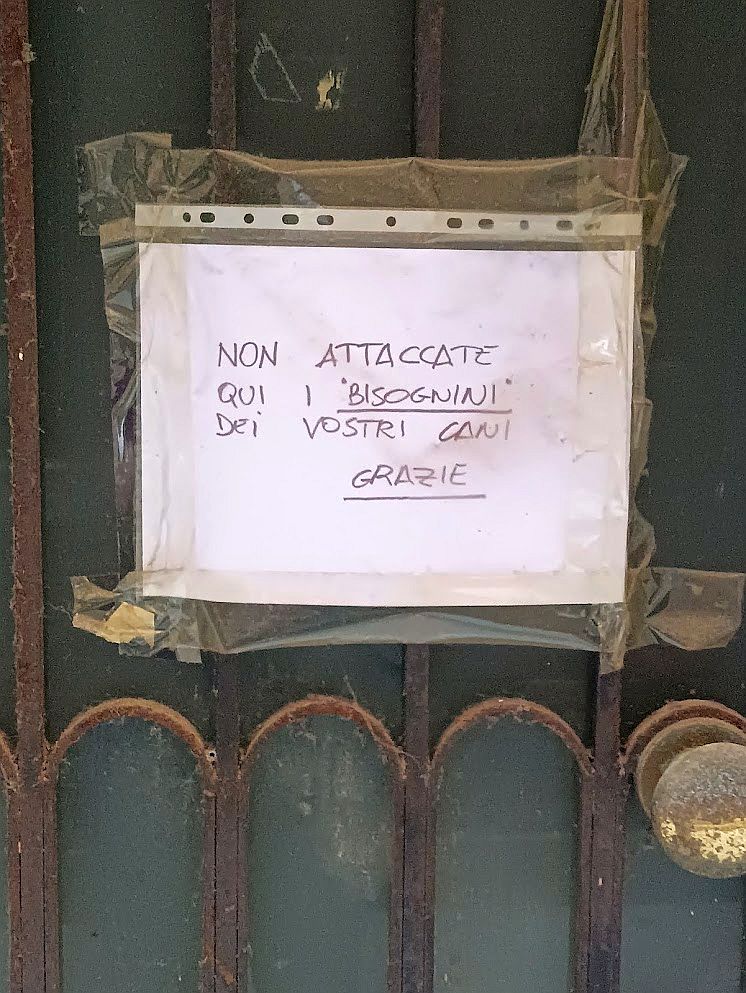
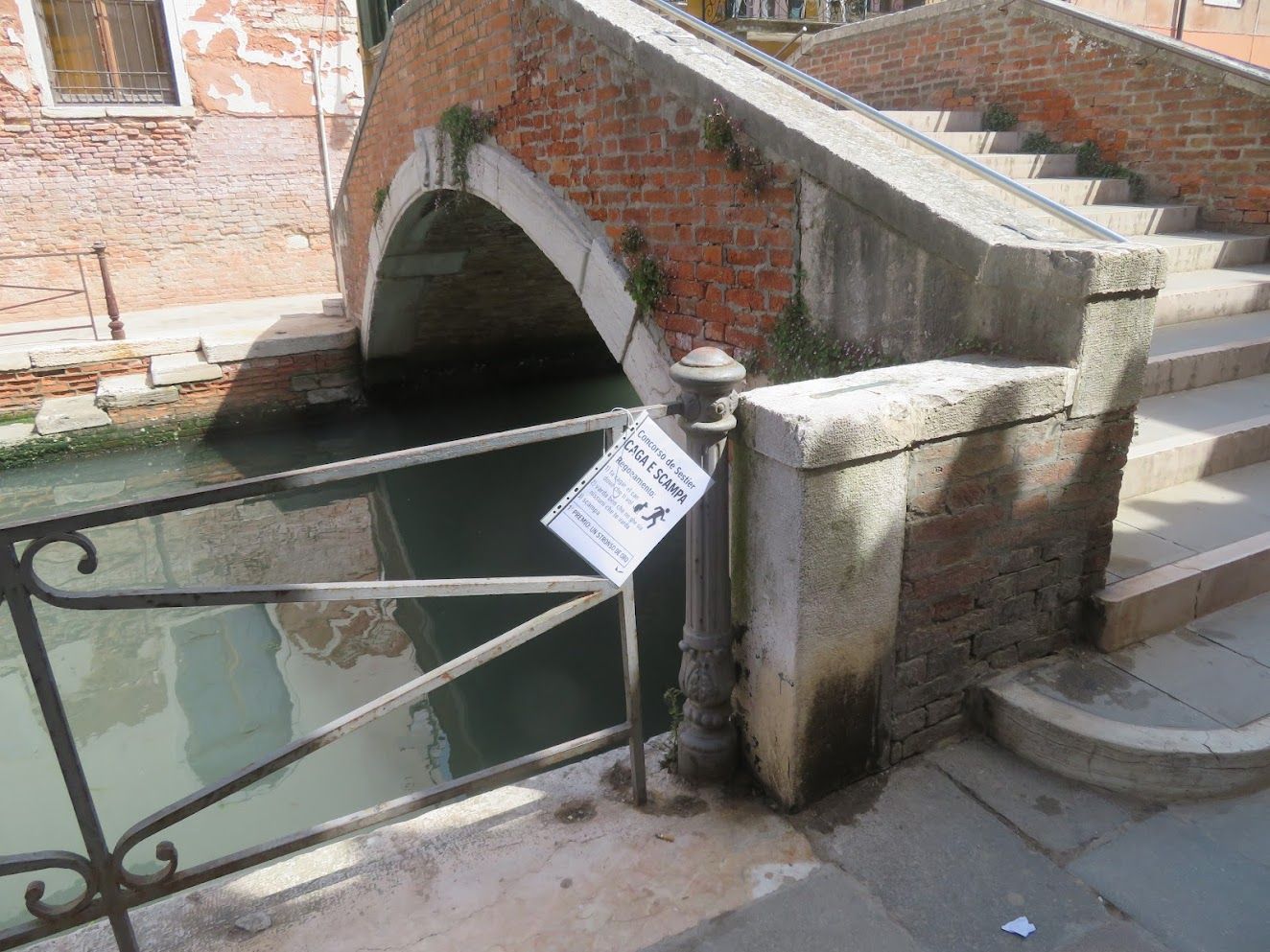
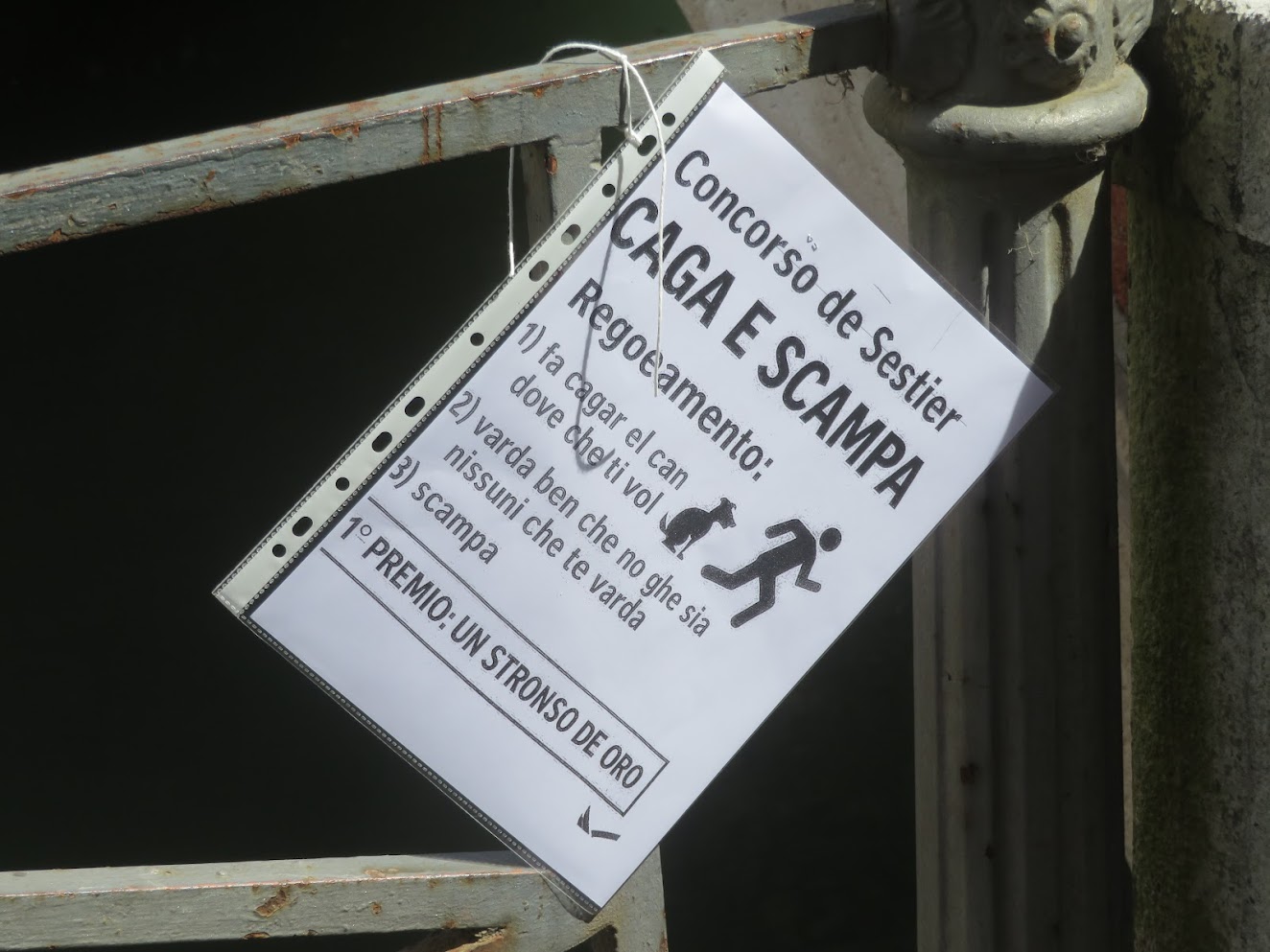
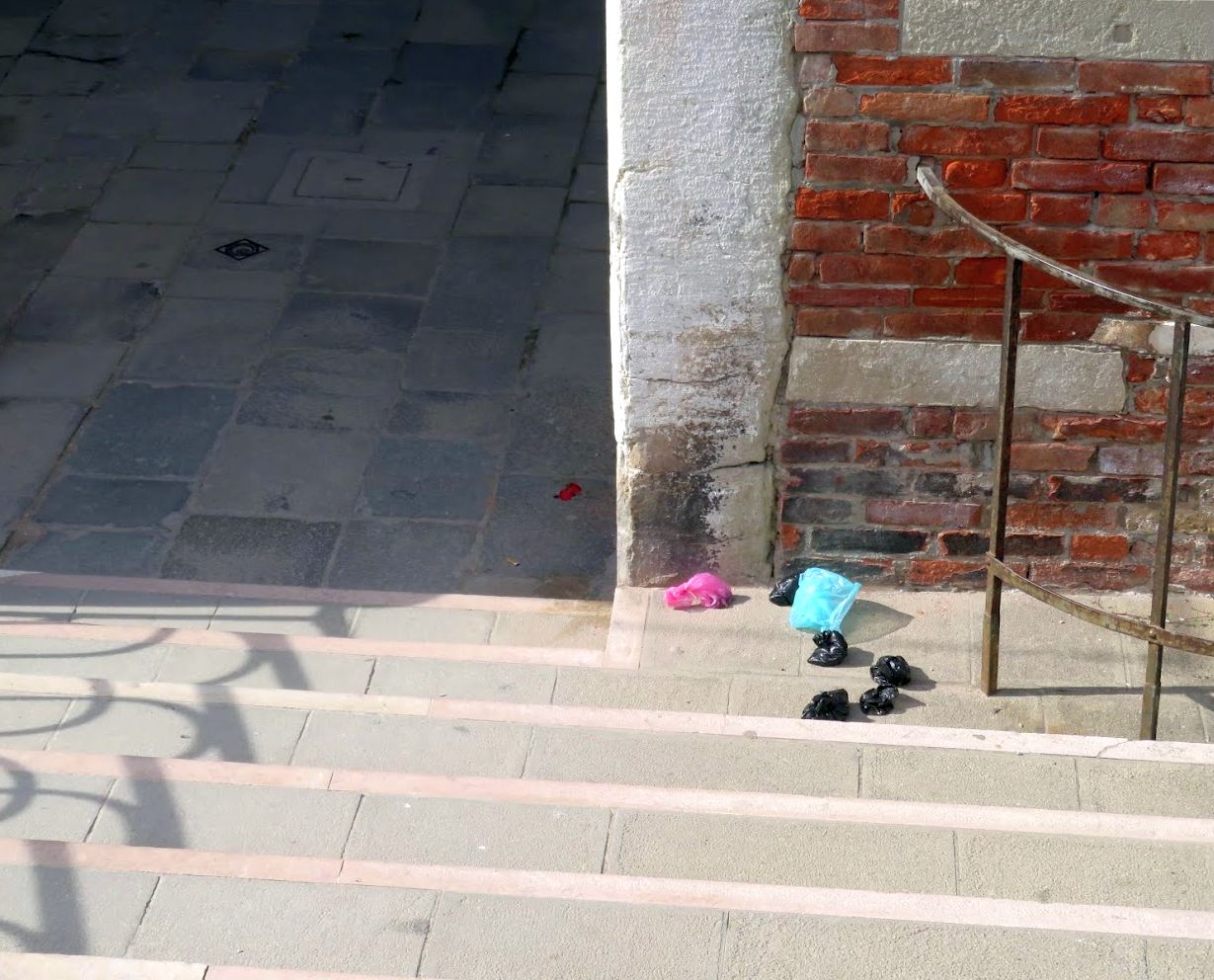
“Do not attach here the ‘little needs'” (a polite expression for excrement) “of your dogs. Thank you.” I interpret this to mean that people were somehow hanging the little poop-bags to this door; assuming this is the case, it’s a very weird technique for disposing of the disposal bags. Just throw them in the trash! You’re hanging them on people’s doors? Things are getting worse than I thought!Sometimes a mysterious person snaps and puts this notice up on various railings. They make no difference whatever.In Venetian, a very clear message: “A sestiere-wide contest: Poop and escape. Regulations: 1) Make your dog poop whever he wants to 2) Look around really well to make sure nobody’s watching you 3) Escape. First prize: A turd of gold.” I myself haven’t seen an owner just stand by his/her/their pooping dog, then walk away. What does happen is that the person will open their door and let the dog out to deal with the call of nature alone. This way nobody can accuse the owner of approving the dog’s deposit. Not made up.The baggies come in various colors and are usually just dropped wherever the force of gravity compels the human to let it fall. This was unusual — somebody deciding to make a little collection point, which seems civilized compared to some alternatives, but still. Not invisible.
One day a few years ago the Gazzettino published a small personal anecdote relating to this general subject. I deeply wish I had kept it, but the story, told in the first person by a woman, was unforgettable. It went like this:
She came out of her house in Dorsoduro early-ish on a Sunday morning to discover an enormous dog pooping nearby. The owner was patiently waiting, then dog and owner nonchalantly began to stroll away, leaving the material behind.
She called out to the owner to return and remove it. He pretended not to hear and kept walking.
So she shut her door and began to follow them. He quickly realized this and began to make sharp turns into and out of small streets in an attempt to shake her. She stayed right behind him. He sped up. She sped up. Clearly this could have gone on for hours, the two of them weaving their way through the byways of Venice, maybe over the bridge to the mainland, maybe to Milan, or Switzerland, but no matter — both she and the man knew that sooner or later he was going to have to return home. She was implacable.
So eventually he gave in and returned to the scene of the crime and picked up the poop. He was furious, of course, and I imagine that if she’s still alive she’s still telling this story at every family gathering, to the grandchildren, the nieces, the cousins… Vigilante justice with no shots fired.
And there are the random doggish situations or characters:
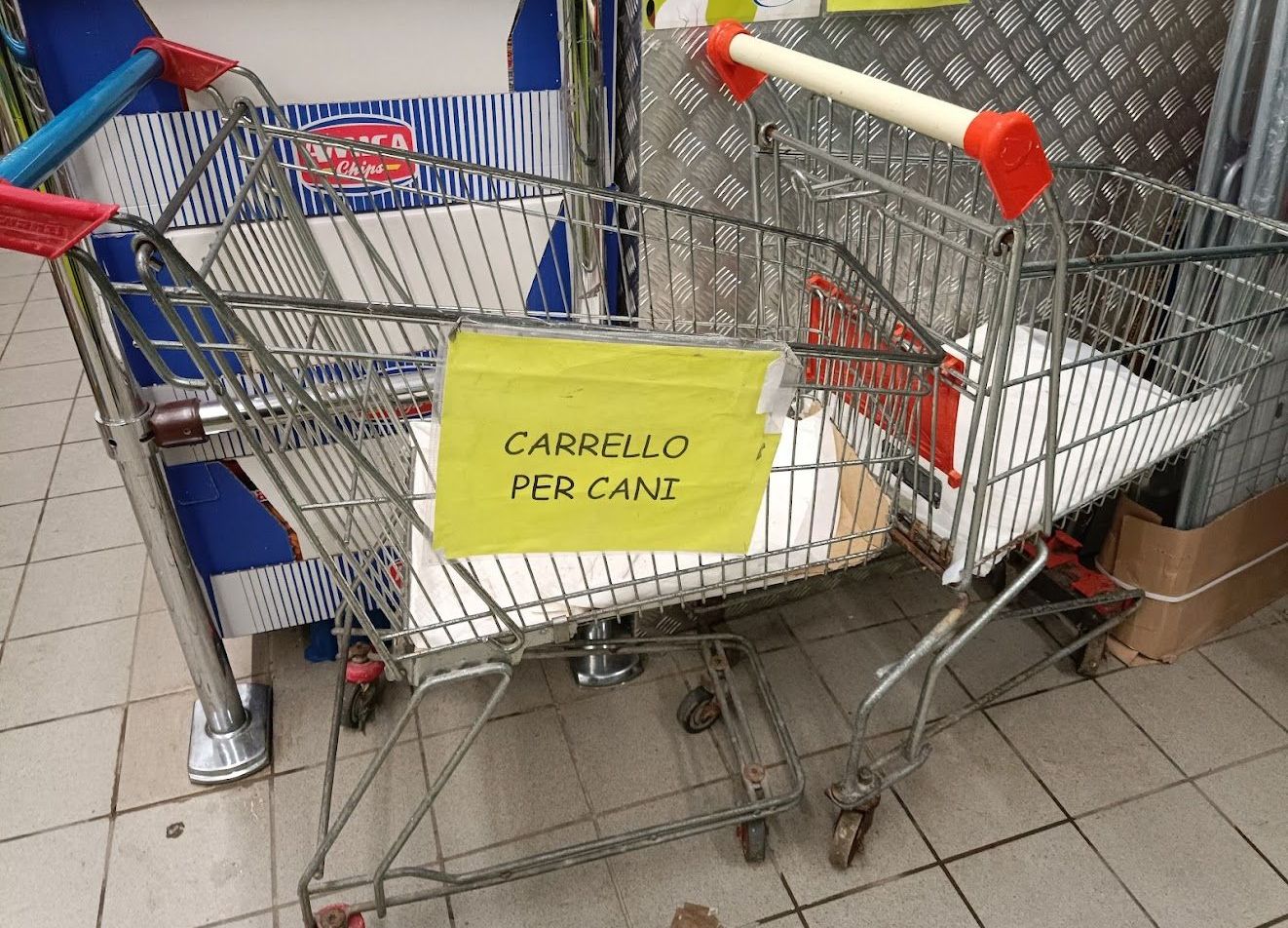
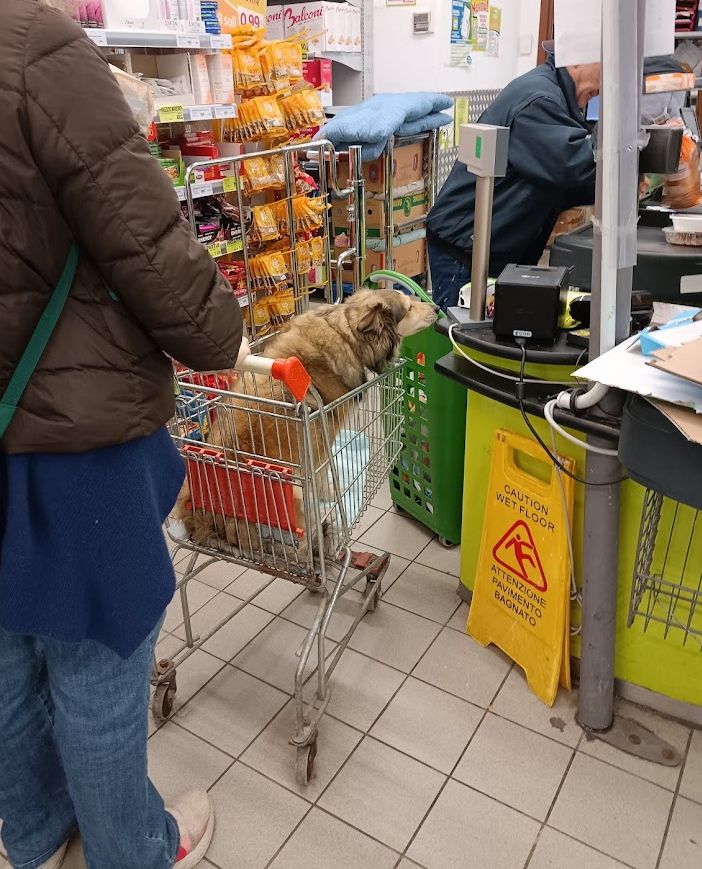
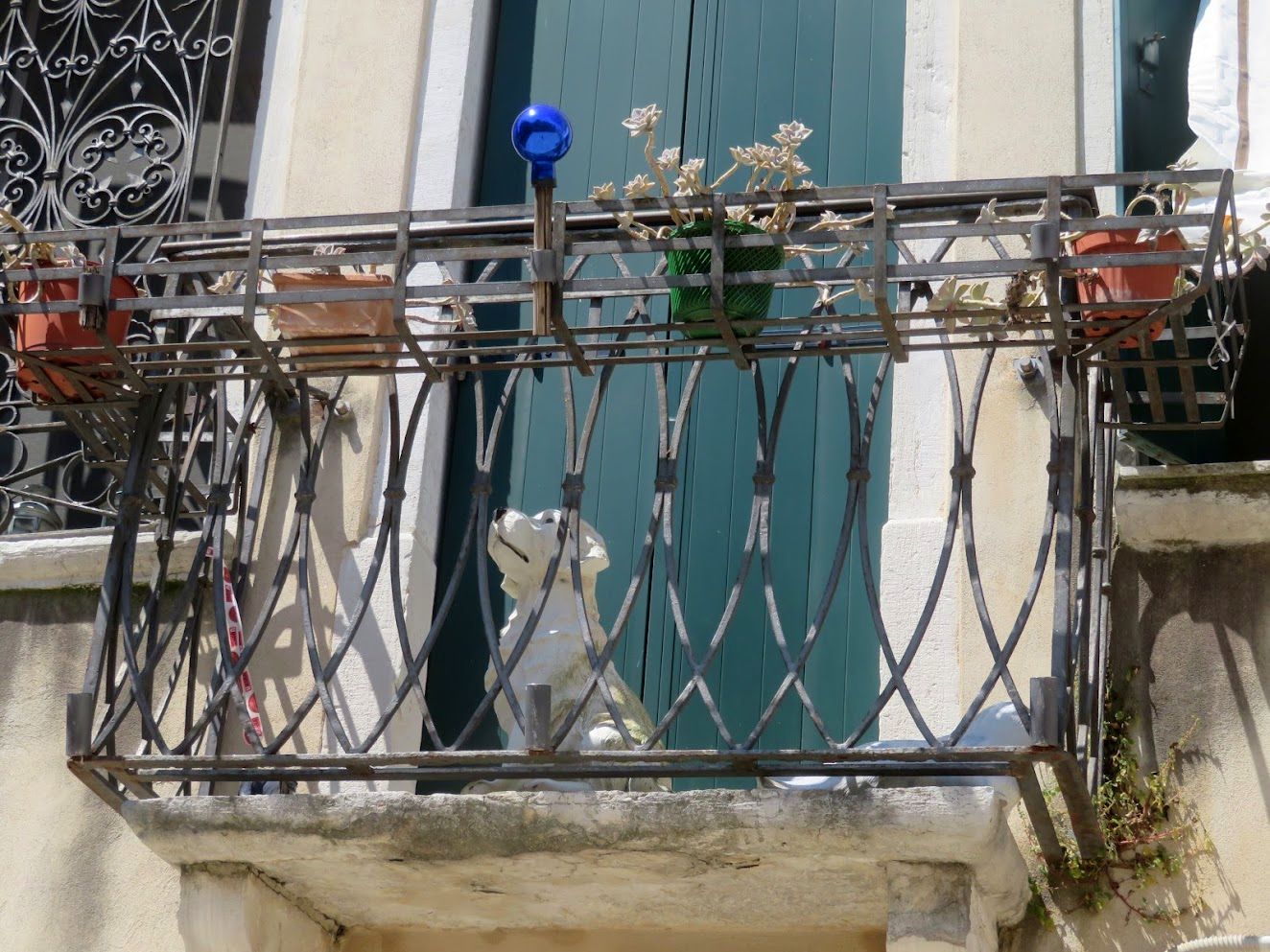
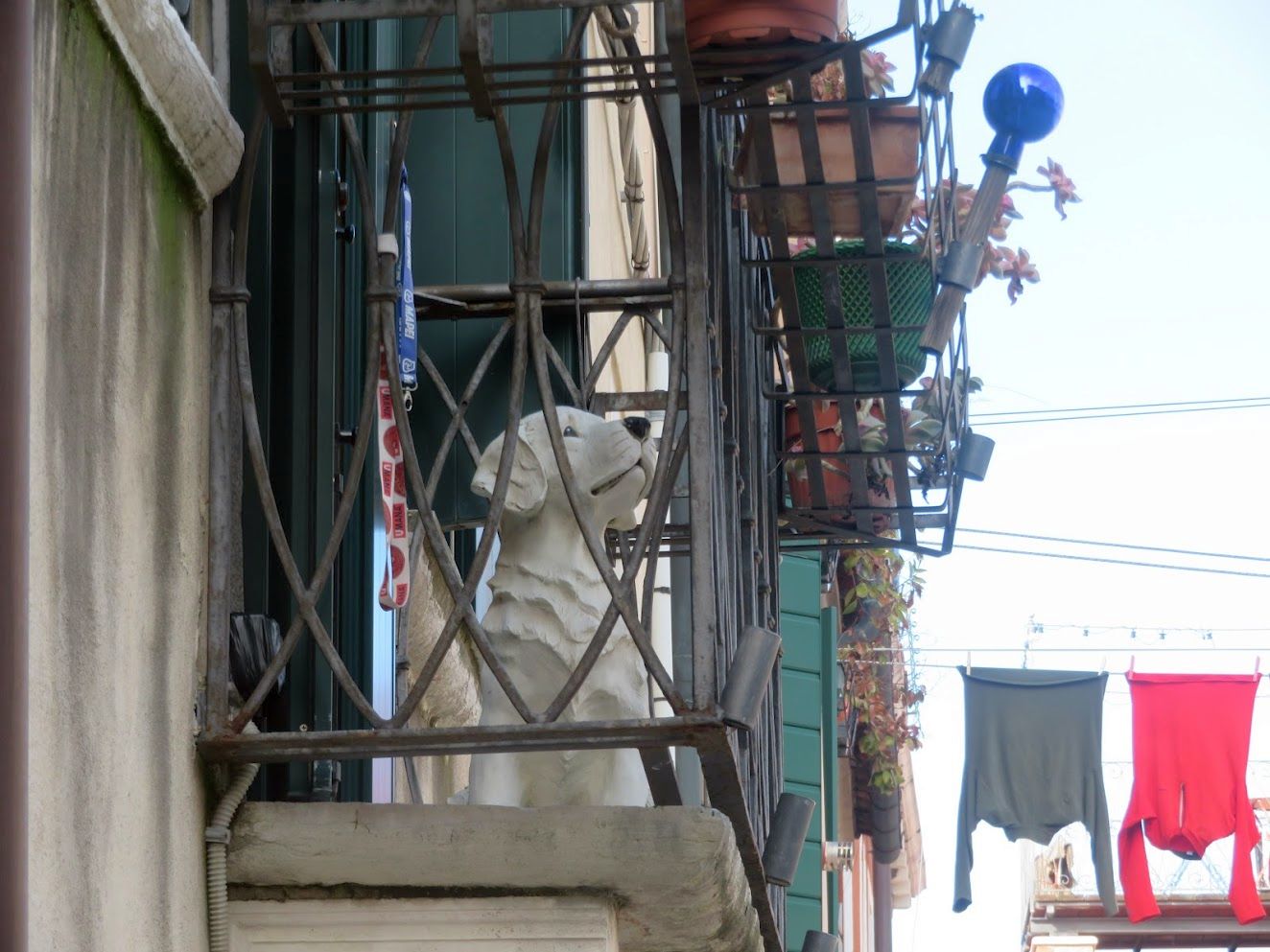
At the entrance to a certain Venetian supermarket you can find these helpful vehicles: “Cart for dogs.” Some owners leave their dogs tied up outside to wait, as in much of the civilized world, but others cannot be separated from them for any amount of time. I thought this was a weird aberration unique to that neighborhood, but then I saw the same thing at different supermarket. That time there wasn’t any sign on the cart — I only found it out when the cashier at checkout told me, just a little sharply, that the smaller cart I had happily filled up was intended for dogs. Not. Made. Up.I am completely without words. Where is her shopping? Is this some kind of special treat promised to the dog, a ride around the supermarket, if it doesn’t snarl at the dog next door?This would be Sherlock Holmes’s dog that didn’t bark in the night.A fake dog solves so many problems. Certainly no need to give it a ride around the supermarket.
Here is my very favorite dog-adjacent story, told to me by a friend who witnessed the event.
Not so many years ago there was a butcher shop in Campiello Barbaro very close to the Peggy Guggenheim Collection. Hence very close to the famous grande dame herself. It’s a matter of record that she adored her Lhasa Apsos (and their graves are in the museum garden). Only the best for them, an emotion shared by most dog-owners, but unlike those others, she could easily provide anything for them that qualified as “best.”
So one day the great Guggenheim came into the shop as my friend was talking with the butcher (also his friend) and requested some morsels of filet for her dogs. The butcher didn’t hesitate, but got right to work cutting, weighing, and wrapping up the delectable meat. She paid and departed.
“You think I gave her filet?” the butcher scornfully asked my friend. “For her dogs?” You might think that scruples are unknown to any Venetian merchant, but sometimes there’ll be one who discovers he has a limit. “I gave her an ordinary cut of beef, and I’m going to give the filet to whatever little old person comes in next.”
So many stories about dogs turn out to be about something else.
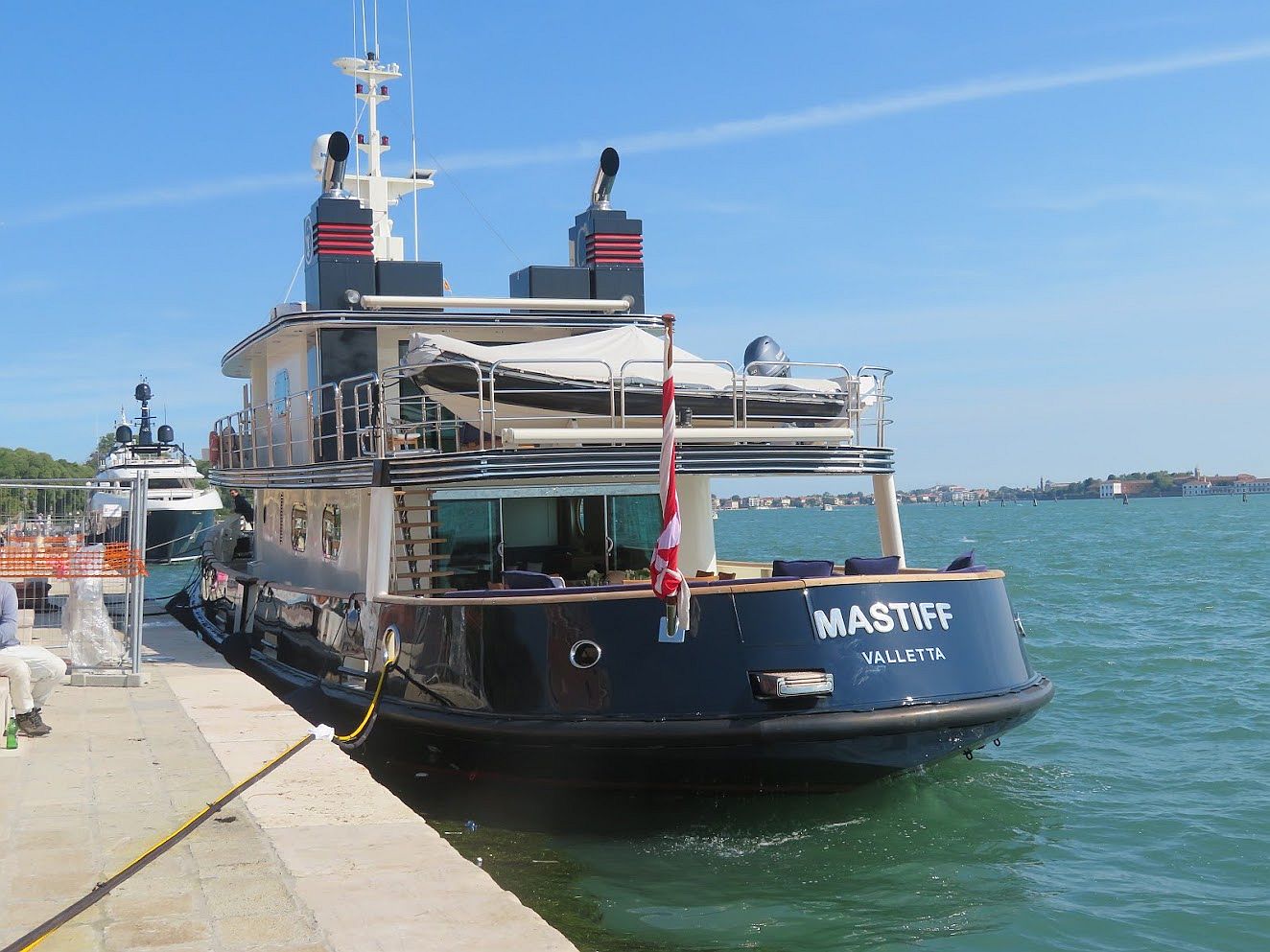
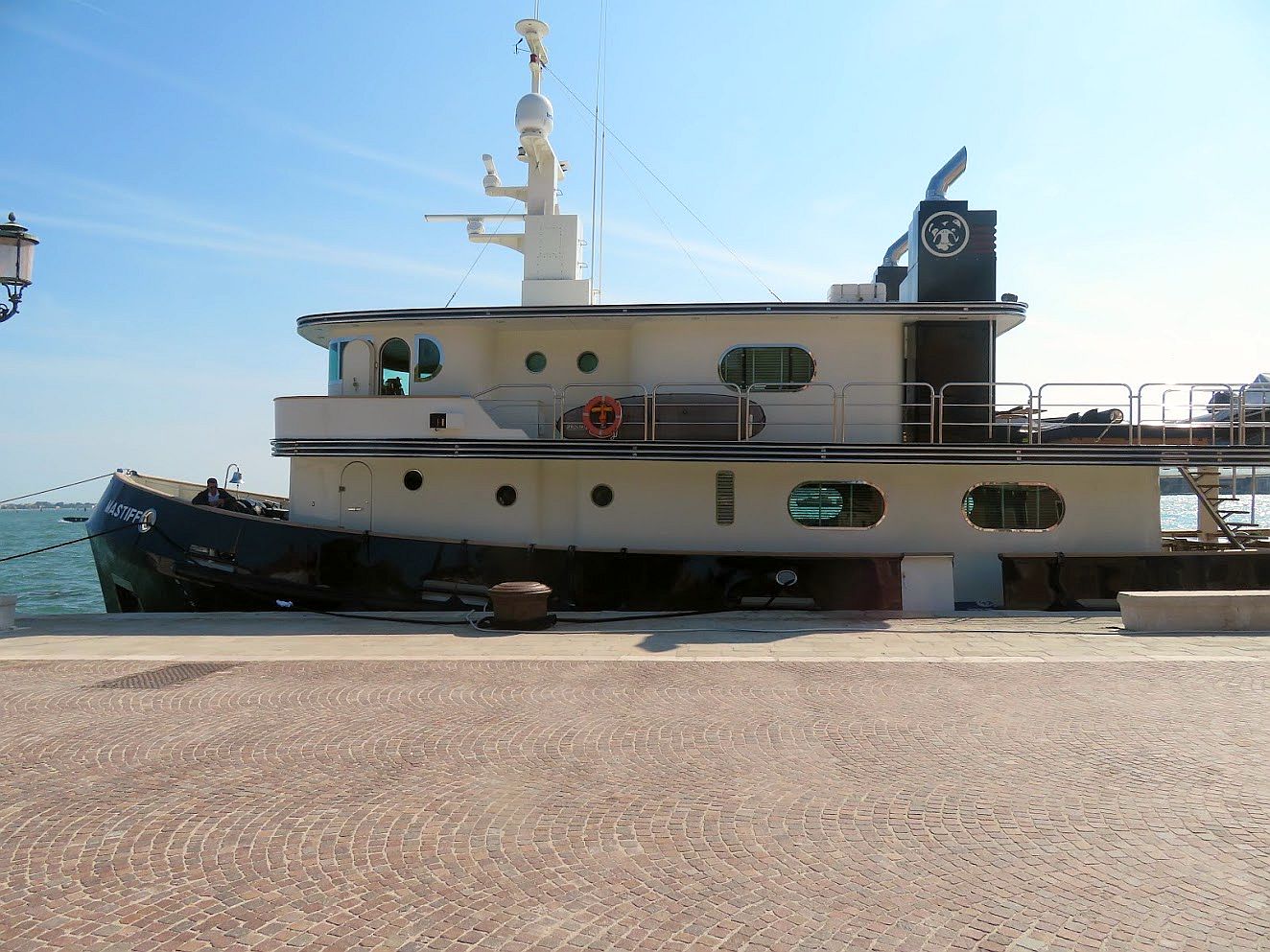
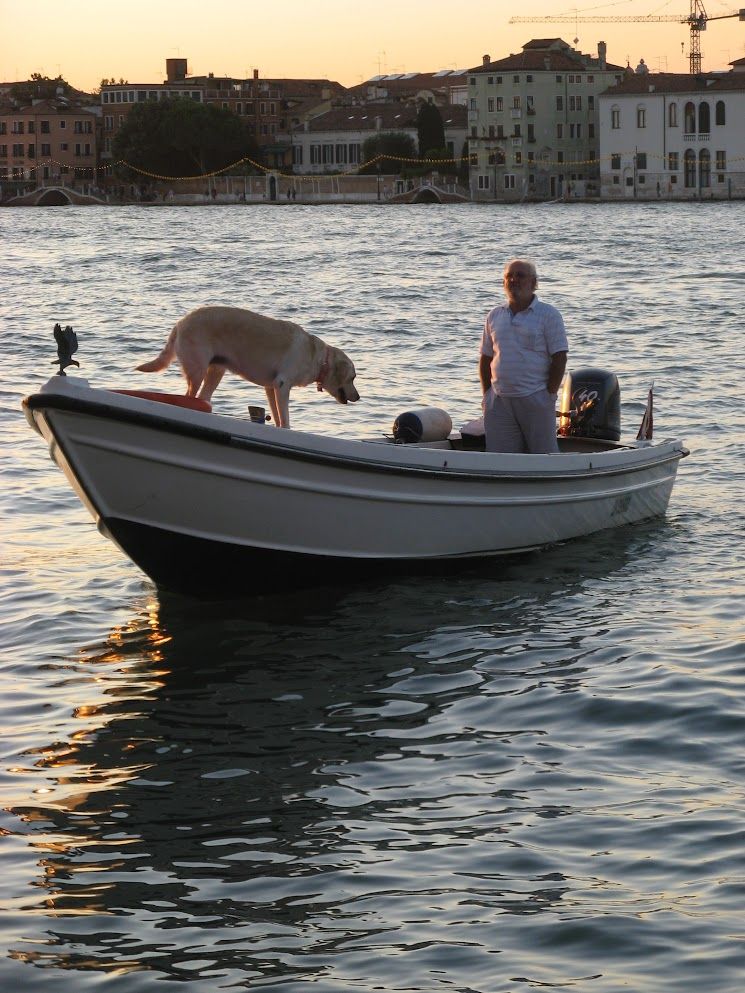
This would be my dog. An ocean-going tugboat made over into a luxury vessel. https://www.yachtcharterfleet.com/luxury-charter-yacht-26262/mastiff.htmYes, I was distracted and thoughtless not to have noticed I didn’t have the entire vessel in my viewfinder. It’s just so cute I’m throwing this in anyway.Some water, a boat, a dog. This must be Venice.
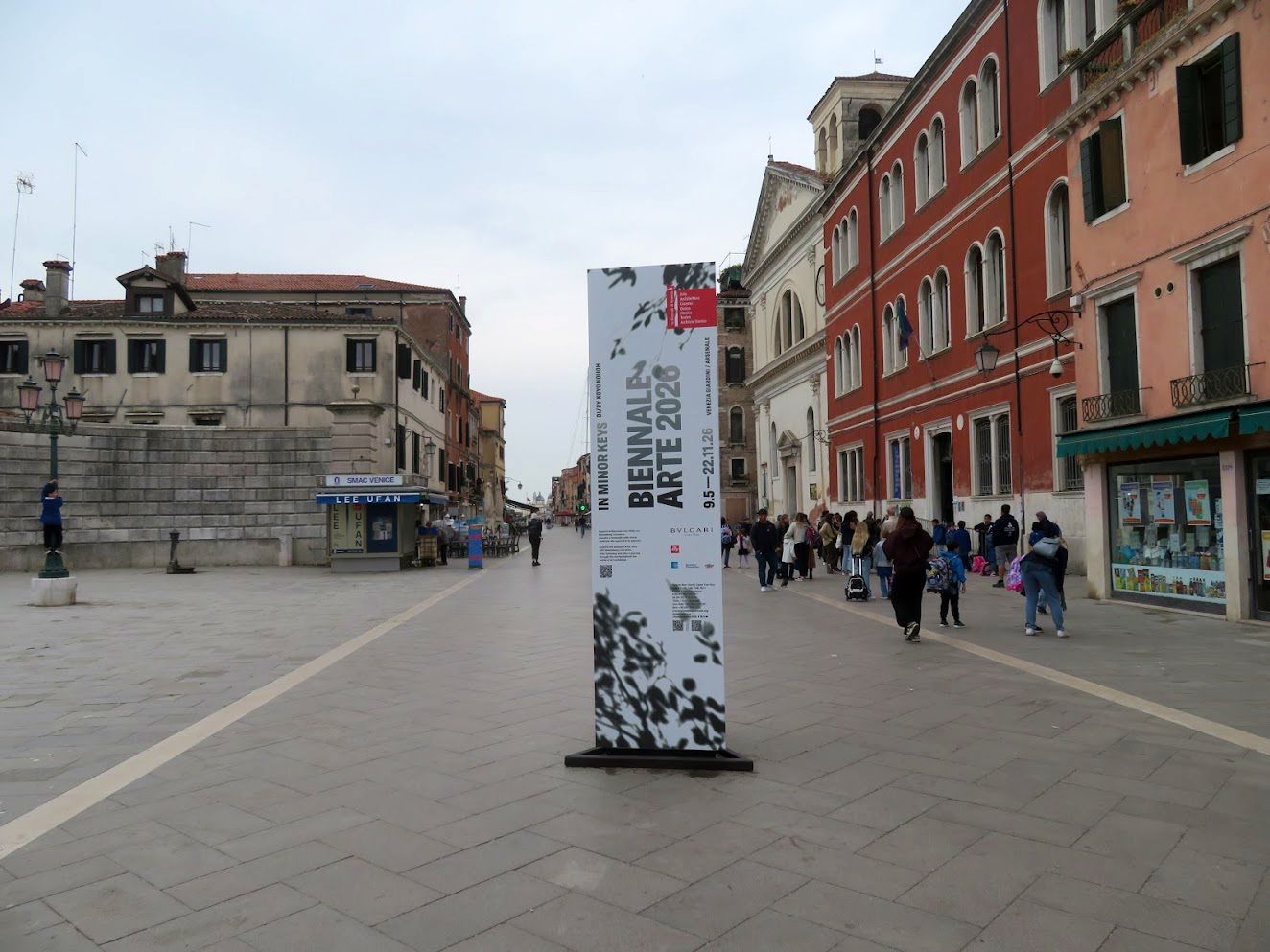
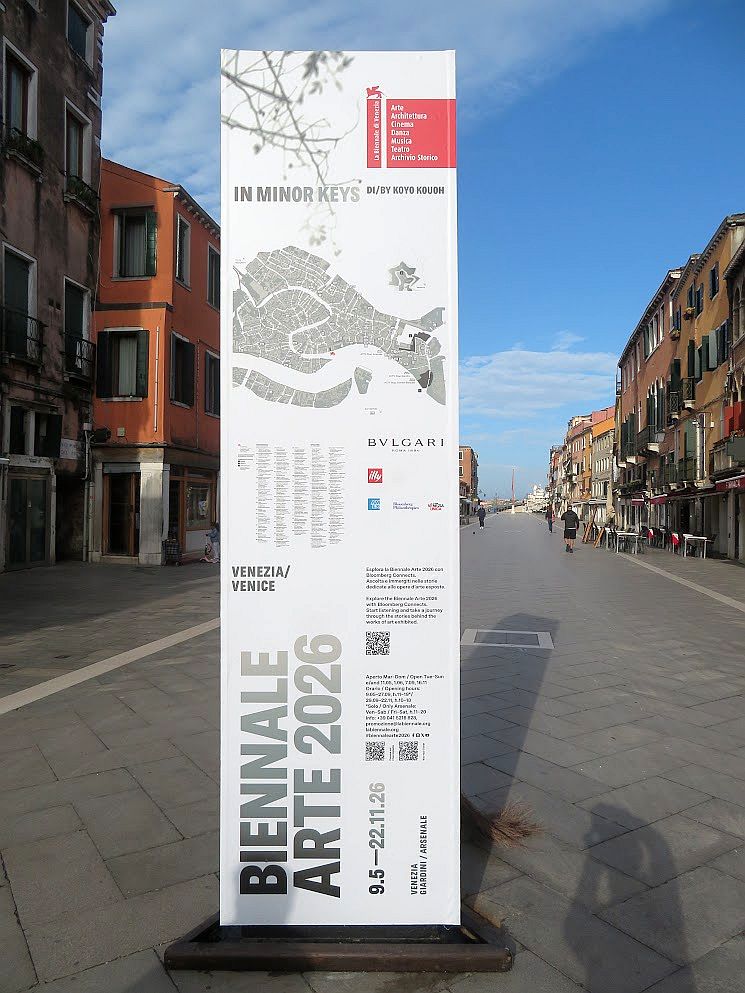
One of the earliest precursors was the stele showing the map of the exhibitions. I notice that the newsstand to the left is earning some extra pelf by dedicating its magazine-display space to an important exhibitor, Lee Ufan. Let the games, so to speak, begin. The Biennale runs from May 9 to November 22.Another side of the triangular structure.
“Art is above politics,” goes the common fantasy here every year when the Biennale international art exposition is about to open. Those who were especially inclined to say (or imagine) it were the directors of the event this year, who invited not only Russia, but Israel, to join the starring lineup.
This struck the public and various political and/or cultural figures or groups as a very bad idea, and they spoke out against permitting Russia and Israel to participate. (“Spoke out” is code for “Pussy Riot made huge scenes with their bare breasts at the Russian pavilion.”) The jury resigned en masse in protest, what with the Russian invasion of Ukraine and the genocide in Palestine and all. They have not been replaced. Off to a great start.
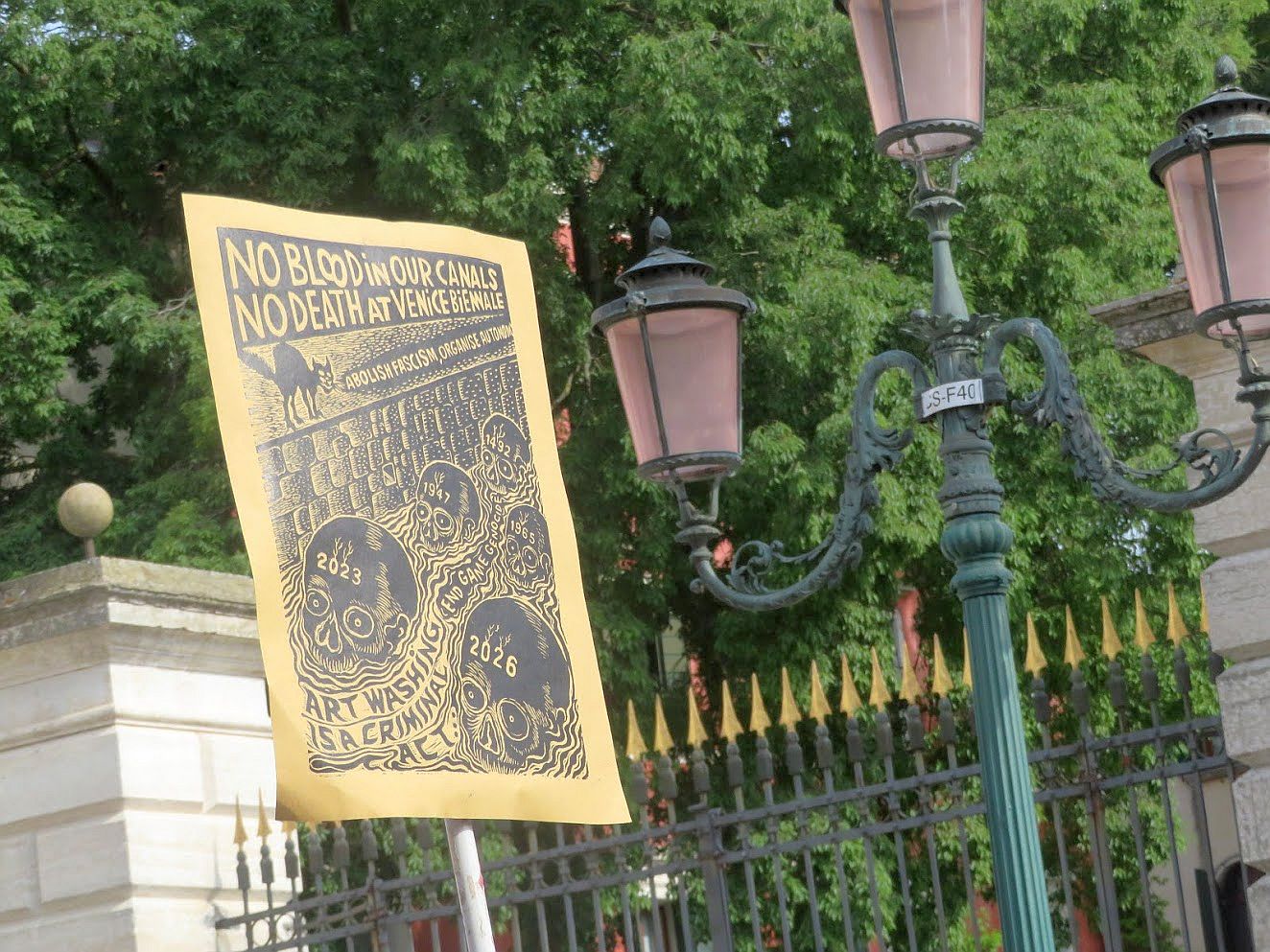
In fact, a new term has appeared to describe the art/politics connection in Venice this year: “Artwashing.” That’s harsh but makes its point. Skipping the politics and heading straight to the art, the critic from The Guardian in London mentioned the “art that stinks.” Not figuratively, but literally. In a world in which pretentious euphemisms stand in for thought and communication, that was an invigorating change. It turns out that some artists were focusing on the excretory, with the addition in some cases of perfumes that reinforce the atmosphere. Belarus, for example, commissioned the creation of a perfume with its artwork that replicated the smell of a “freshly dug grave in the Belarus countryside in late August, laid with rotting flowers.” Is this art? Politics? Their mutant love child?
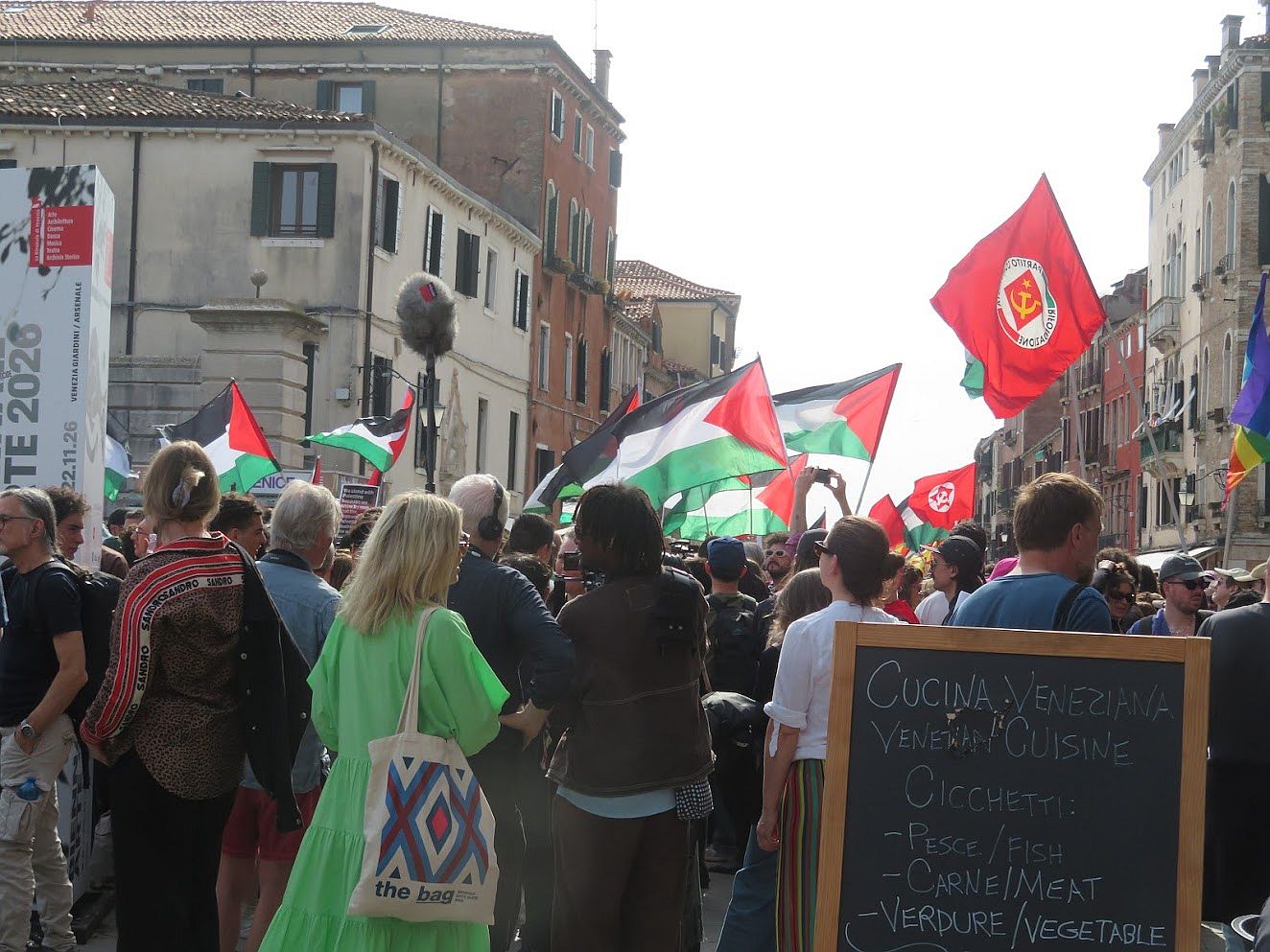
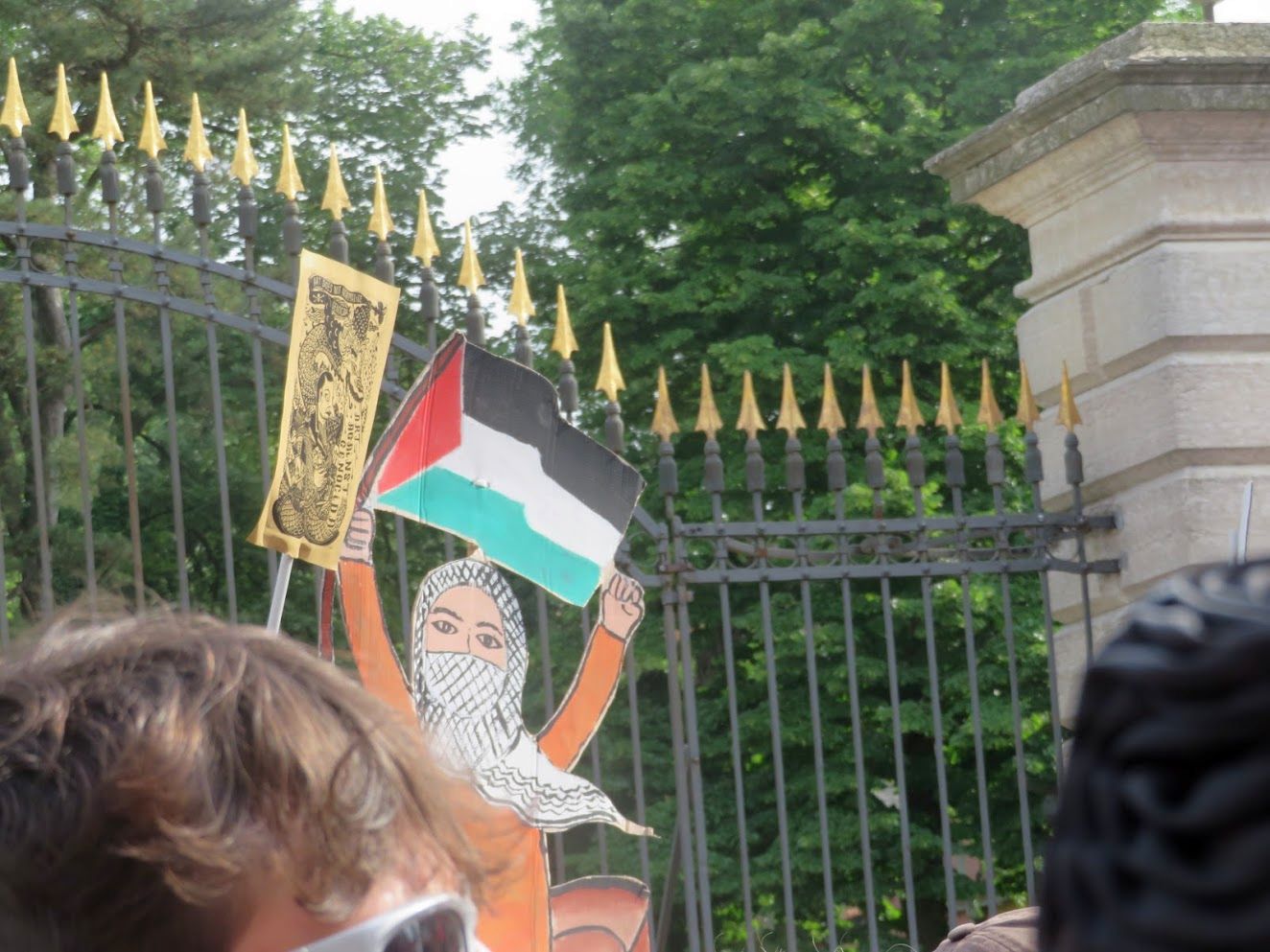
As far as I can see, politics has long since taken the Biennale hostage. Participants have something to say, and then they call it art. We even had a real protest, complete with riot-geared police and a police helicopter roaring overhead for hours.
But I’m getting ahead of myself.
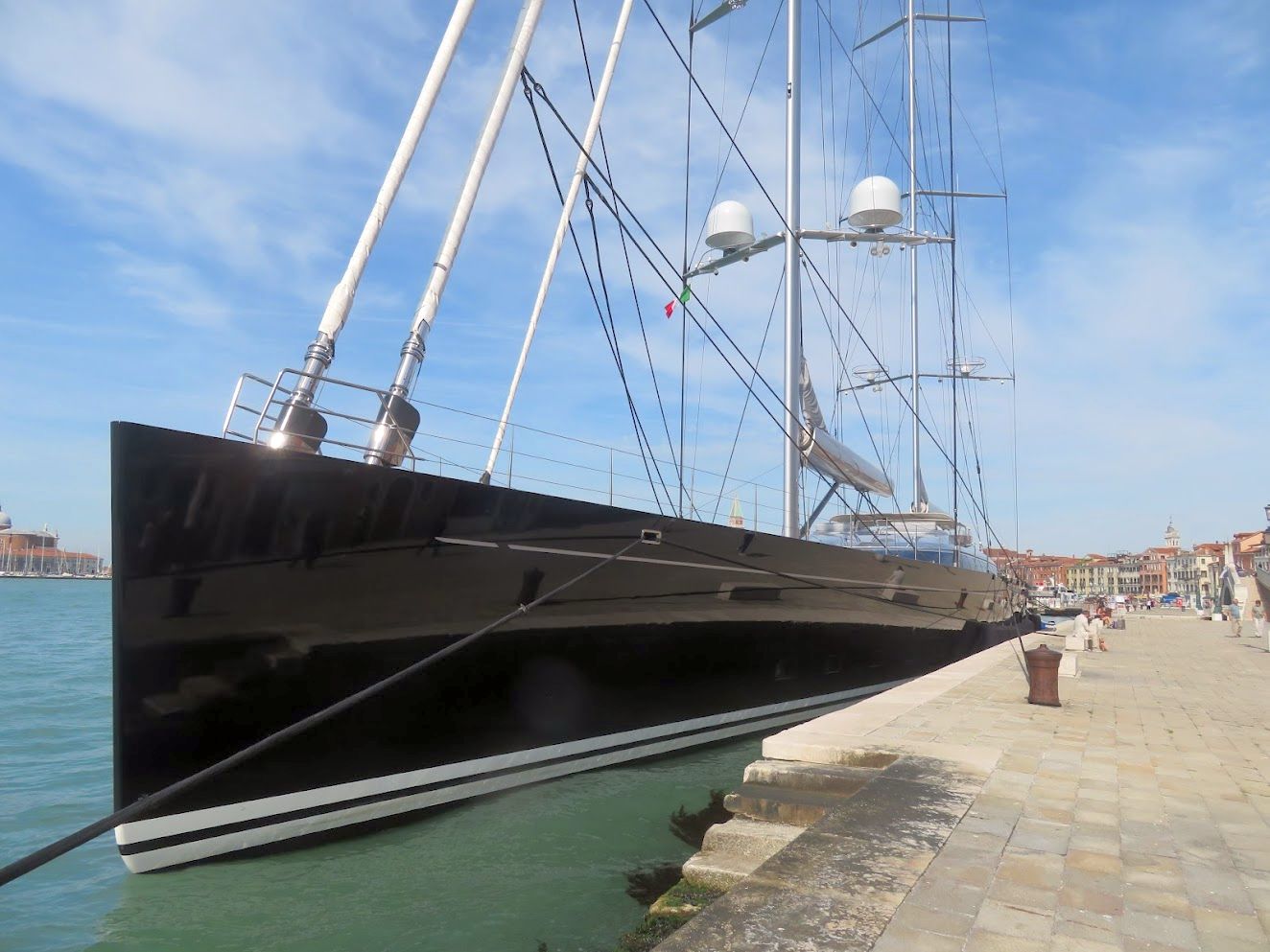
Rupert Murdoch’s yacht “Vertigo” was the first of several luxury boats brought in presumably for publicity parties. I can’t say what happened on this yacht, it disappeared before the real activity began.
The “pre-opening” week is an experience in itself, protests or no. It began more or less on May 4, with the always entertaining international swarms of journalists, critics, maybe even some artists. They descend in their thousands on Castello for an early look at what is sometimes referred to as “the Olympics” of the art world. I get what they mean, but considering that Italy is currently evaluating the usual damage — financial and environmental — that the Winter Olympics inflicted on the Italian Alps only two months ago, it’s a term I’d suggest avoiding.
Seeing as much of the activity is concentrated outside our front door, the week is an assortment of sensations brought by streams of journalists and art-world people. The sound of many rolling suitcases at all hours, the plundered supermarket shelves, the clogging of streets and bridges by people who have to stop to talk, to consult their phones, to look at each other, or just look around. You get the feeling that it isn’t that they have stepped into your world, but that you’ve been somehow transported into theirs.
The official inauguration was Saturday, May 9, so for the next seven months (closing November 22) Venice will be chugging along powered by the engine of the Biennale. Here is an assortment of images from the week.
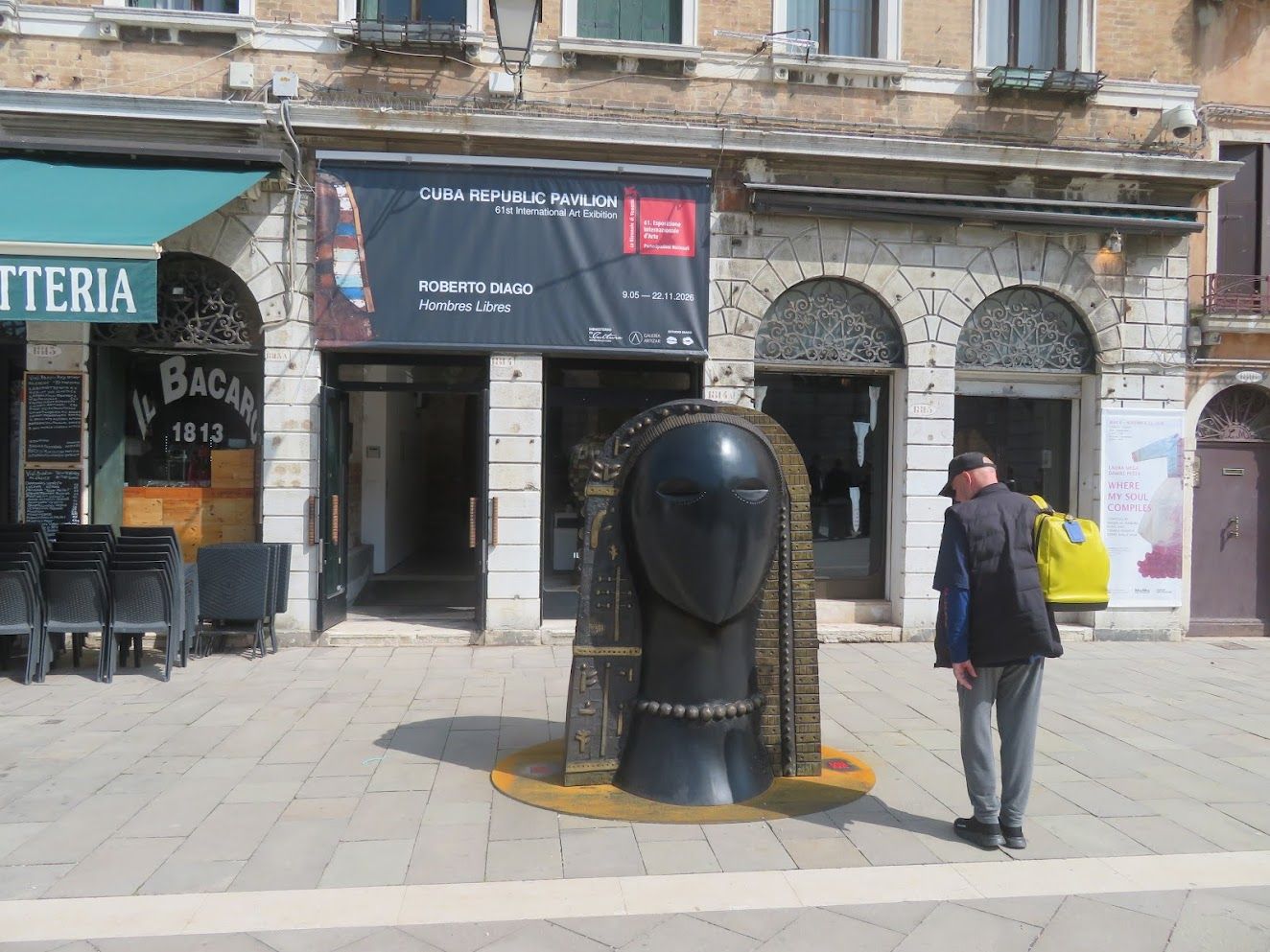
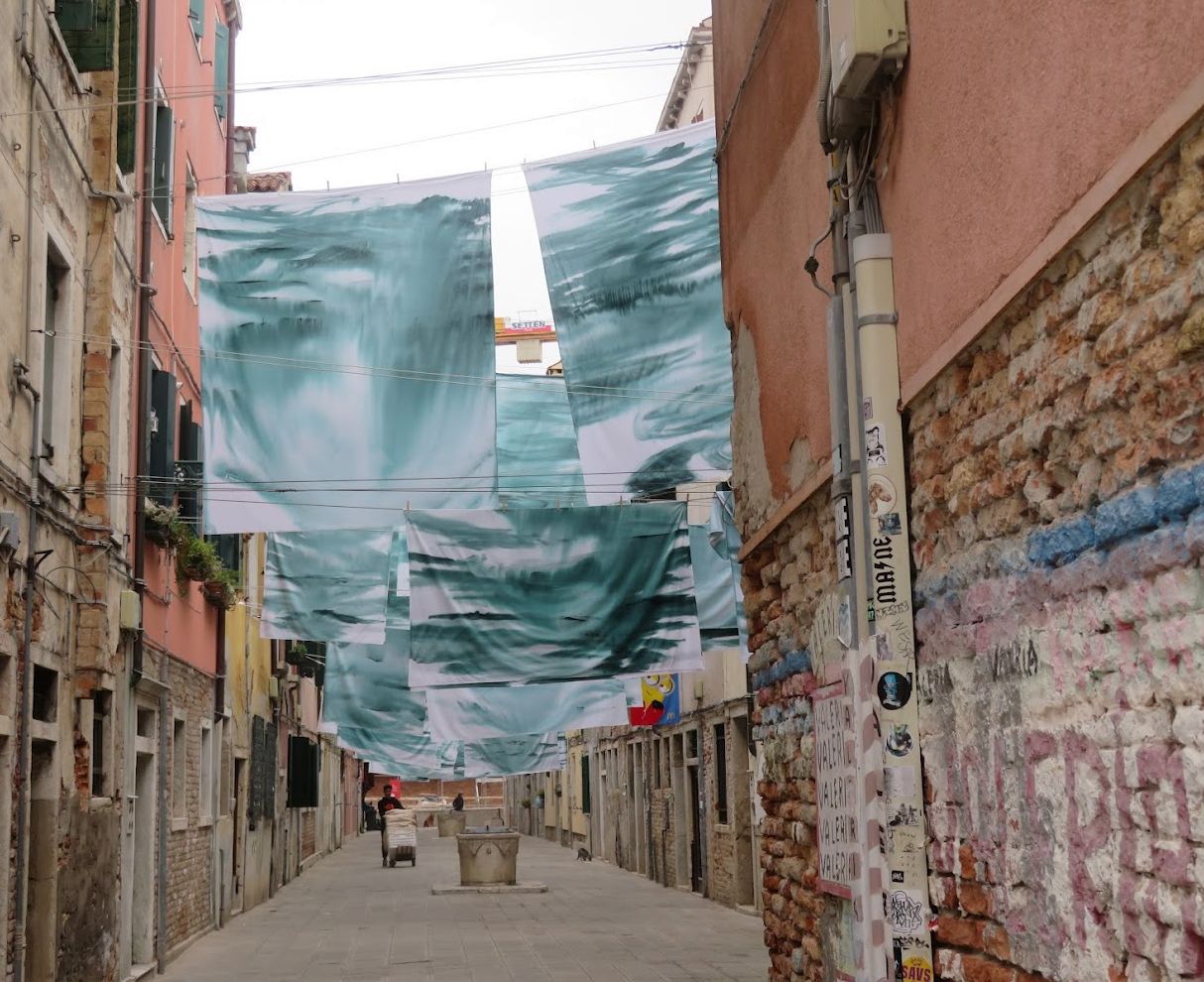
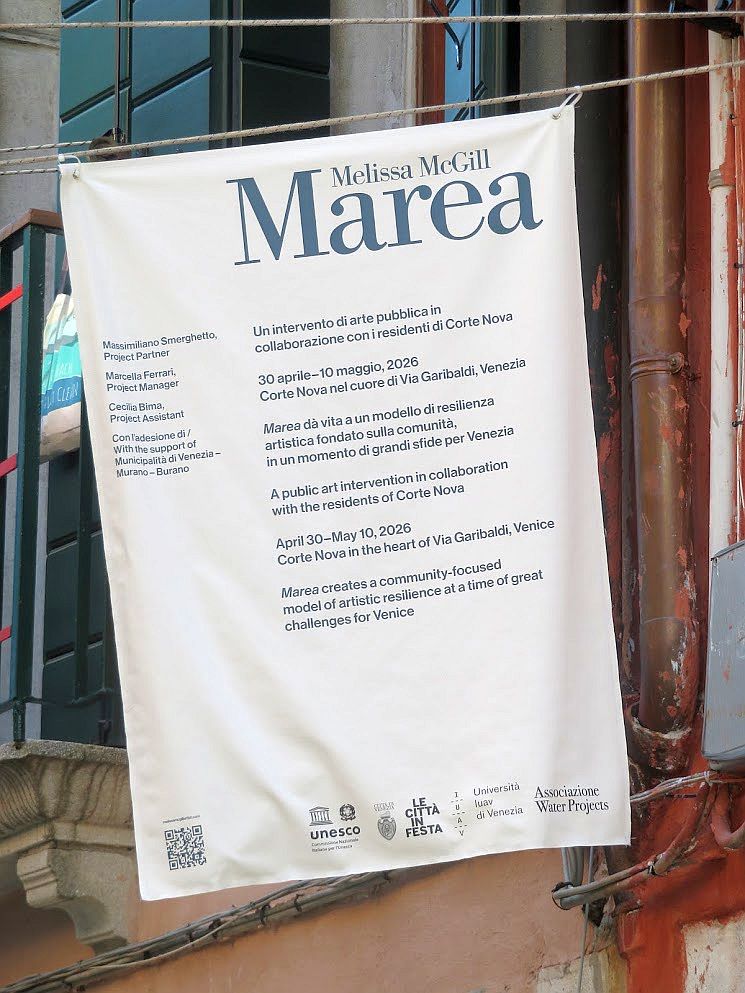
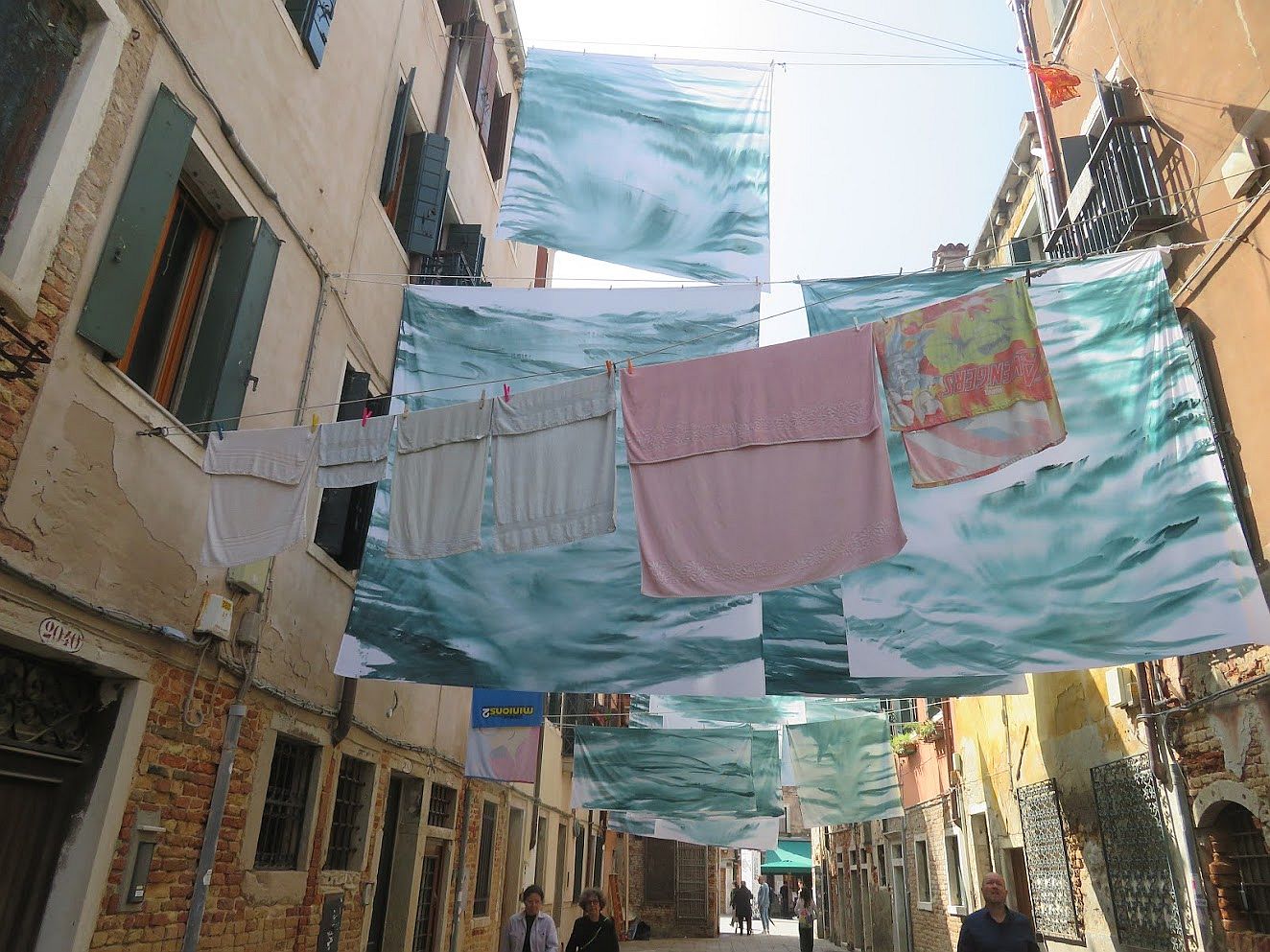
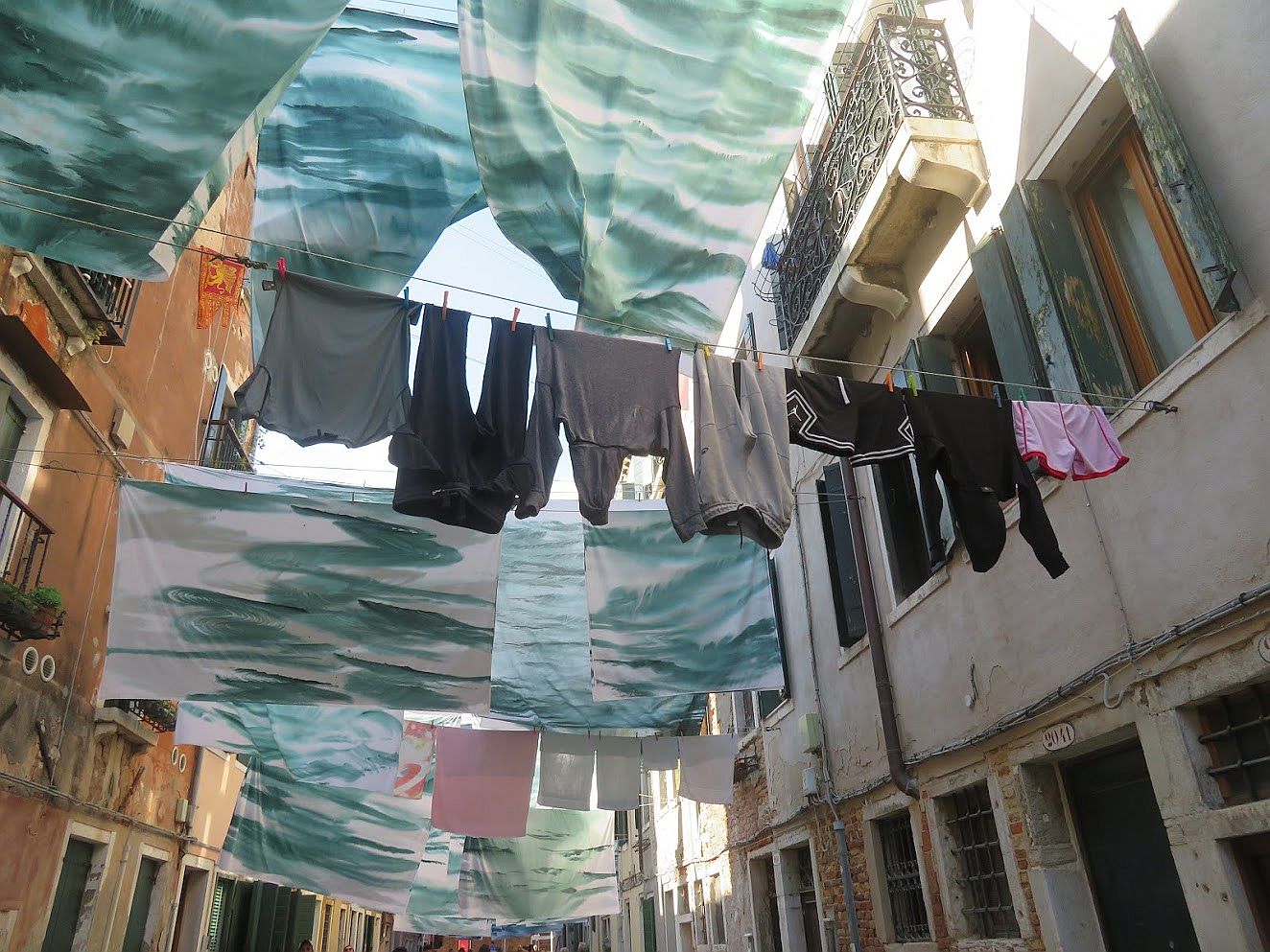
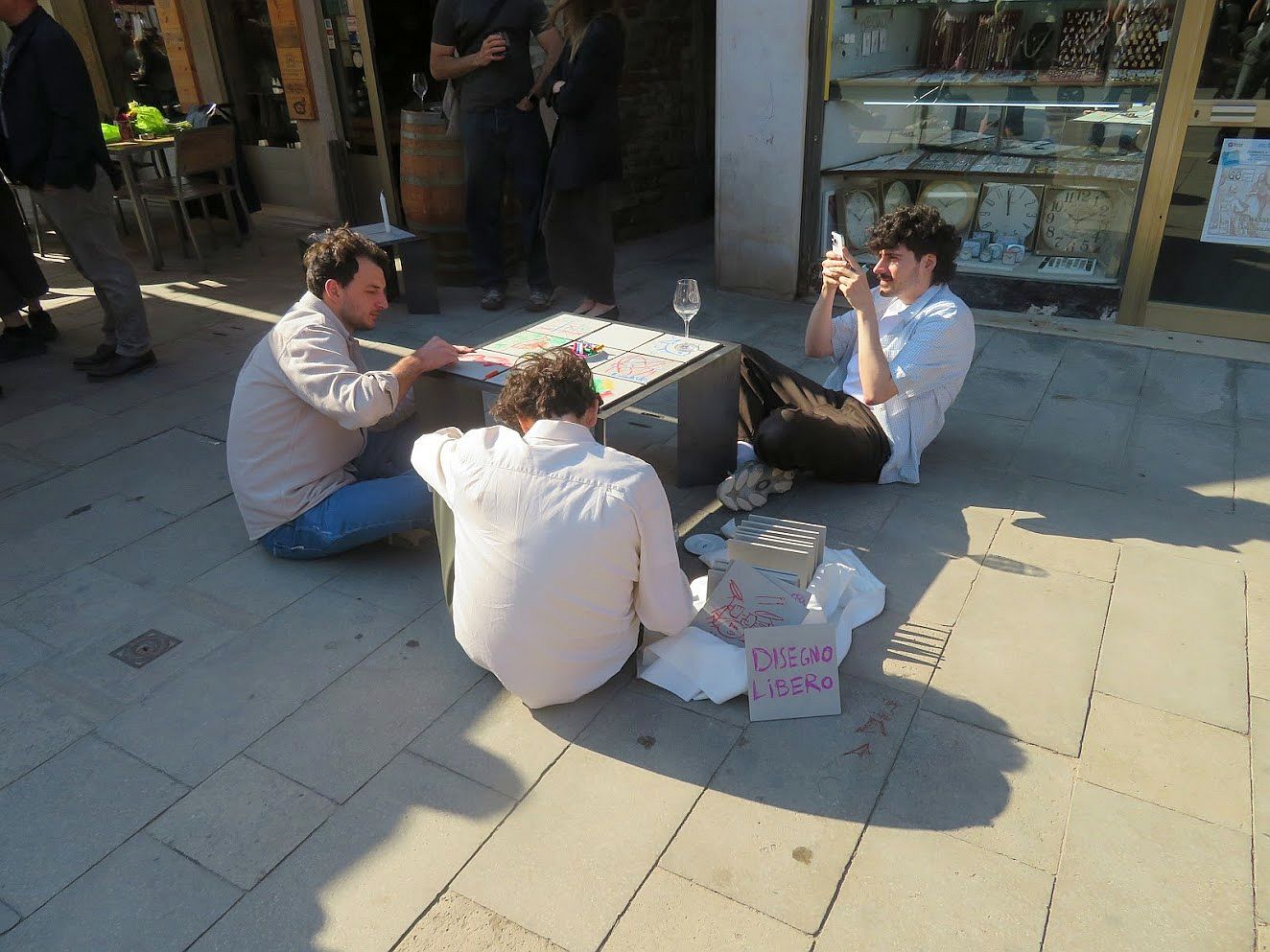
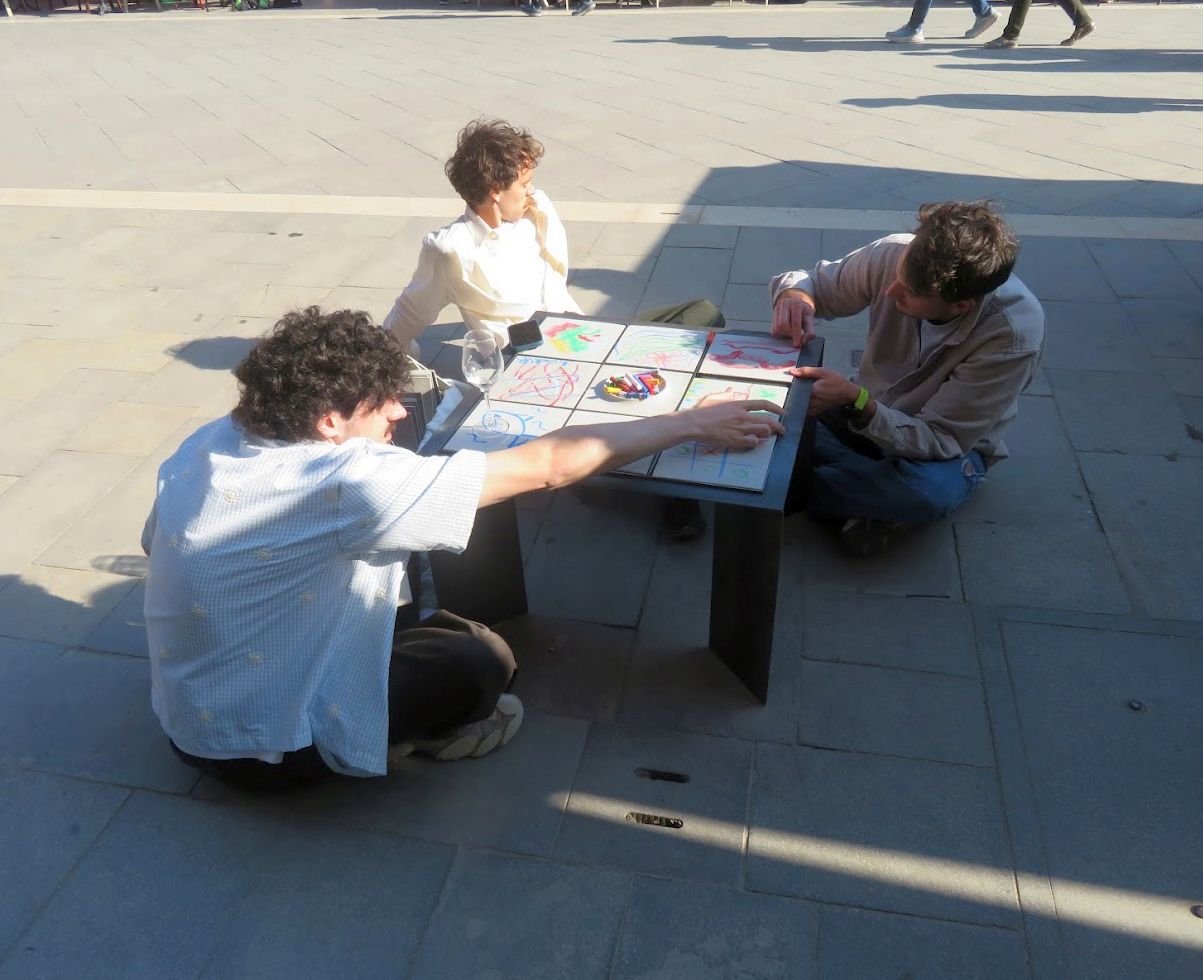
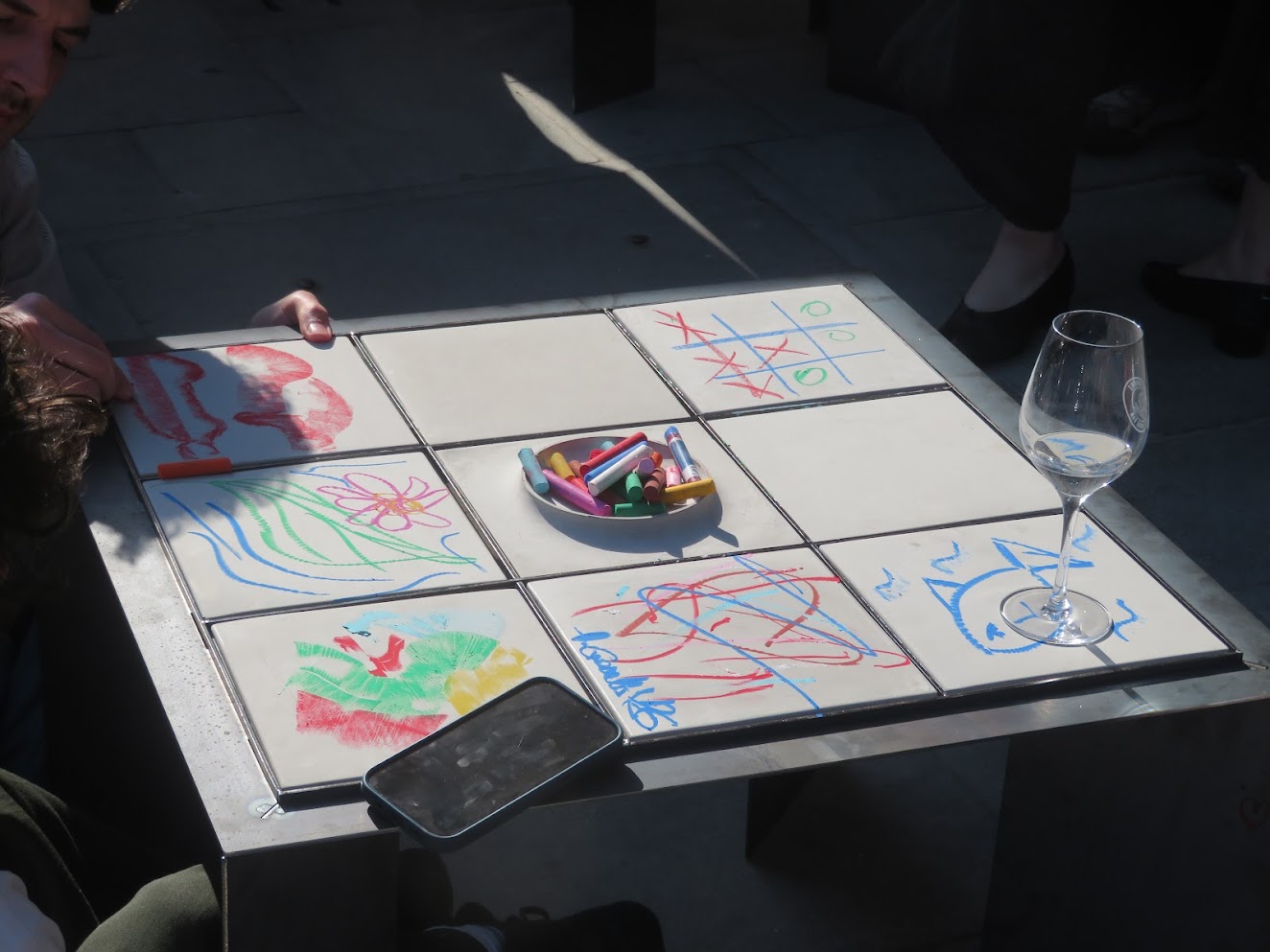
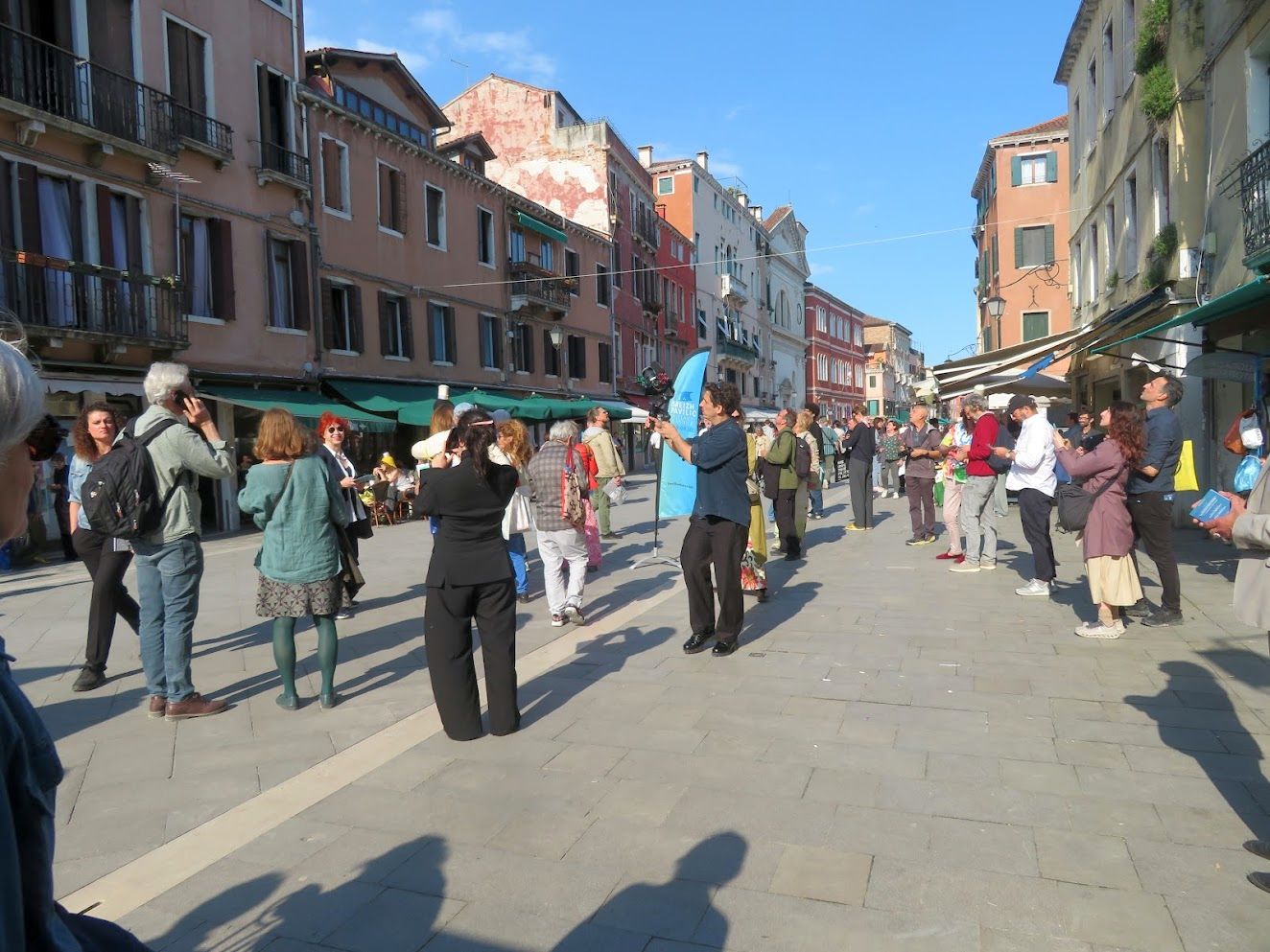
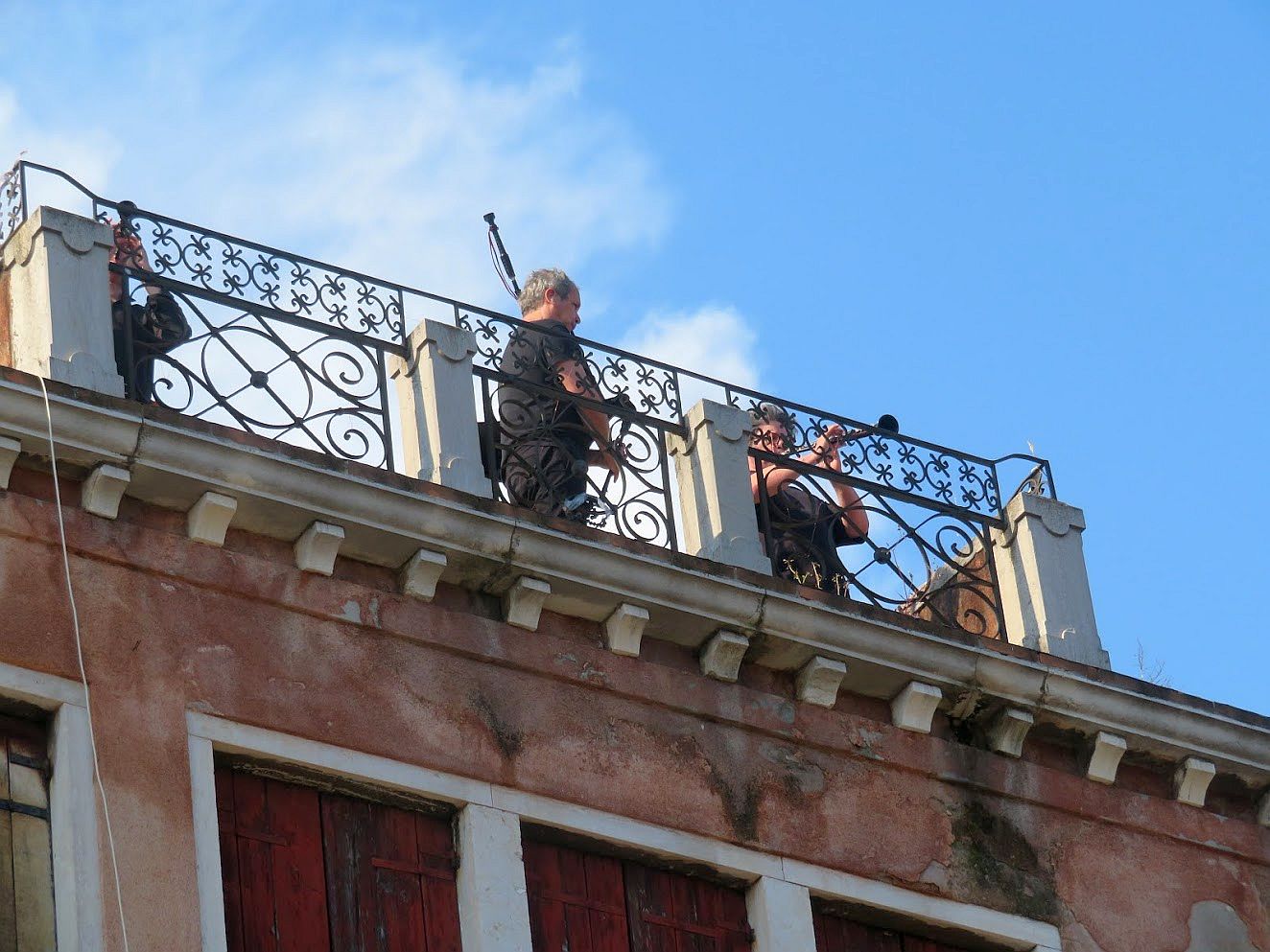
This was the first artwork that took its place on via Garibaldi. They don’t drag it inside at night, it will be here till winter. I’m wondering whose dog will be the first to succumb to its exotic allure.This creation is called “Marea” (“tide” in Italian). It was up for eleven days and looked very blithe when the sun was shining (not for long on a side street like this) and with the breeze blowing, which it isn’t here. Without those elements it was rather lackluster.I like the reference to resilience. I’m not sure what “artistic resilience” might be, or how this model might be a useful illustration, but Biennale-speak makes everything sound important.A few residents decided to return to domestic resilience and let the symbolism of the tide fend for itself. The sun is shining, the towels are wet. Art is all very well but the basics of life are not to be trifled with.There’s the art world, and there’s the real world. Real world wins.The little sign saying “disegno libero” means “free design,” implying you can join in to express your inner artist just like you did in kindergarten, including sitting on the ground.At least they’re not promoting some complicated theory of art or life.I didn’t even ask why. You just go with it.Raucous instruments were audible coming from somewhere up high along via Garibaldi. People stopped when they realized it was a performance by musicians from the Brittany pavilion.I love that Celtic music but these three were stuck on “Celtic” and hadn’t yet made the leap to “music” and got lost at “cacophony.” Fabulous position for their show, though. People seem to have really made an effort to use whatever space they could find. Newsstand, clotheslines, rooftop terrace. Pavement… probably a bathroom somewhere…
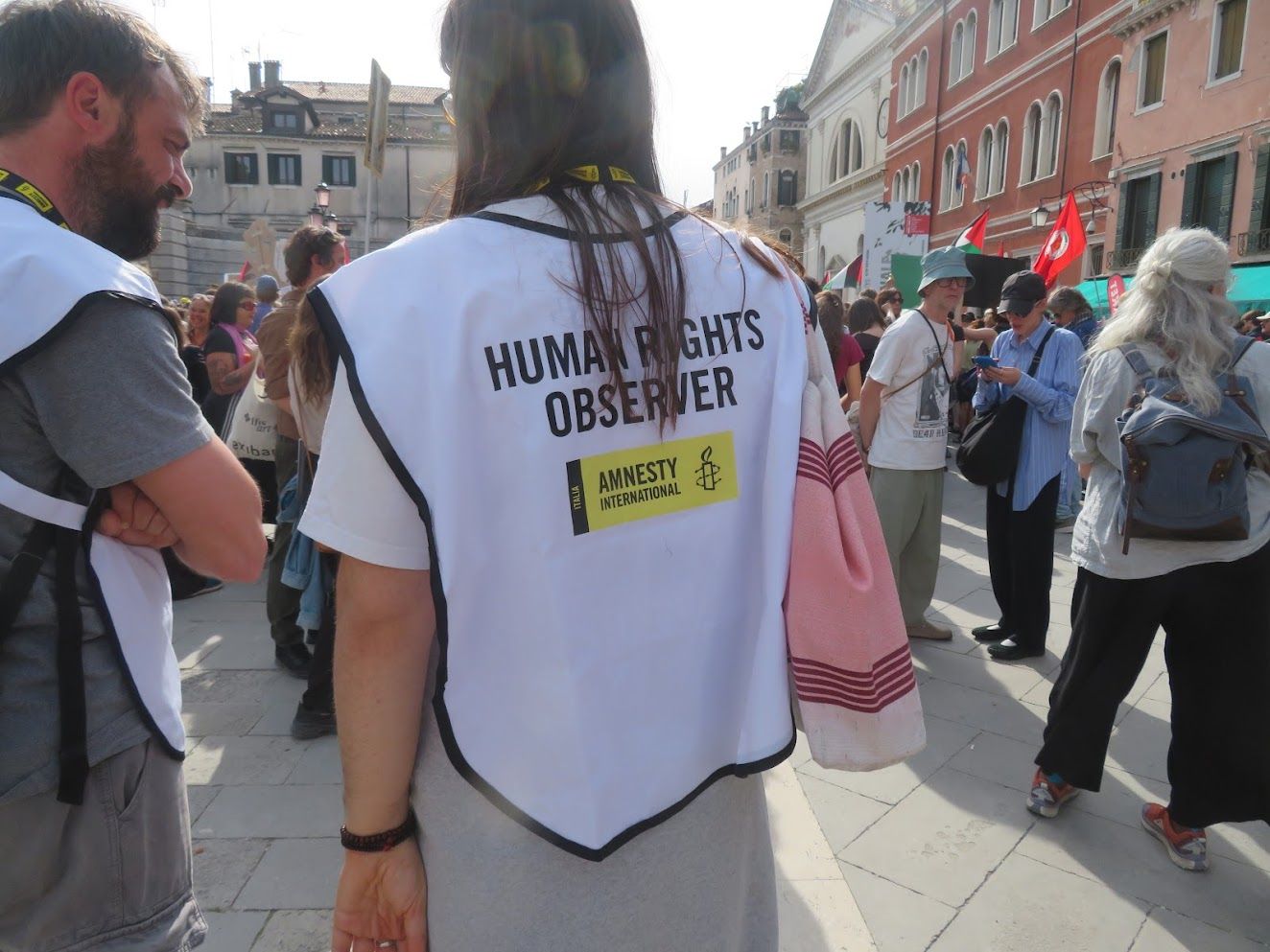
Friday afternoon saw the big protest against Israel’s participation in the Biennale. Not only did we have people here on the street, 20 national pavilions were closed because their staff was on strike in solidarity. For the record, they were Austria, Belgium, Egypt, Lithuania, Catalonia, Luxembourg, Poland, Slovenia, Spain, Switzerland, Turkey, Finland, The Netherlands, Ireland, Qatar, Malta, Cyprus, Ecuador, and the UK.
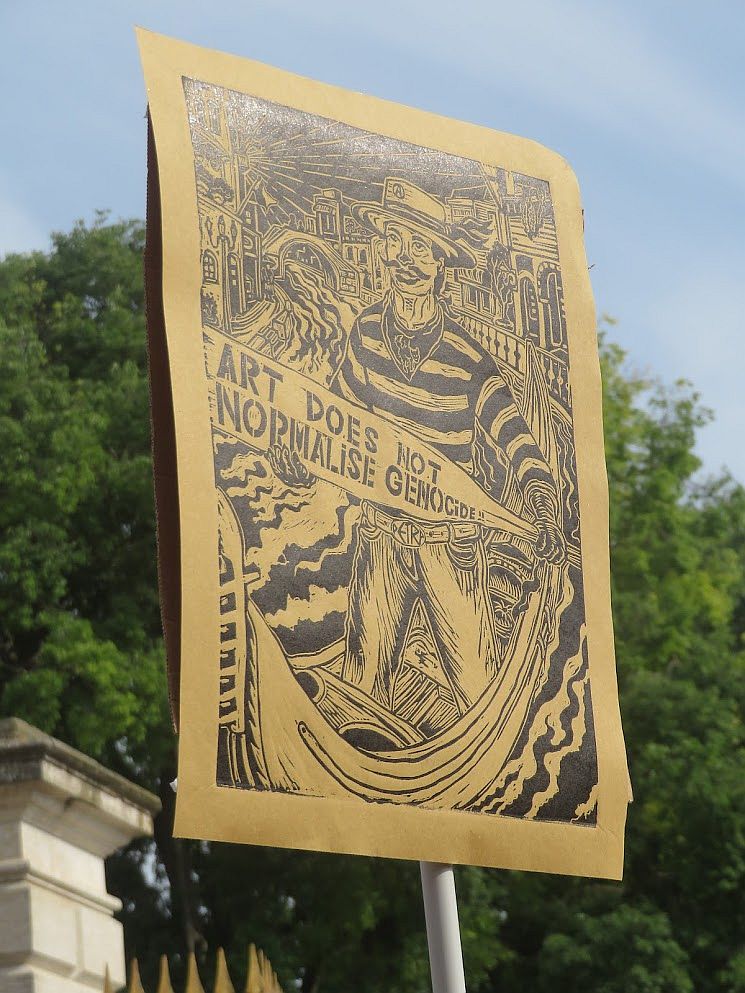
Needs no translation.“Artwashing is a criminal act.” Finally art and politics have to look at each other.Suddenly all that Biennale-speak has been pushed aside for clear, declarative sentences.
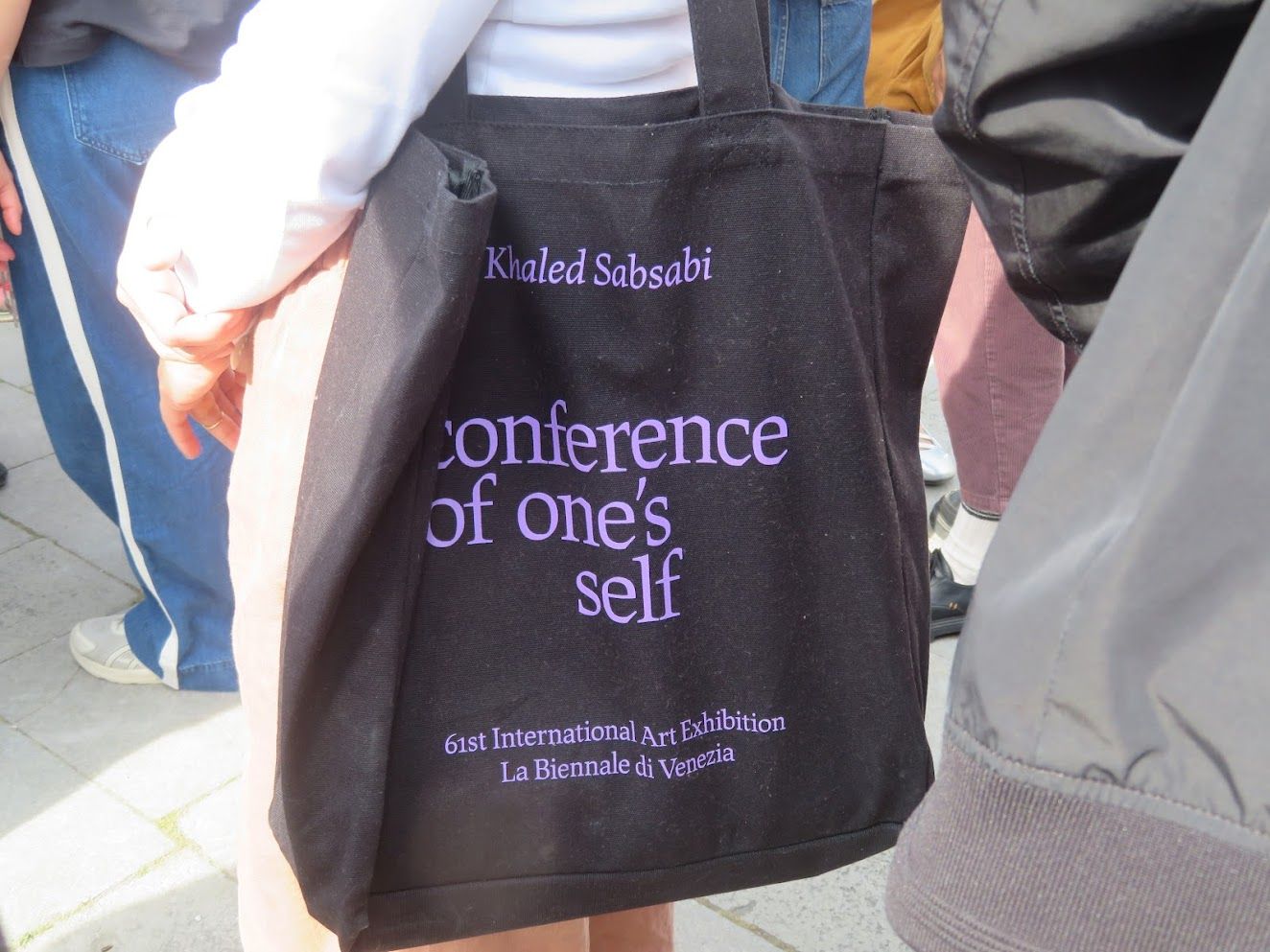
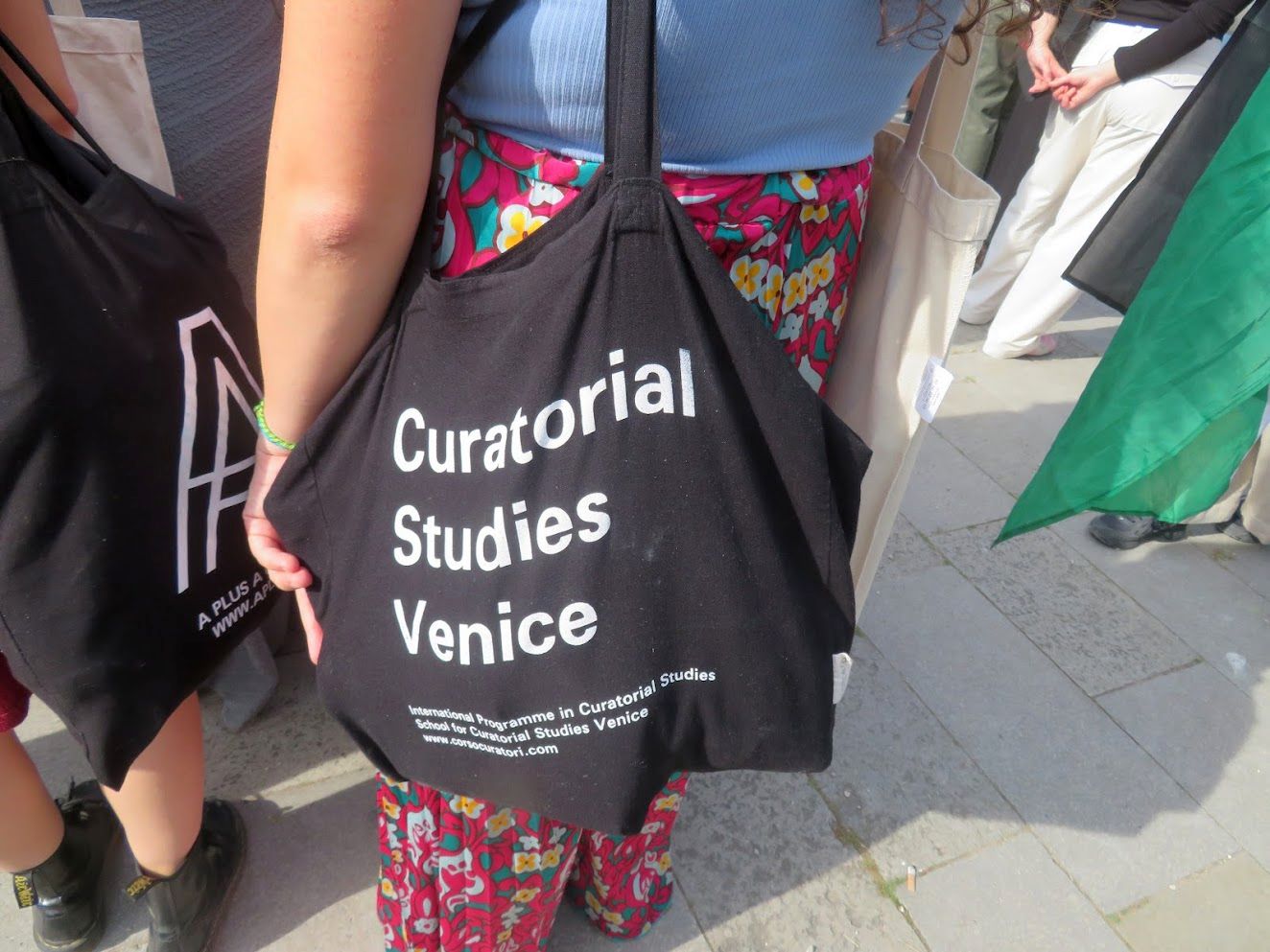
Everybody seems to have been somewhere before coming here. The Biennale was bursting with itself.
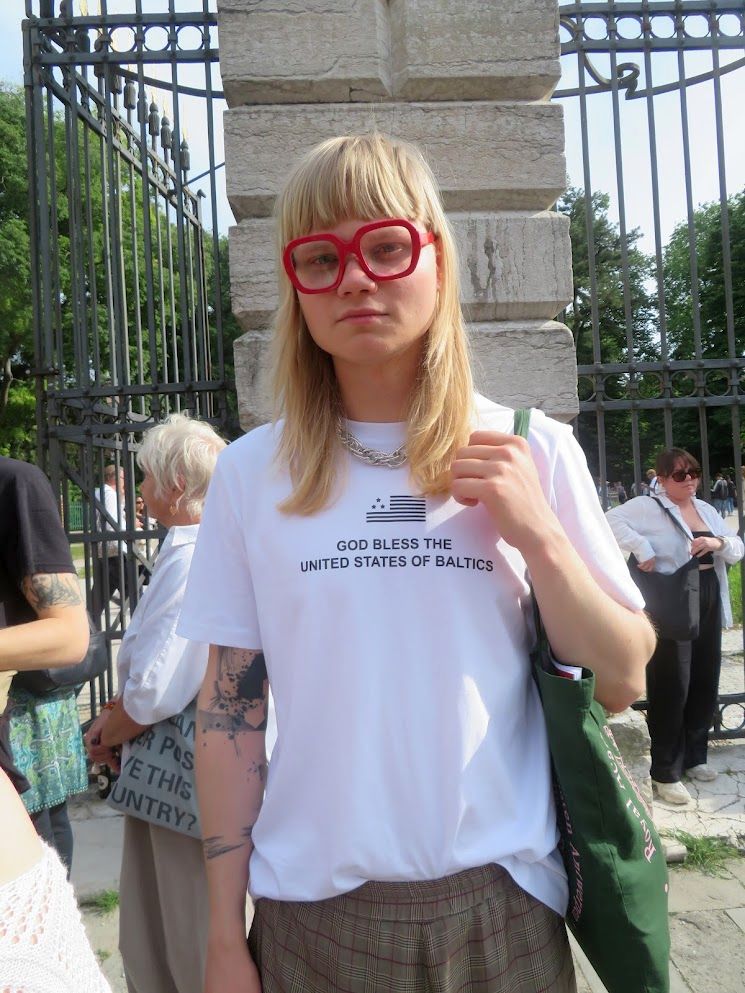
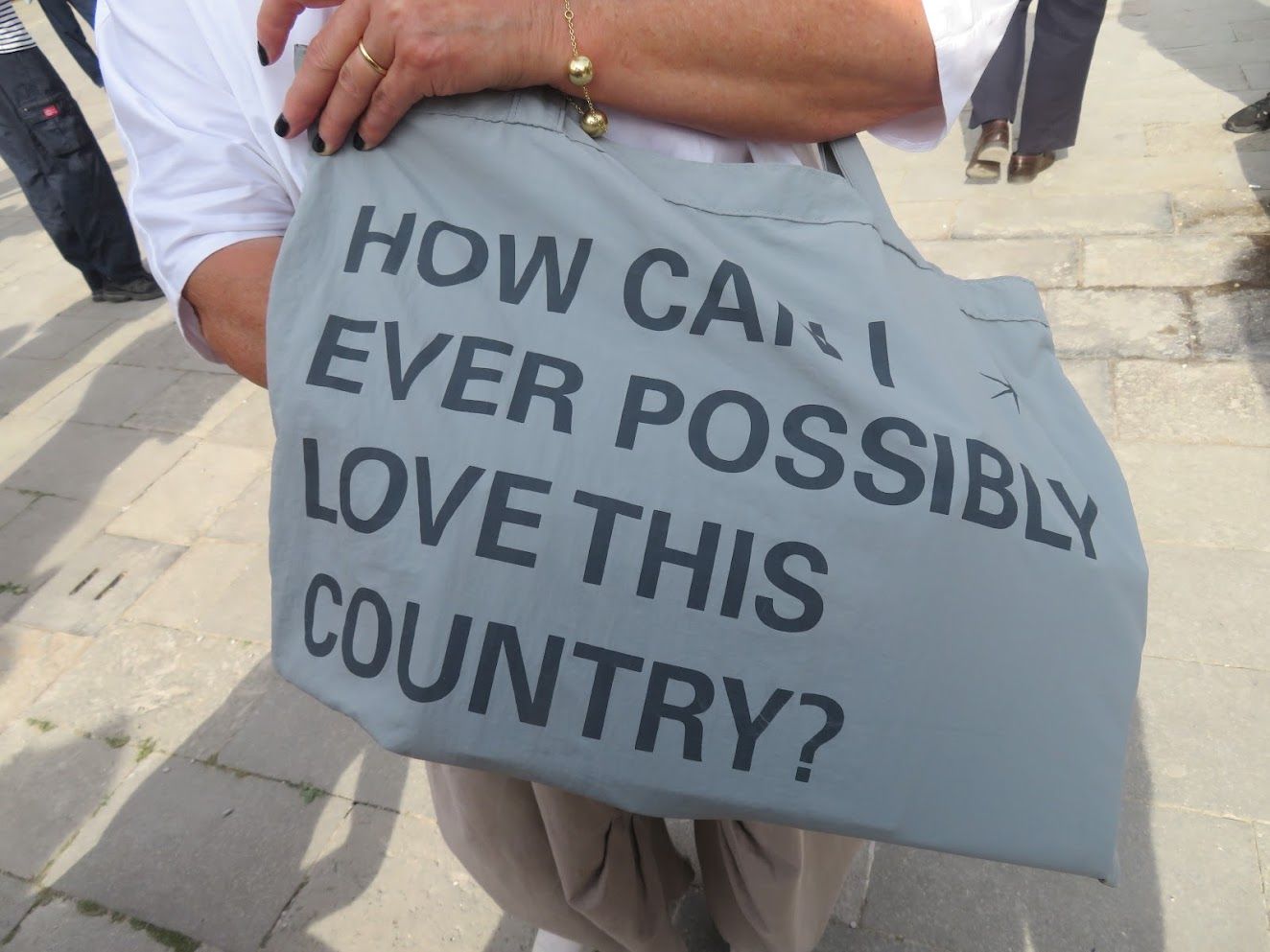
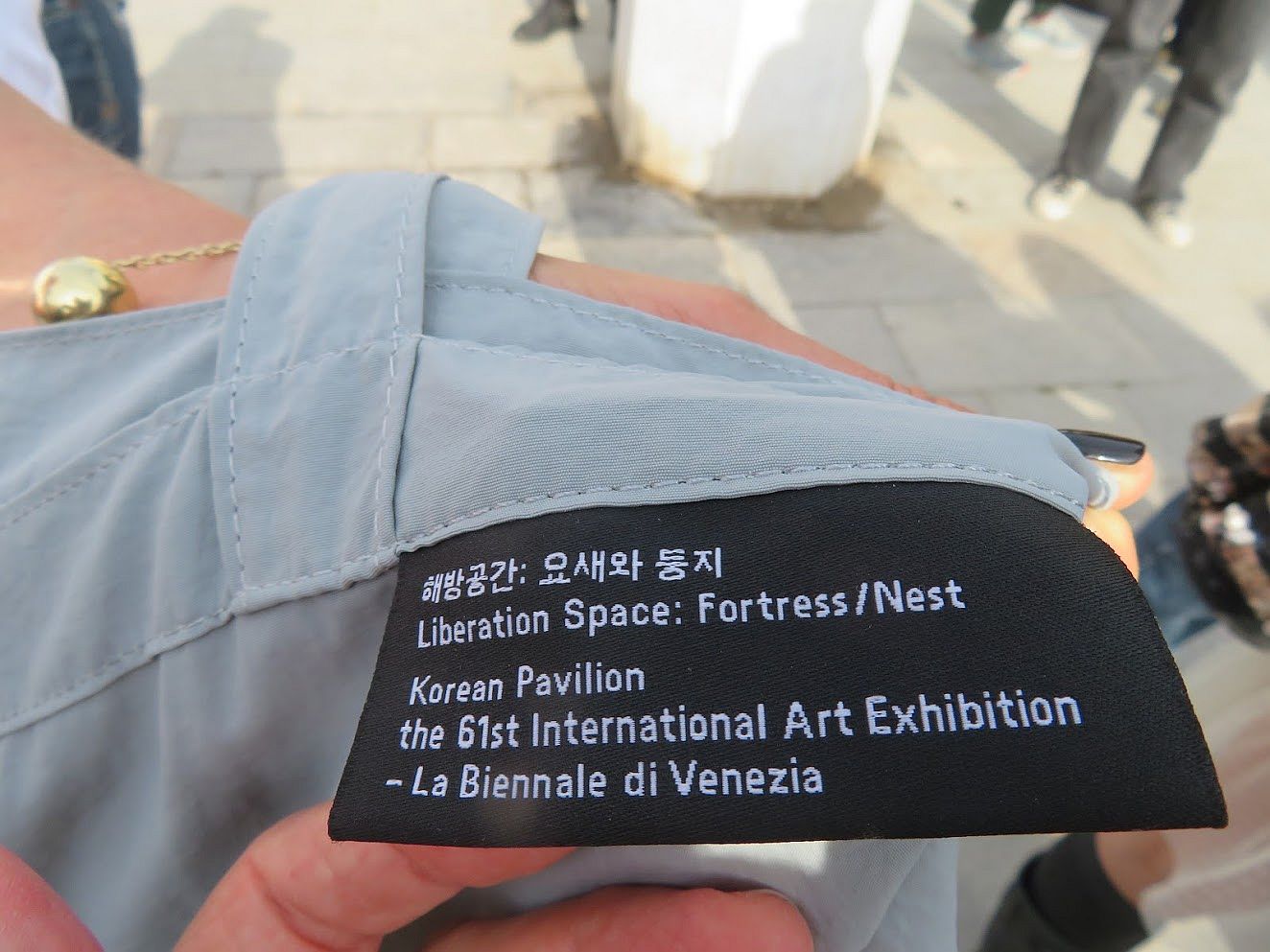
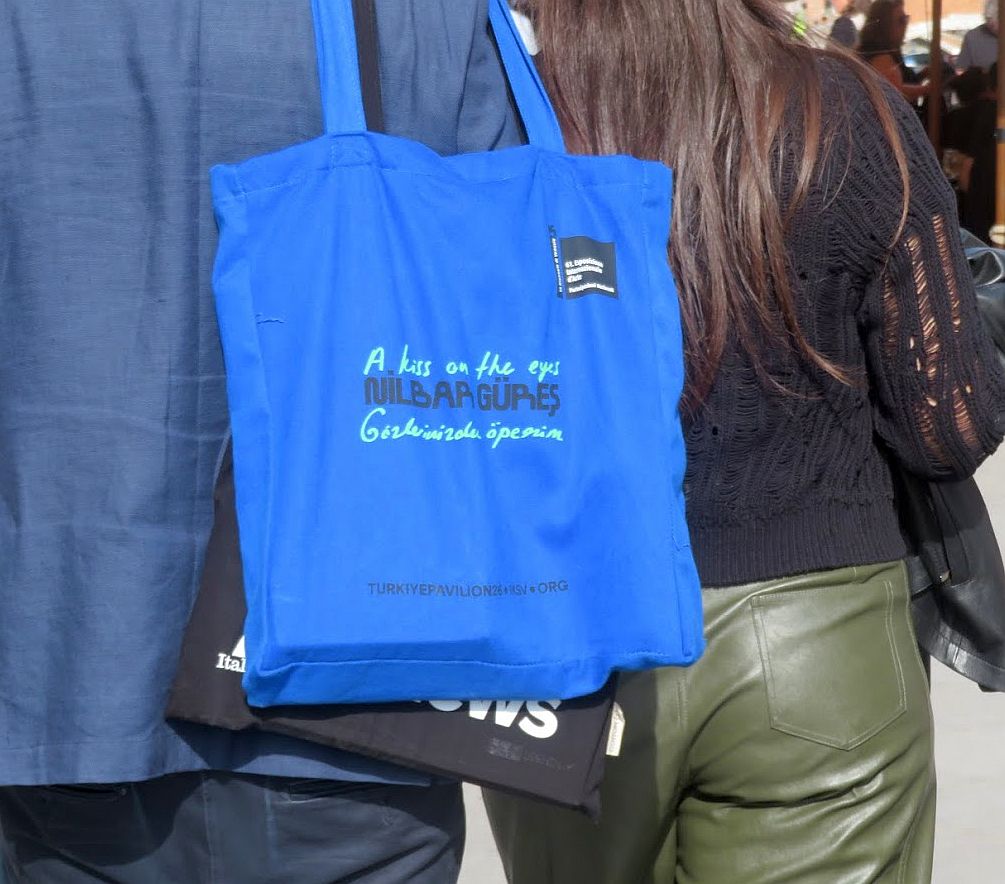
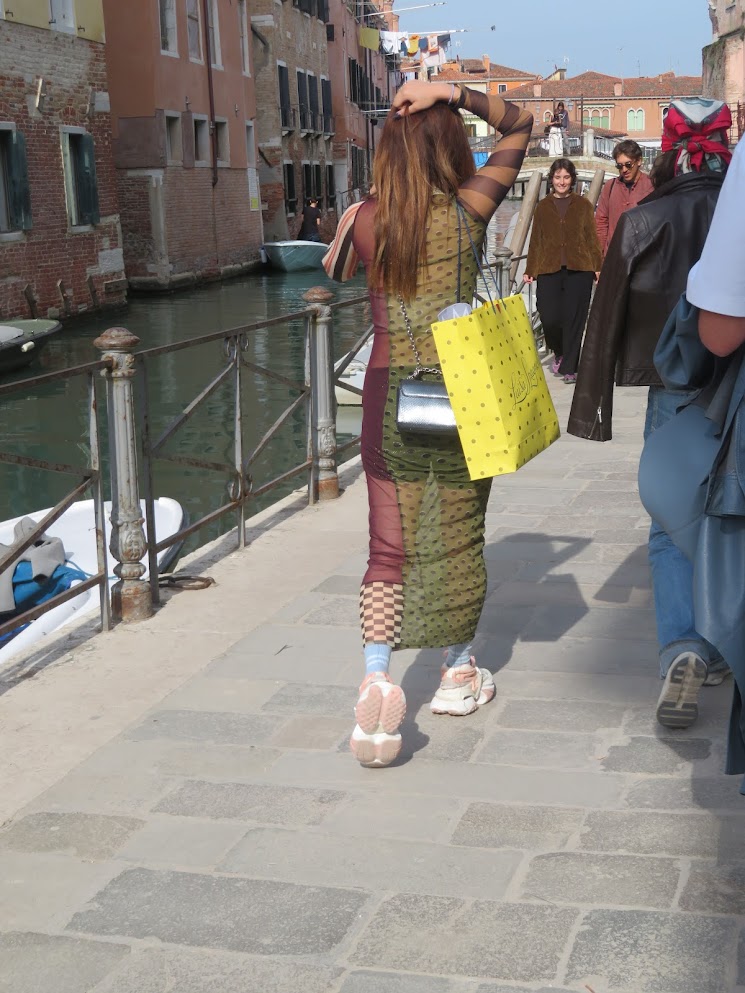
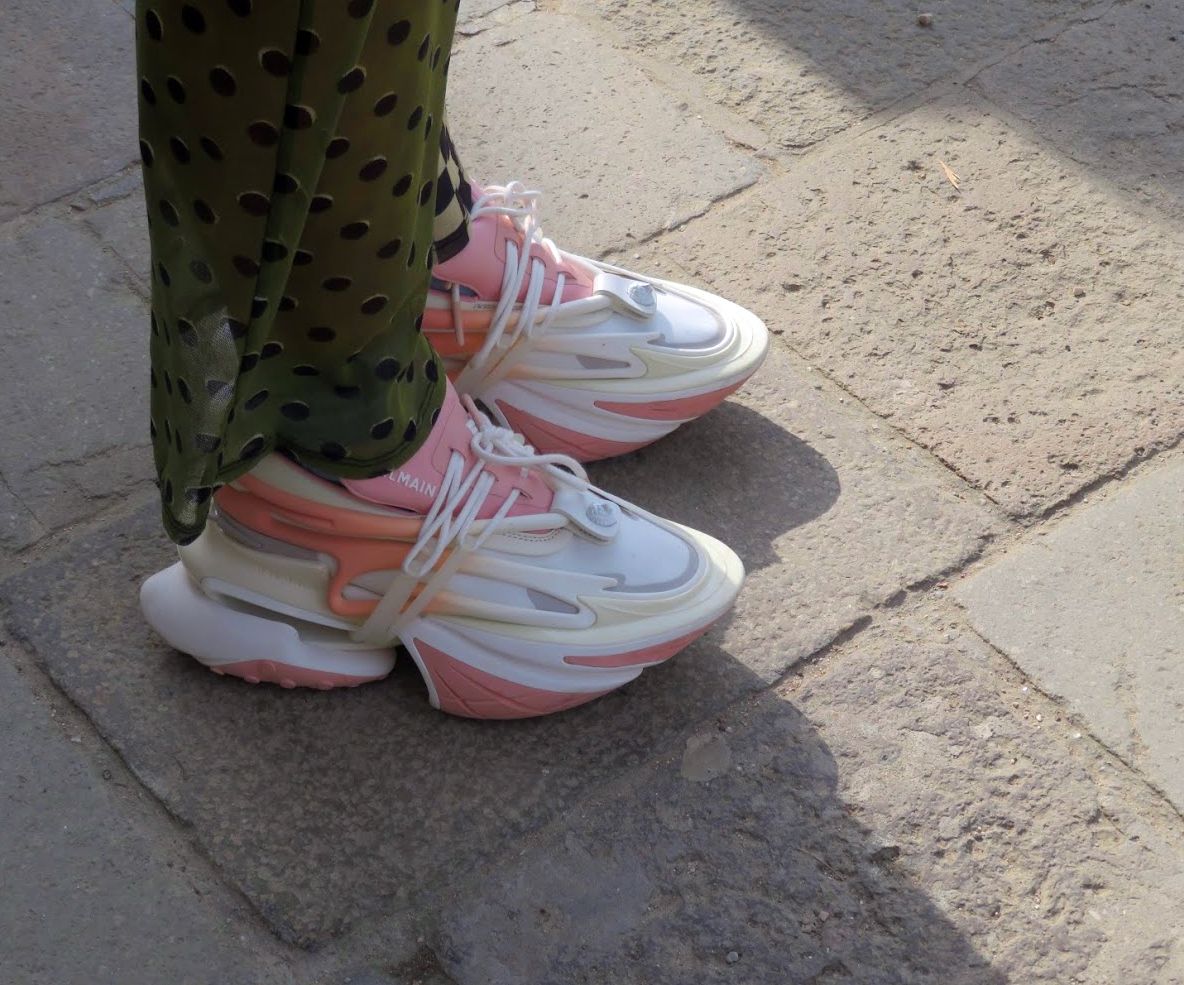
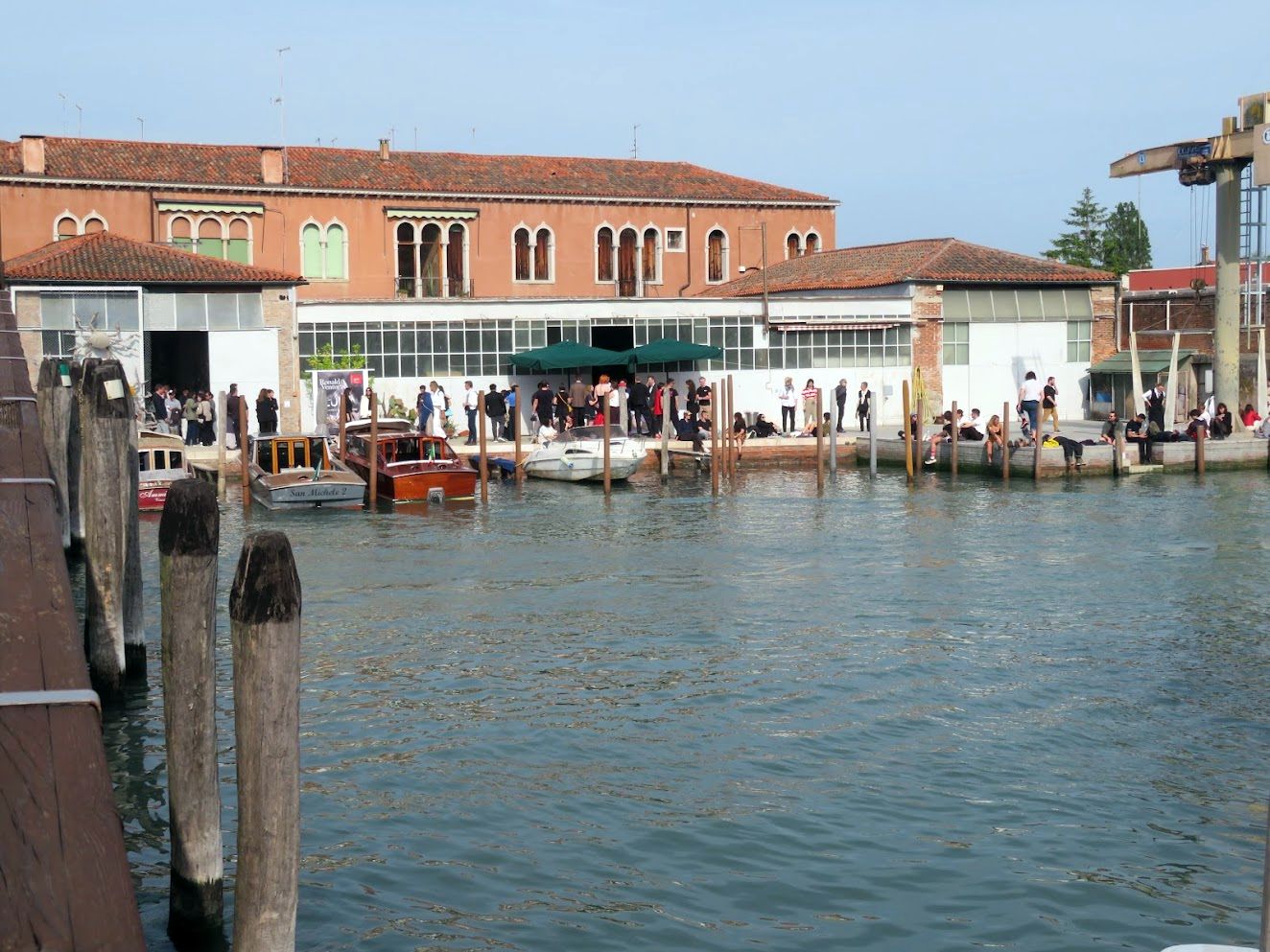
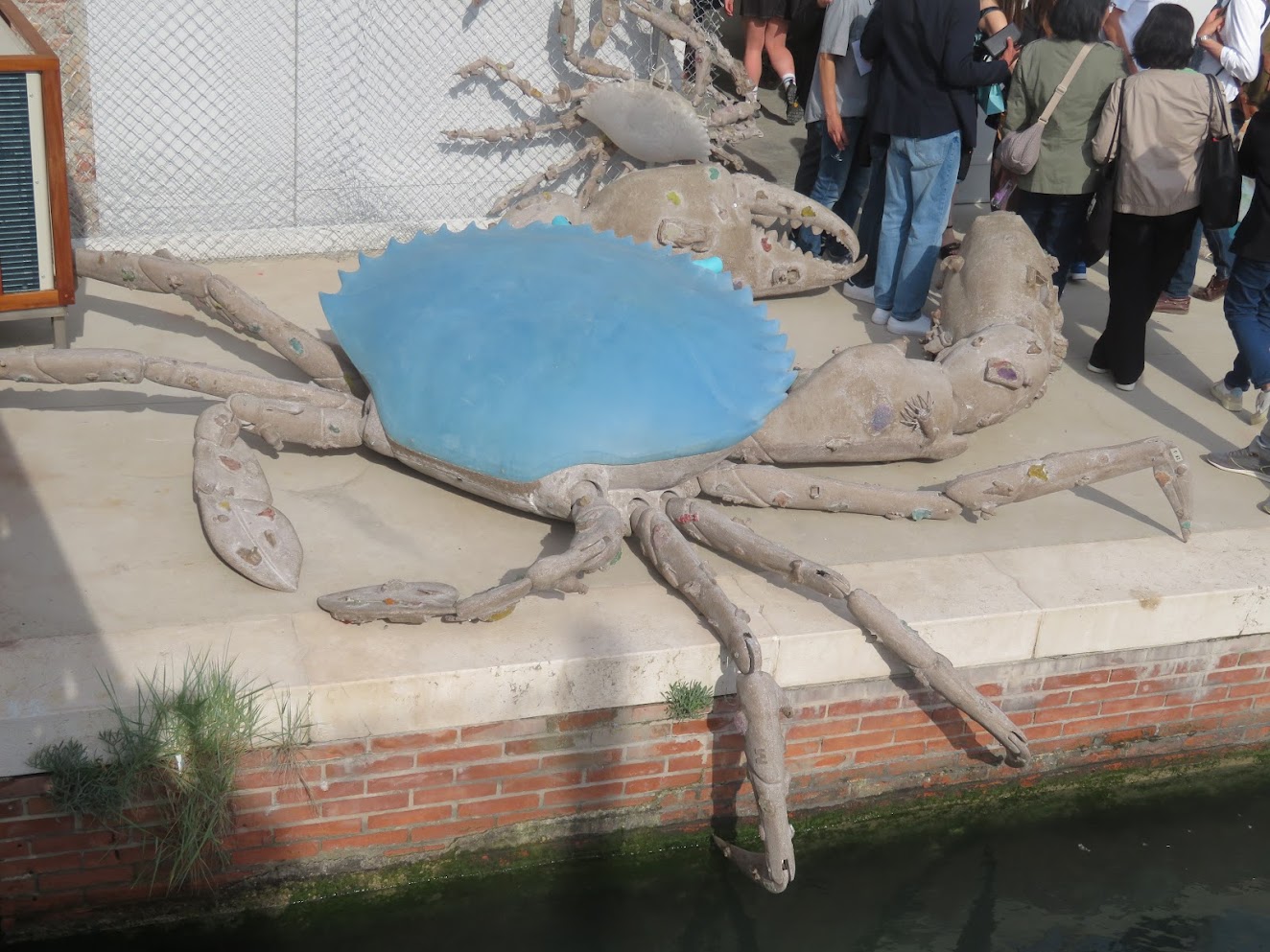
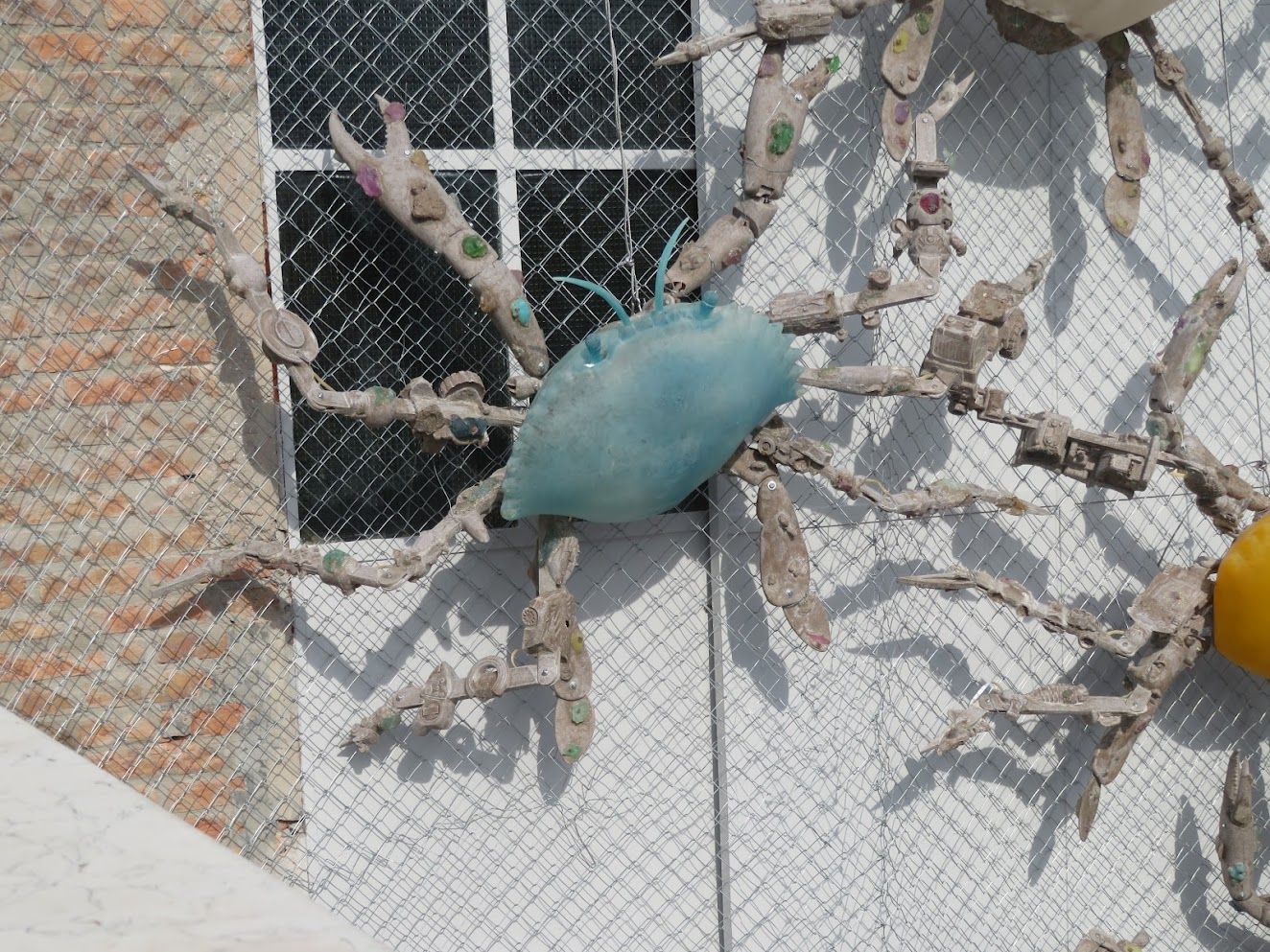
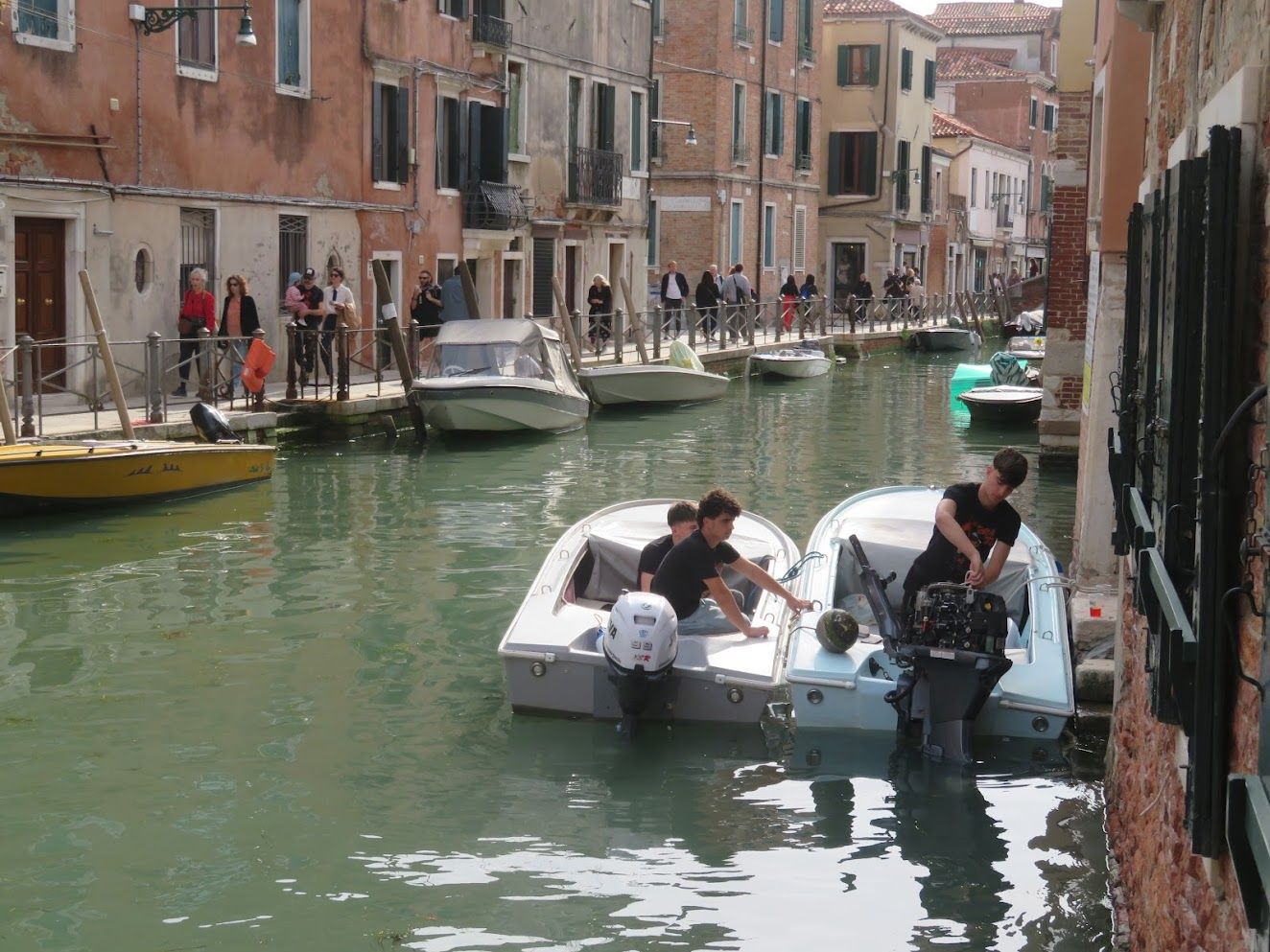
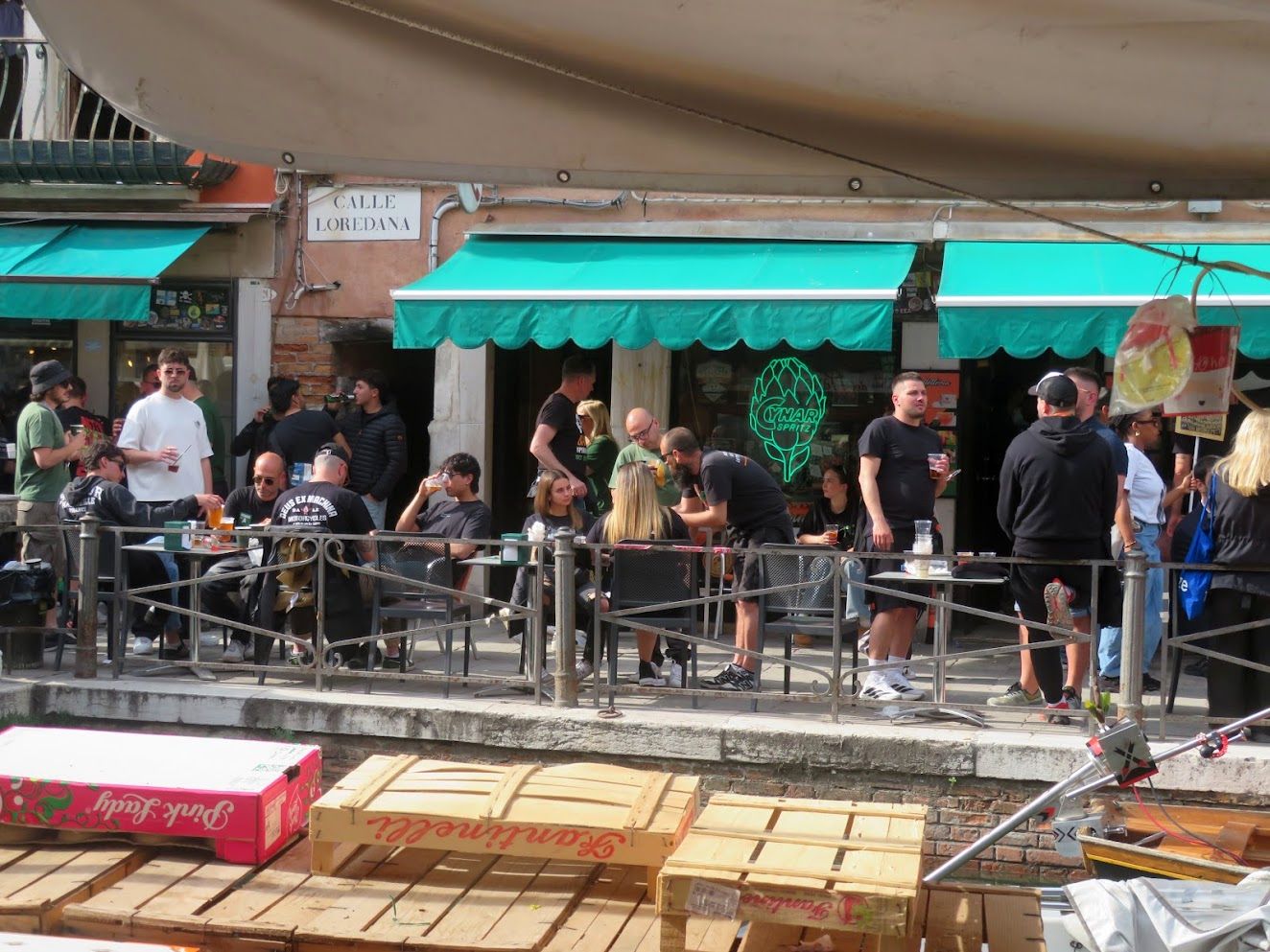
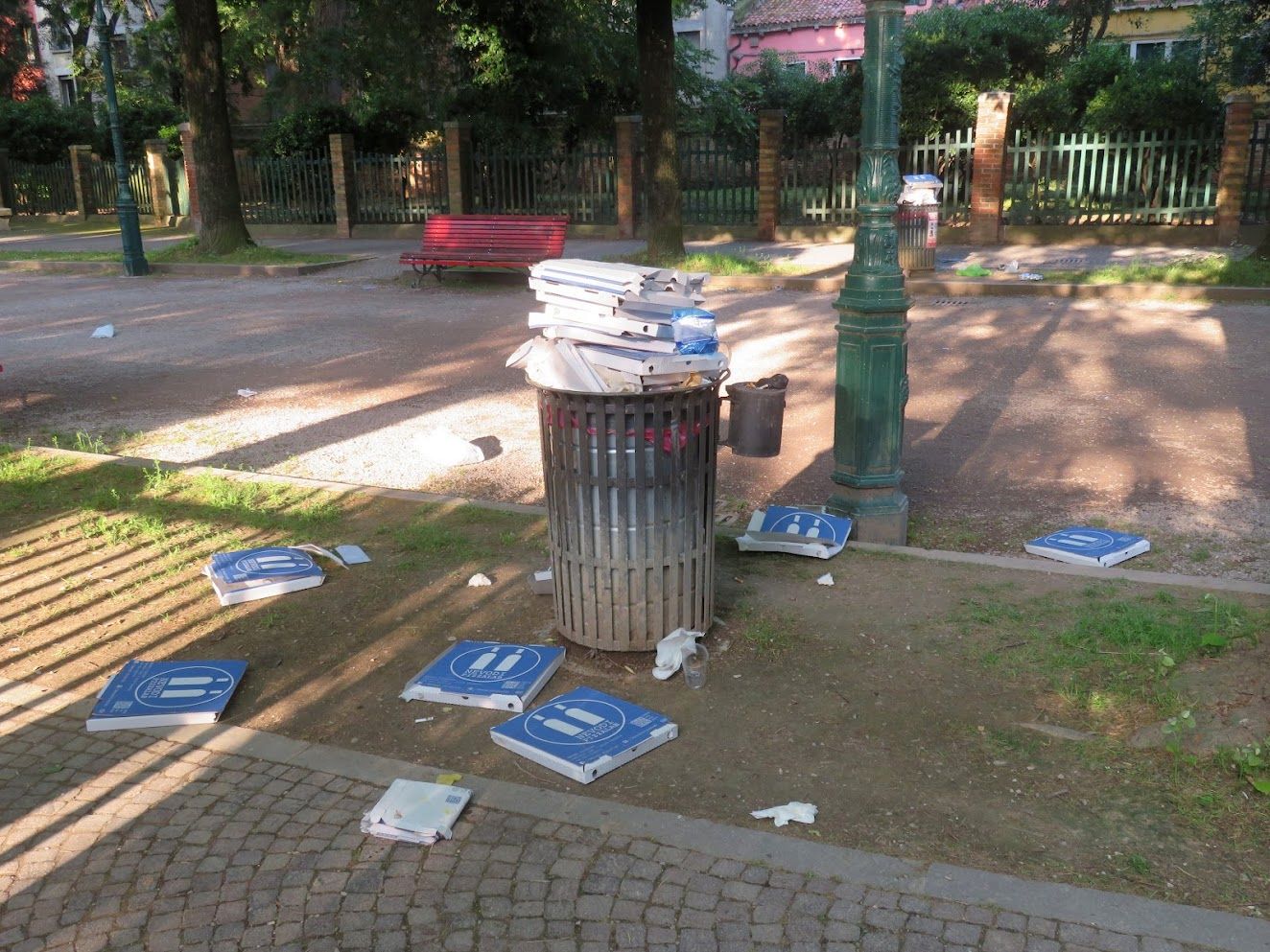
Very tall young person from the Baltics. The person, however self-defined, had a lovely deep voice. I make no guesses or assumptions. The flag resembles the Breton flag but no — it’s of the United States of Baltics, as you see. The shirt’s makers explain the design on their site: “3 stars represent the three Baltic states, and 13 stripes the countries that have owned us.” You could easily have one yourself (note: I get no benefit from this mention, I just think it’s extremely cool): https://pood.dokfoto.ee/tootekategooria/riided/This is a big question. My own question is: Which country? Any country? All countries?Answer: South Korea. I didn’t know we had to worry about them too.The Turkish pavilion weighs in. No soul-crushing comments here, which is nice.I didn’t pay enough attention to how people were dressing this year, but this girl cried out to be immortalized. She is literally shedding money. The dress-like wrapping is amazing all on its own and I’m guessing it cost plenty of bahts. The Luisa Spagnoli shopping bag makes it clear she hadn’t been spending all day looking at art. But the shoes were the crowning (so to speak) touch.The shoes are called “Unicorn” and are made by Balmain, the French haute couture house. They cost 995 euros ($1,172).Just over the bridge leading toward San Pietro di Castello a boatyard has joined the crowd in hosting exhibitions. Forget repairing taxis and barges in the old shop, there’s art to be shown.Yes, blue crabs made of iron are art. At least it looks like iron. At the Biennale it could be ground-up extruded distressed cowrie shells made to look like iron.Smaller crabs clinging to the netting. Ahoy matey.And in viaGaribaldiWorld life is proceeding in a totally normal way.This bar/cafe is where the local fans of the Venice soccer (football) team gather before the game. Or any time they feel like it, like today.Sunday morning you can see that the festivities have peaked and passed. The pizza-eaters deserve a compliment for trying to put the trash away neatly. Lack of sufficient bins and more than enough seagulls have created this scene. Or wait — maybe this is an art work?
Just remember — and I’m not being sarcastic — the Biennale is better than Carnevale. Because Carnevale is full of people dressing up and pretending to be something or someone they’re not. The Biennale people aren’t pretending anything. They’re absolutely serious about all this.
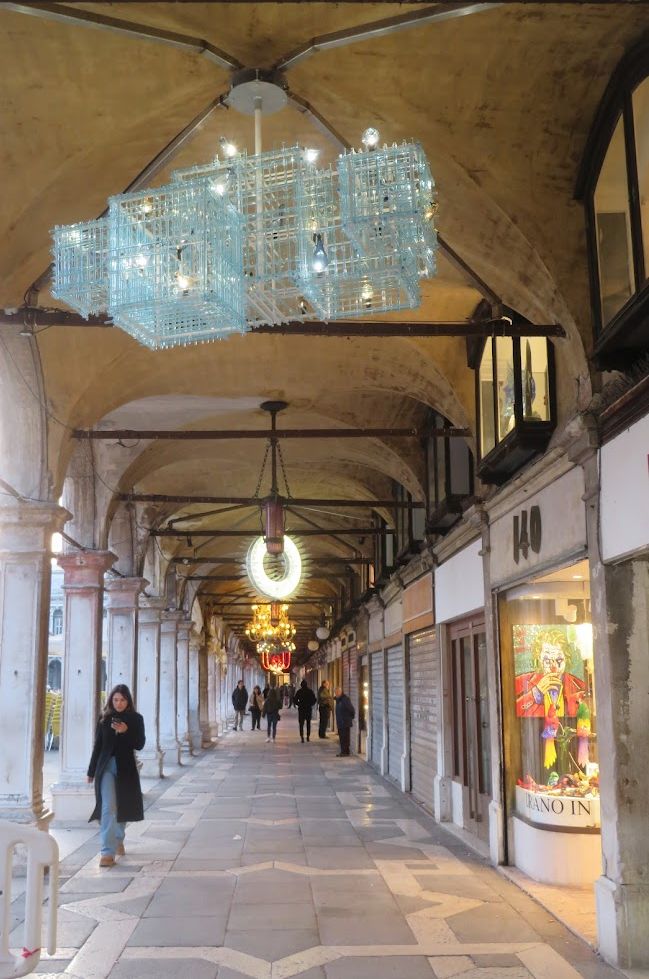
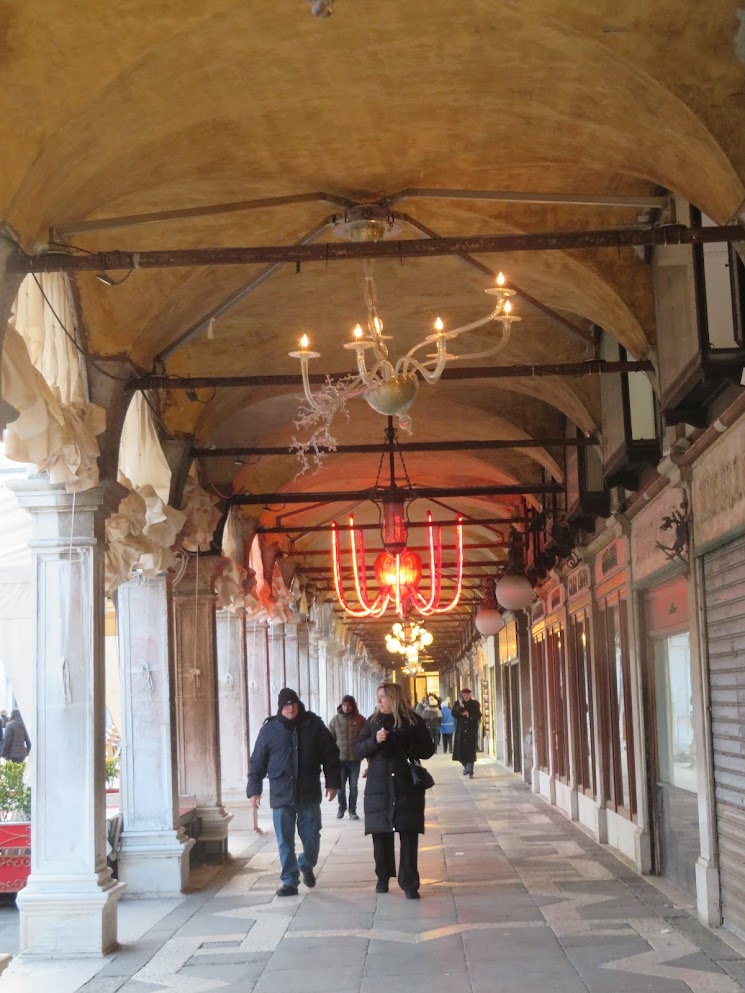
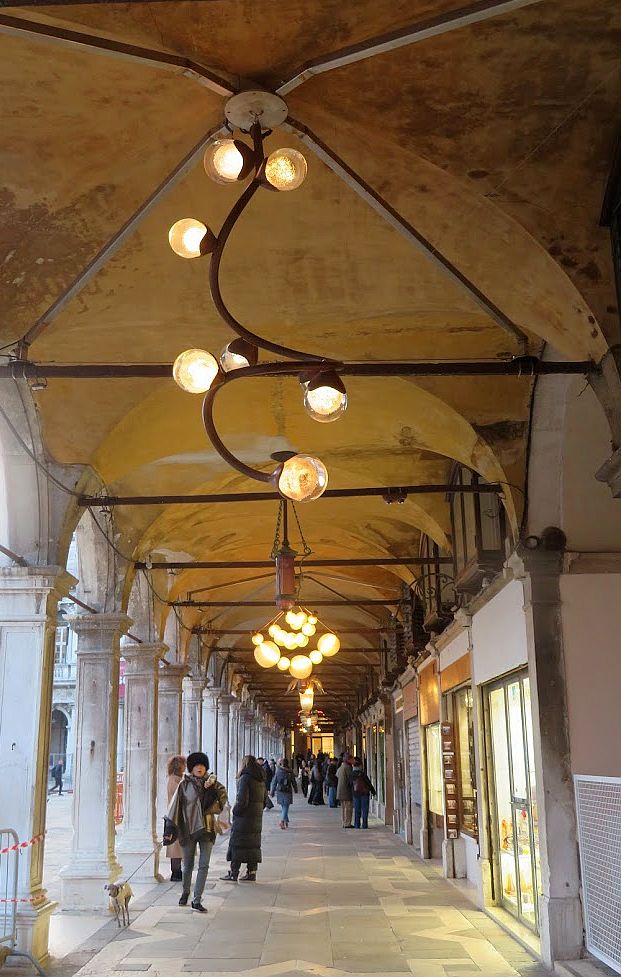
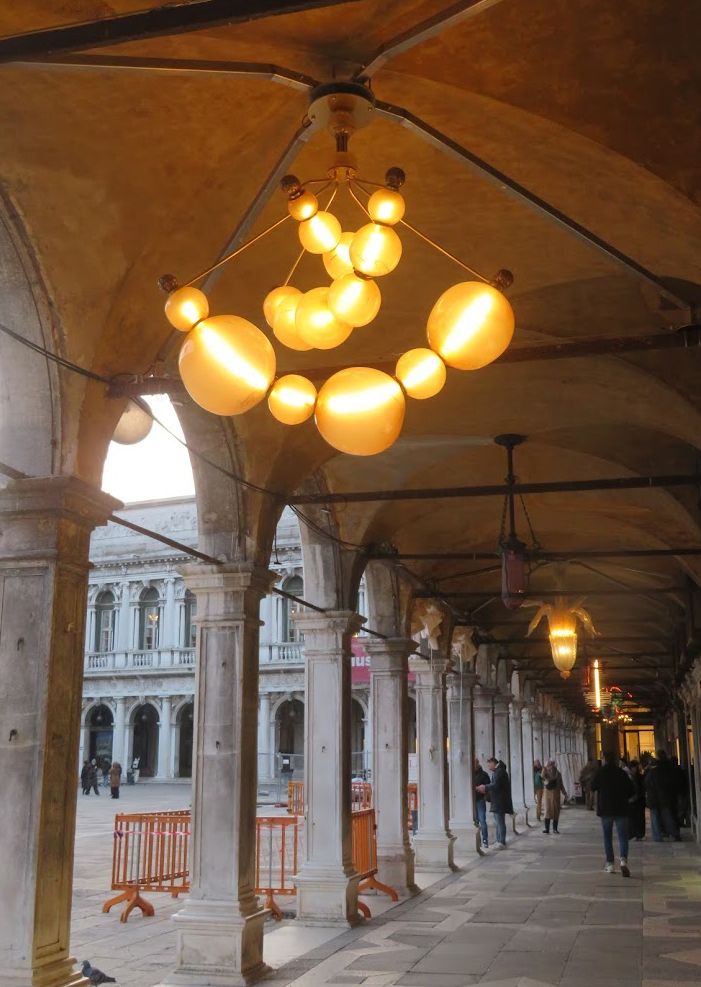
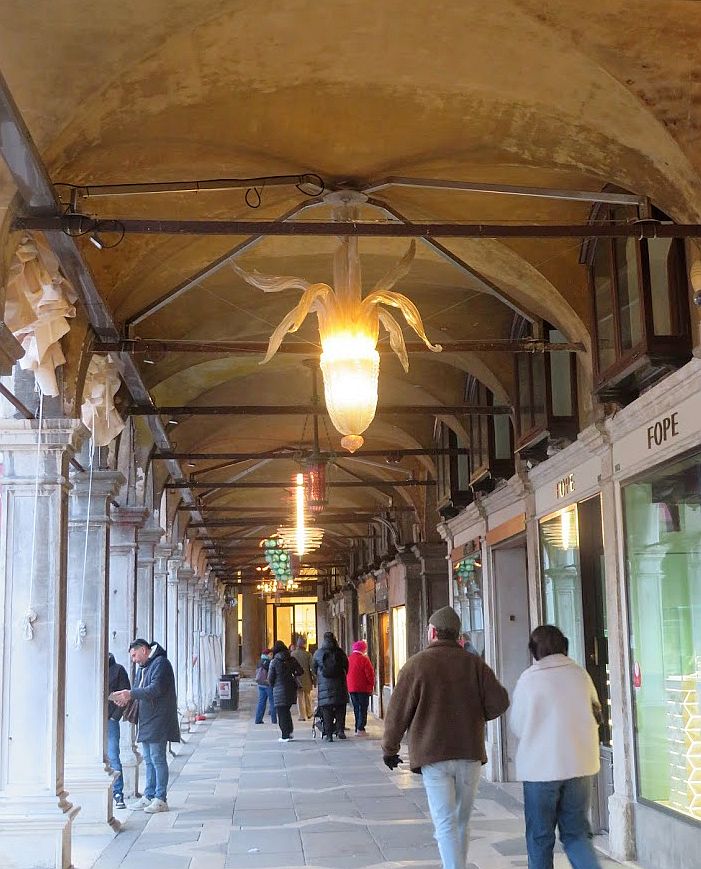
The walkway beneath the Procuratie Vecchie on the north side of Piazza San Marco is looking kind of edgy. One does not award points for this kind of work but if it were a sport they all deserve the maximum for “execution.” “Style,” on the other hand, remains in the eye of the beholder. As it should.
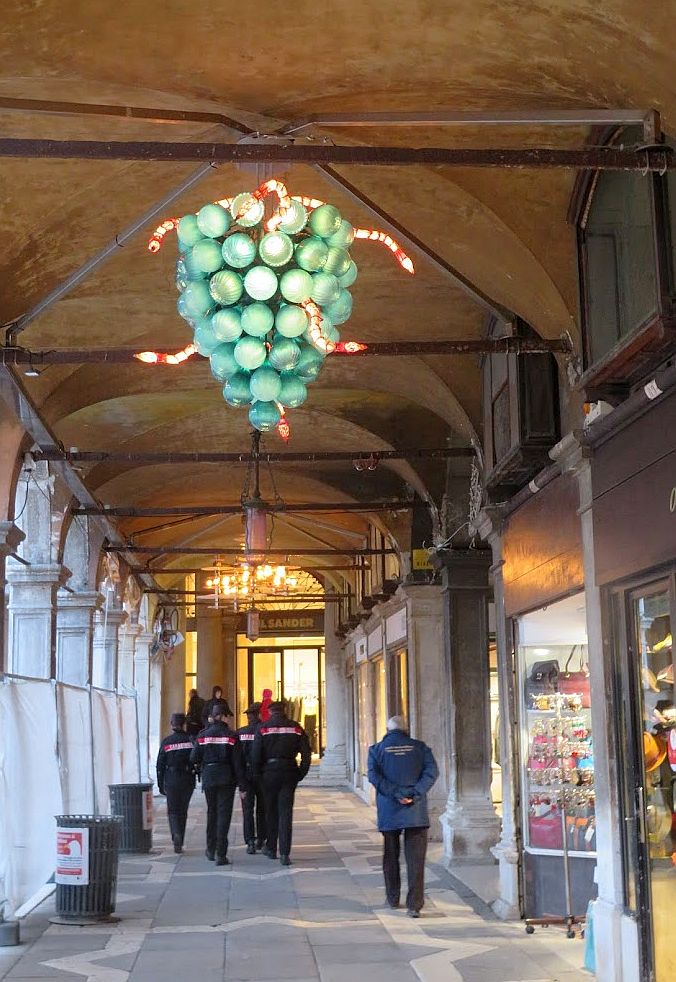
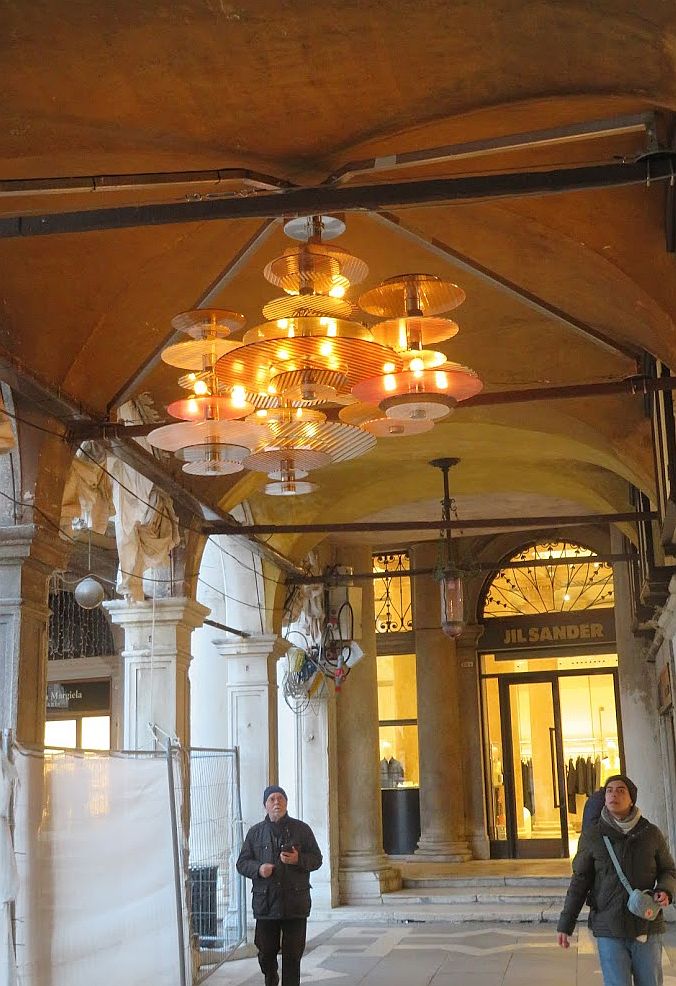
Last November 22 the passageway under the Procuratie Vecchie at the Piazza San Marco lit up with 12 glowing glass chandeliers. Yes, I’m very late to this subject, but I do not go to the Piazza every day, nor do I subscribe to the “Murano Glass Daily Astonisher” (totally made up).
Late as I may be, the lamps will be shining until March 1, so there is still time to see them if you’re in the neighborhood.
This year is the third edition of an annual invitation-only exhibition, “Murano Illuminates the World,” to showcase the collaboration of international glass masters with Muranese “furnaces” who were given the assignment “chandeliers.”
I admire the technical and creative talent that the artist and glassmaster displayed in this extraordinary collaboration. As for the appeal of any individual piece, opinions will certainly be respected. The mystical meaning of each work is elucidated in the excellent report from “Venezia Today” online (translated by me).
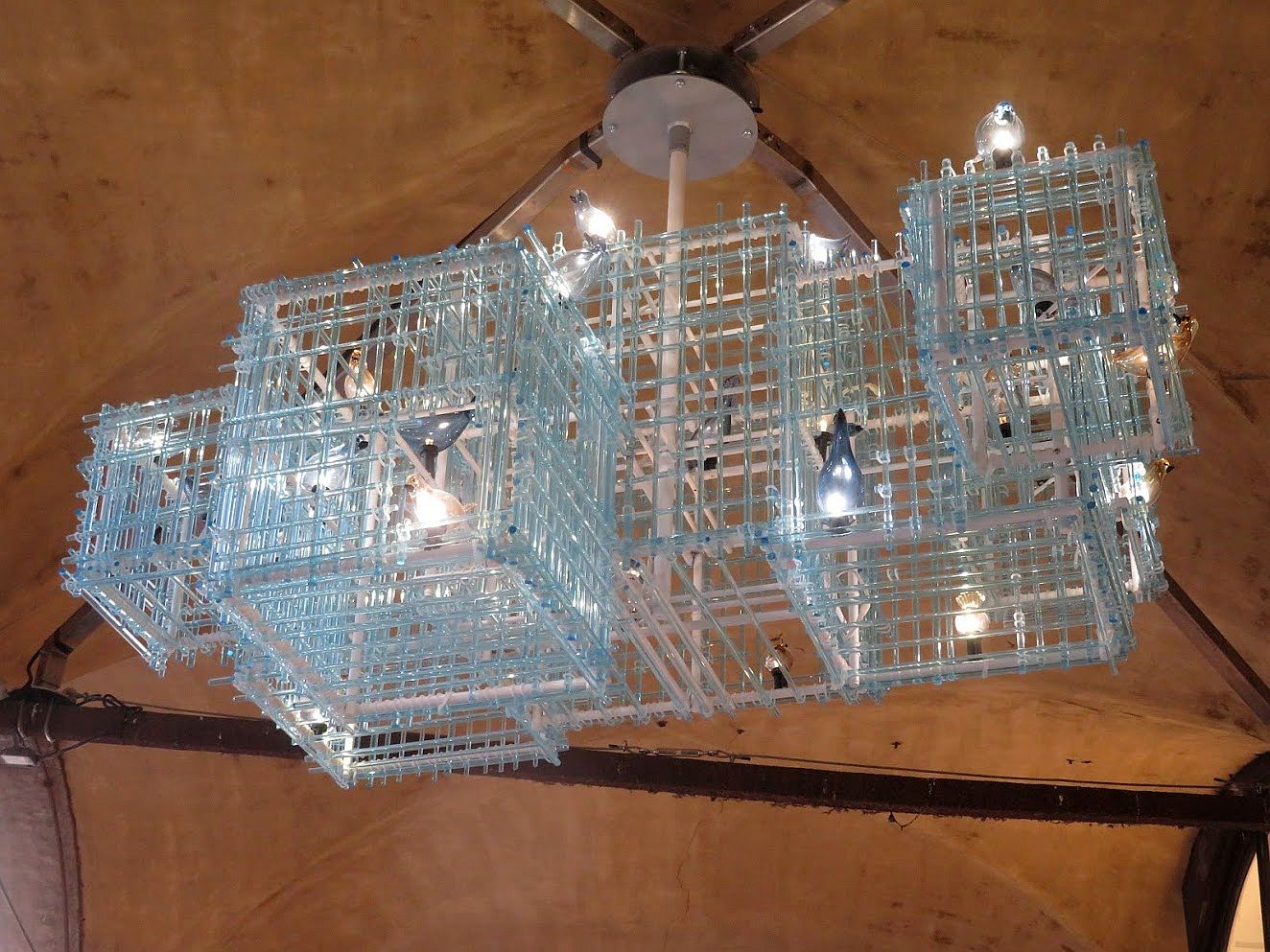
Inside/Outside Ru Xiao Fan, with Effetre and Seguso Gianni. A birdcage complete with birds, in and out. “The work reflects the choice between security and liberty, and evokes the myth of Eden and the ‘invisible cages’ of the present. To leave the illusion of protection requires courage, but only he who risks can discover the true significance of flight.”
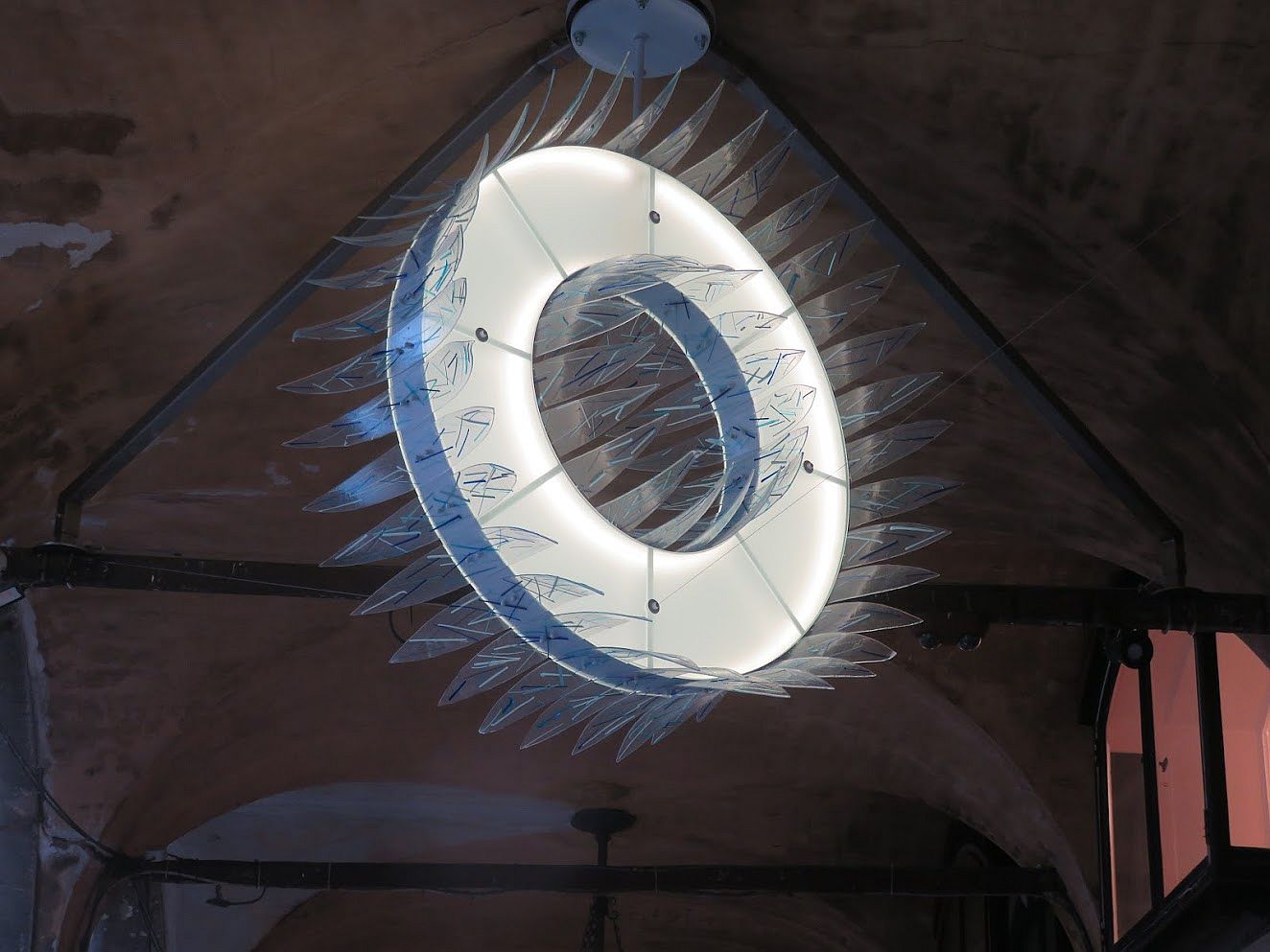
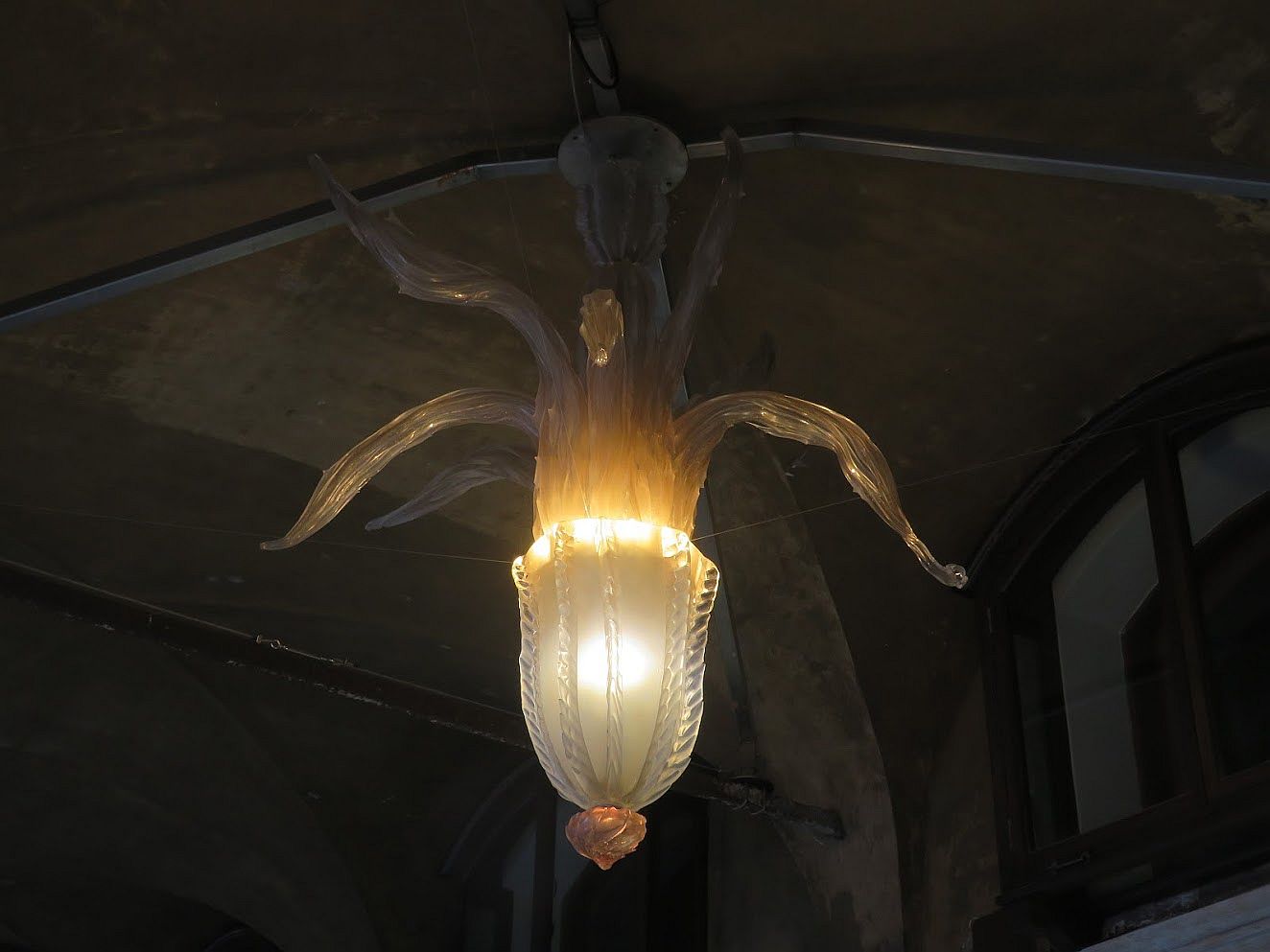
Life’s Meaning The Abate Zanetti school, with master Eros Raffael. A group work born of the creativity of the young glassmasters. “The chandeliers’ leaves decorated in various shades of blue filaments symbolize the cycle of life. The leaves recall water, the origin of every form, and by their harmonious movement speak of time, the transformation and the eternal continuity of existence.”
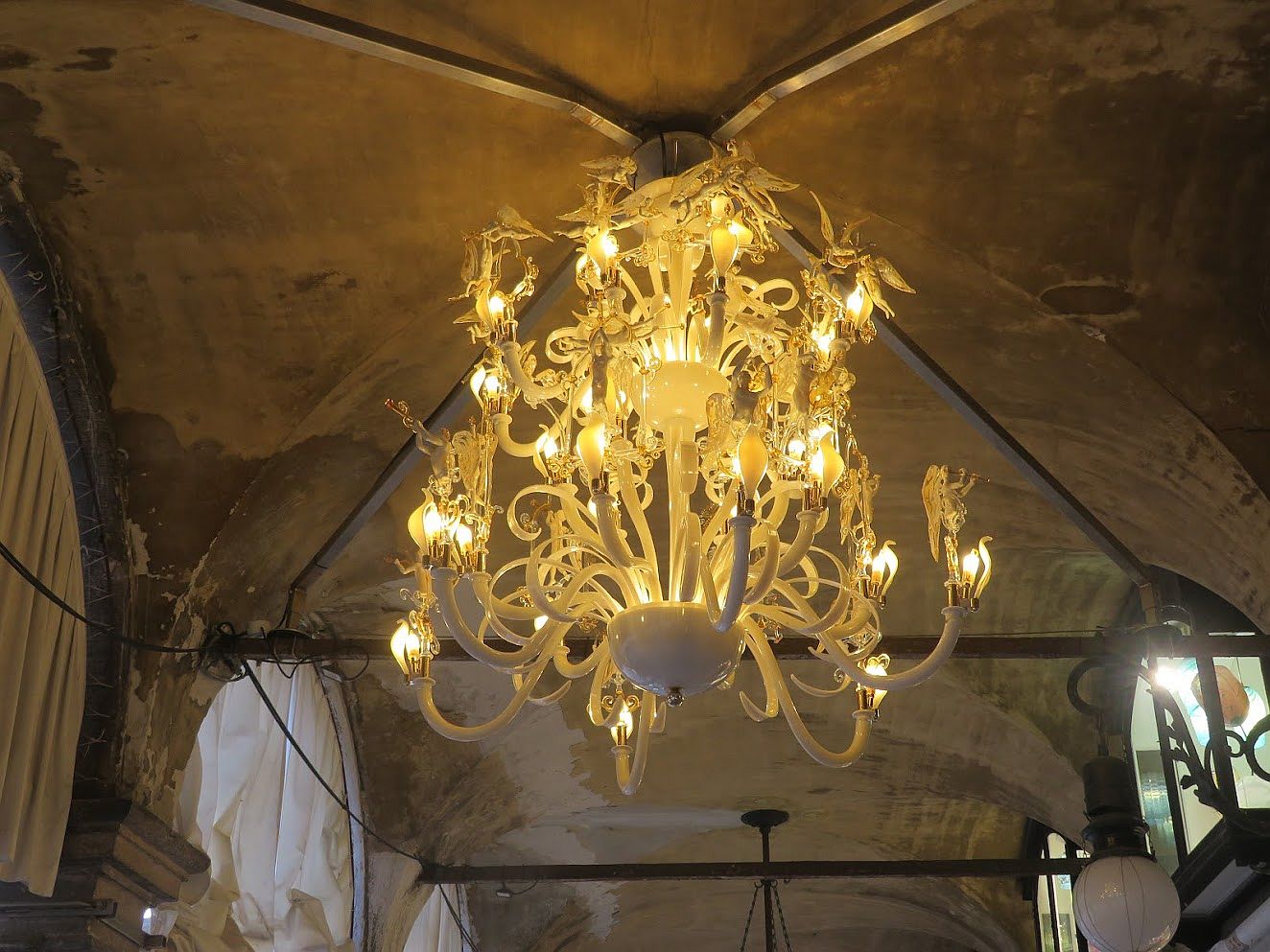
Musica Angelica (Angelic Music) Lucio Bubacco, with Vetreria 3 Artistico Lampadari. “A scenographic composition with an ensemble of angels that play classical instruments. The chandeleier is made of 30 arms and the light they carry becomes the atmosphere that surrounds the angelic figures.”
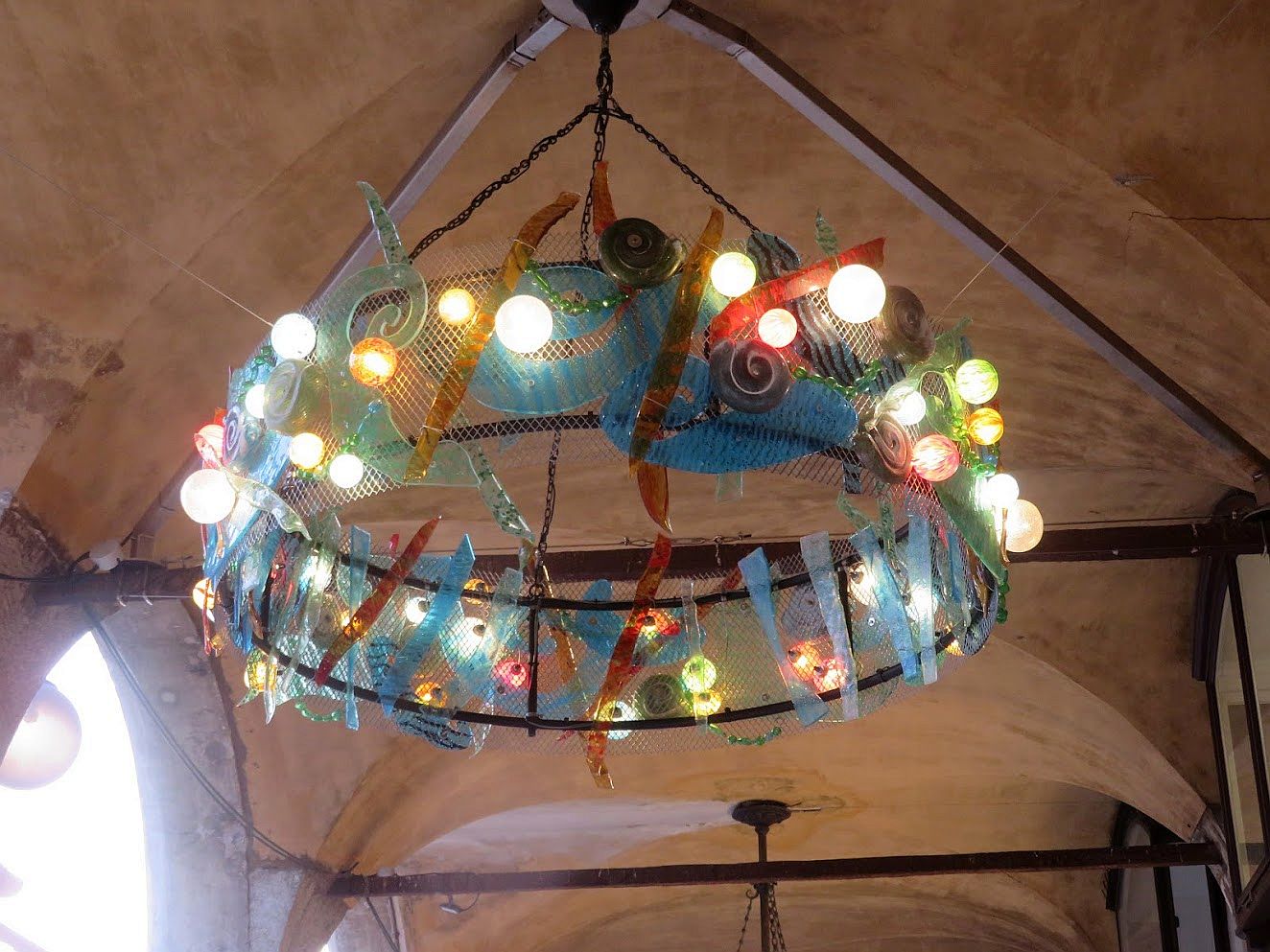
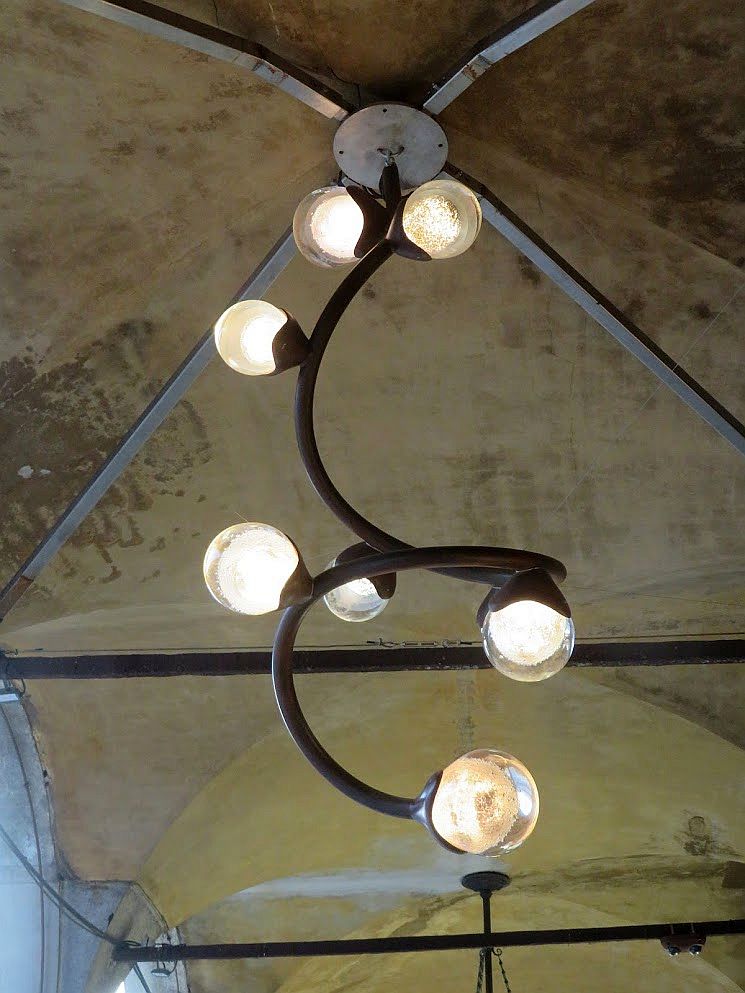
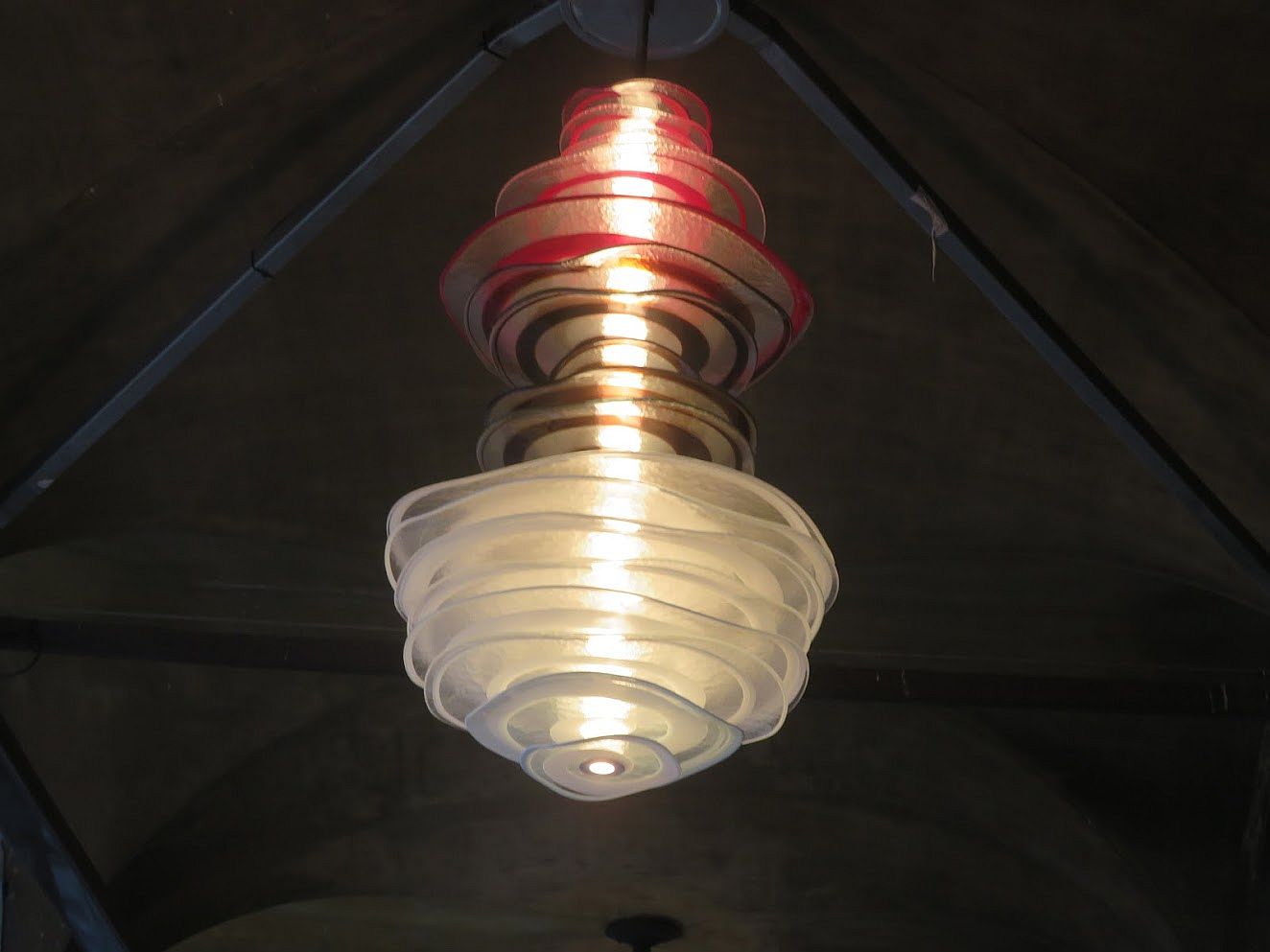
Pool of Light F. Taylor Colantonio with Signoretto Lampadari in collaboration with Calvadore. “Has drawn inspiration from the designs in the archive of the Study Center of Glass of the Giorgio Cini Foundation on the island of San Giorgio Maggiore, and from the ceiling of the railway station of Santa Lucia. The Pool of Light imagines a ray of sunshine that filters through a swirling current of the lagoon.”
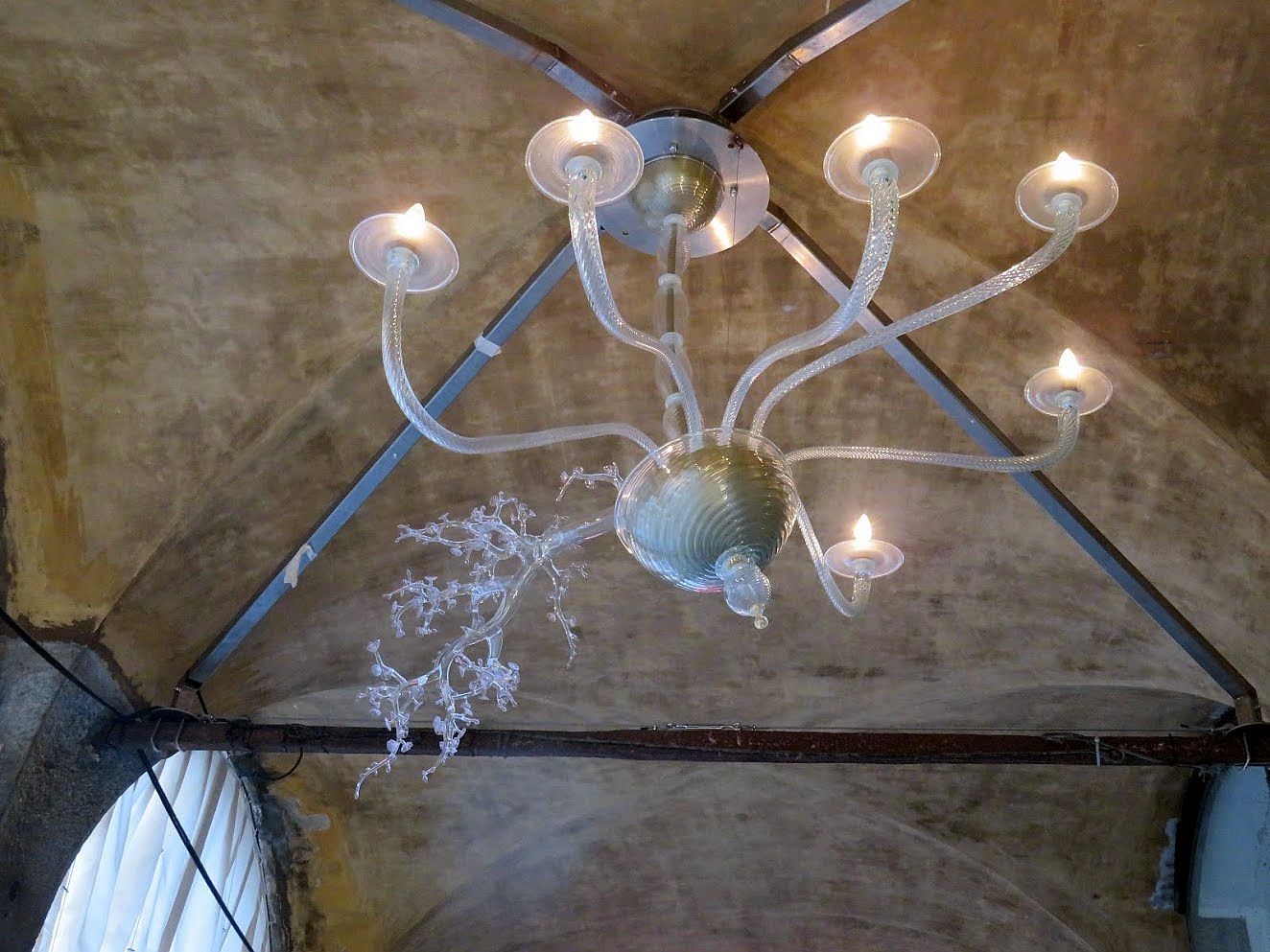
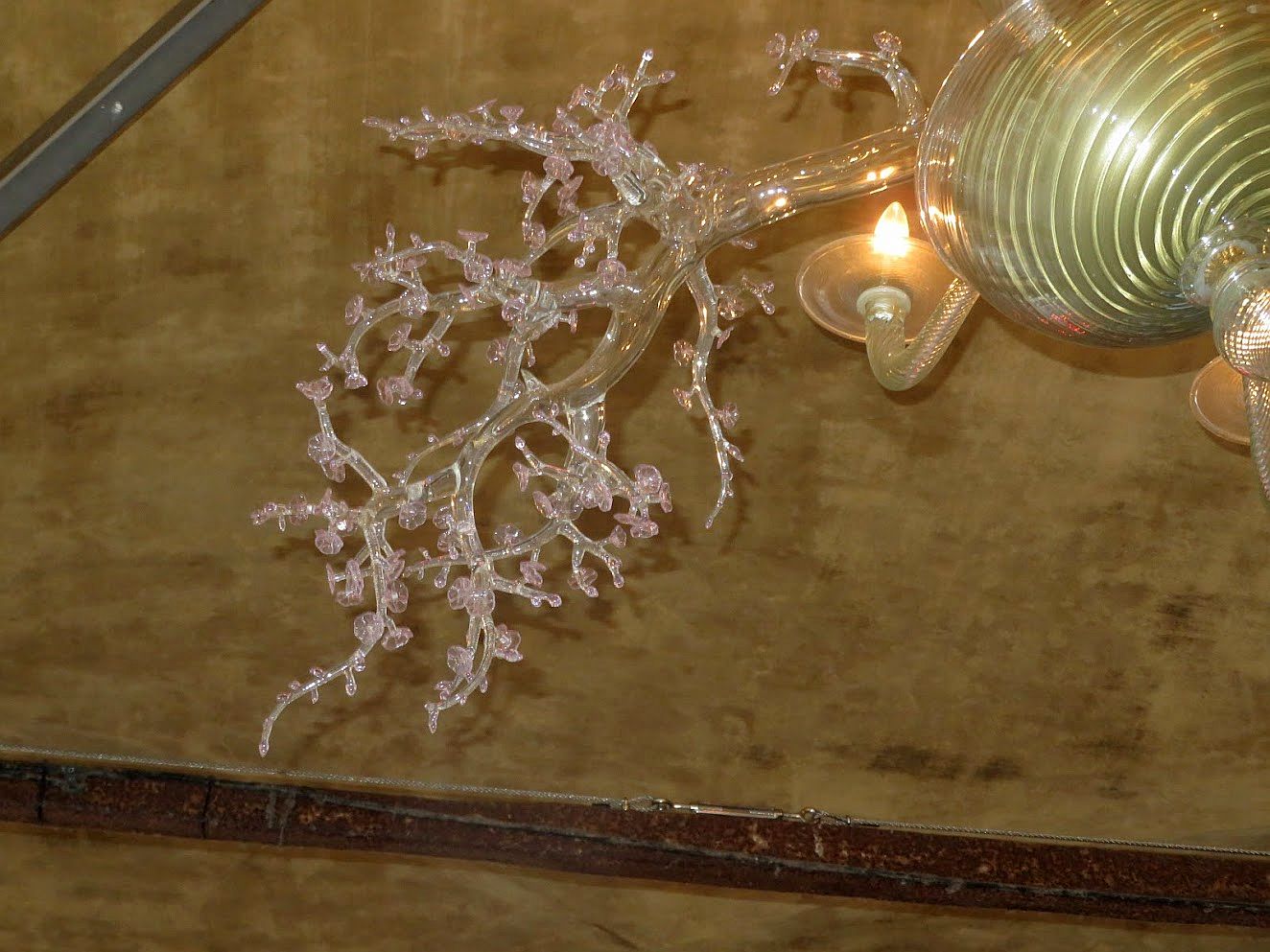
Because it’s impossible to show all the chandeliers in one photo, I divided the walkway into thirds. This is the middle section.Primavera d’Oriente (Eastern Spring) Simone Crestani, with Berengo Studio. “A chandelier inspired by models from the Twenties, where a flowering branch in borosilicate (silica and boron trioxide) glass, studded with pink buds, crosses and unbalances the linear structure in smooth glass to then recompose in a poetic equilibrium, combining geometry and naturalism.”
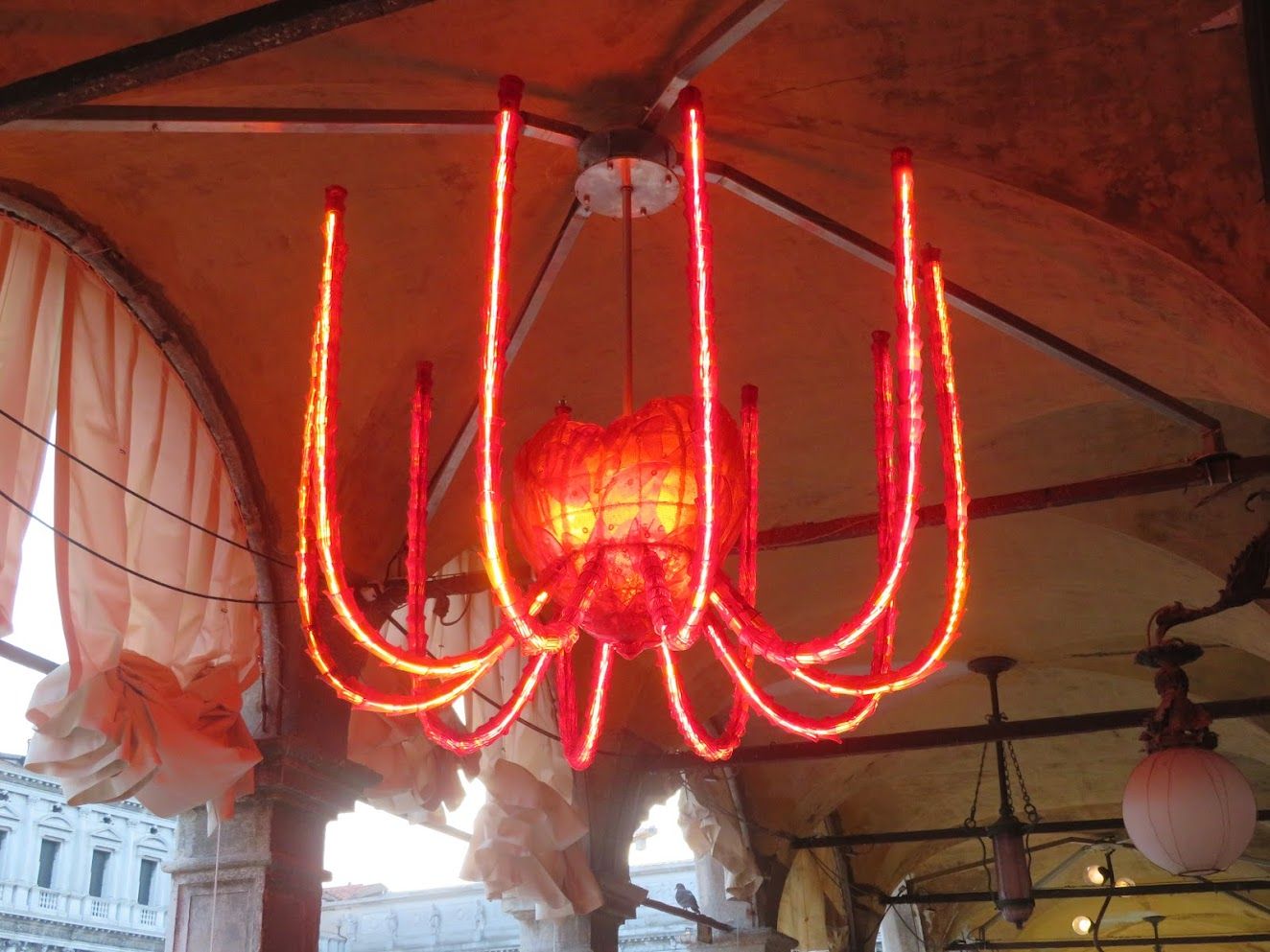
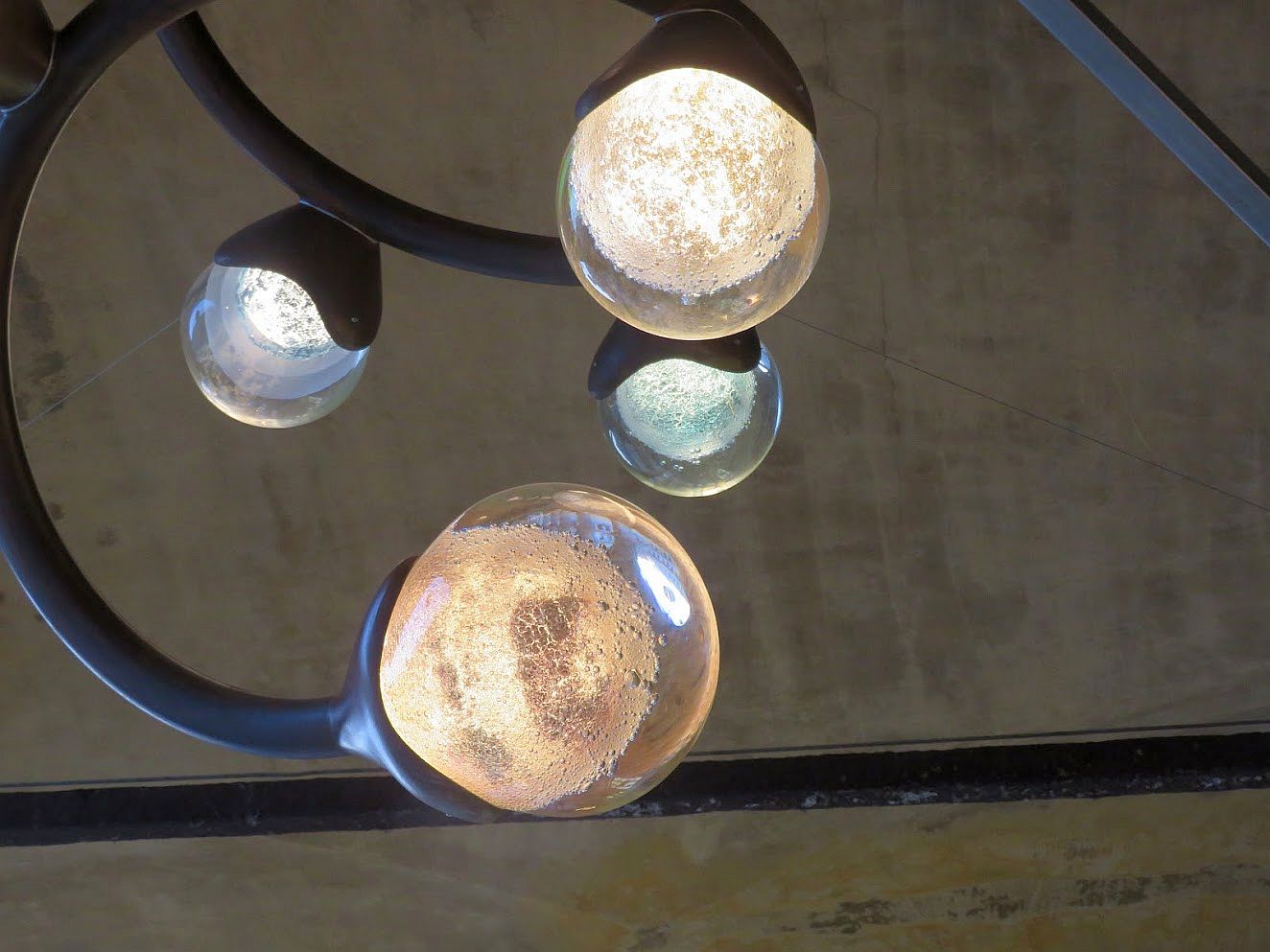
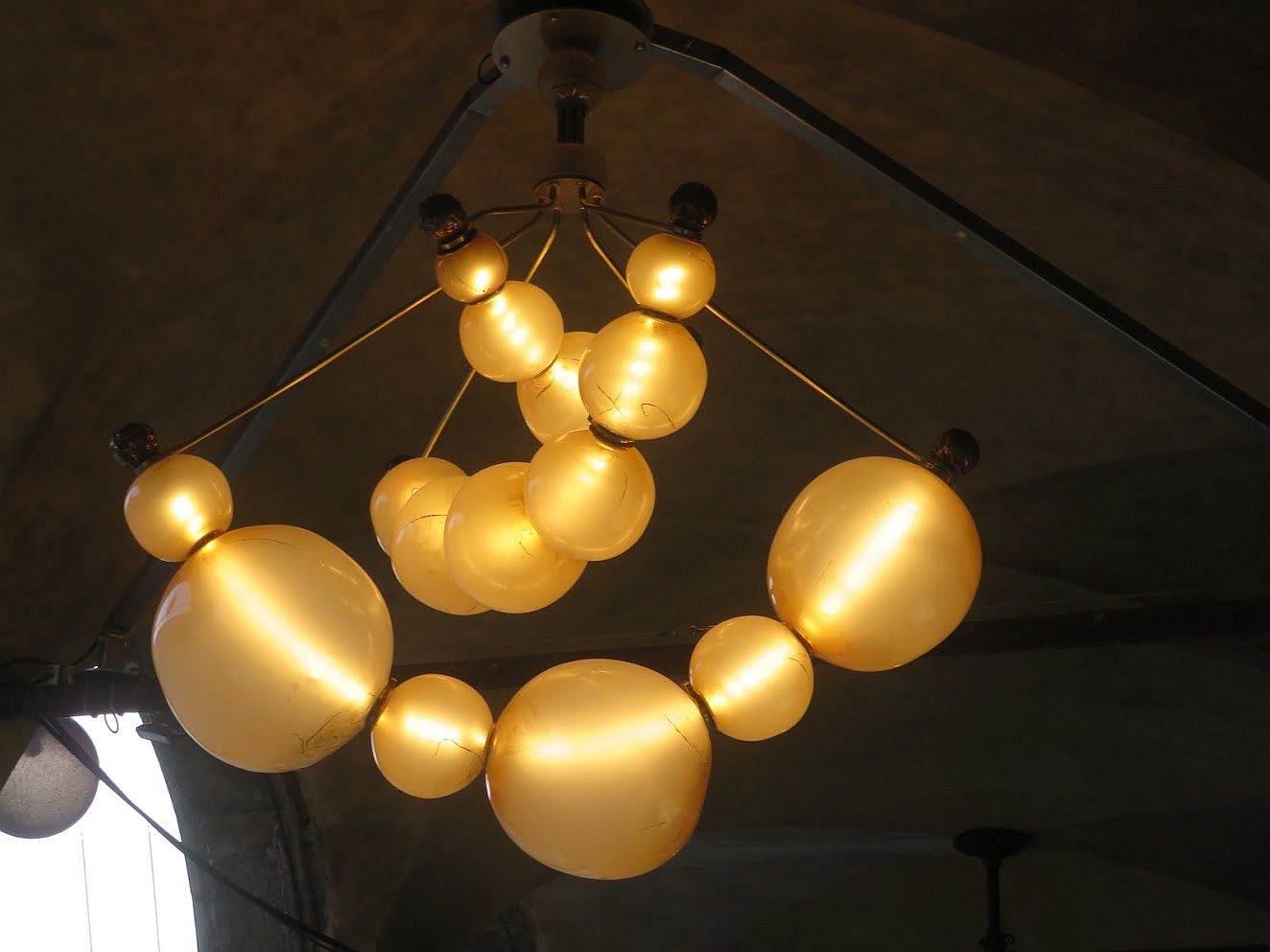
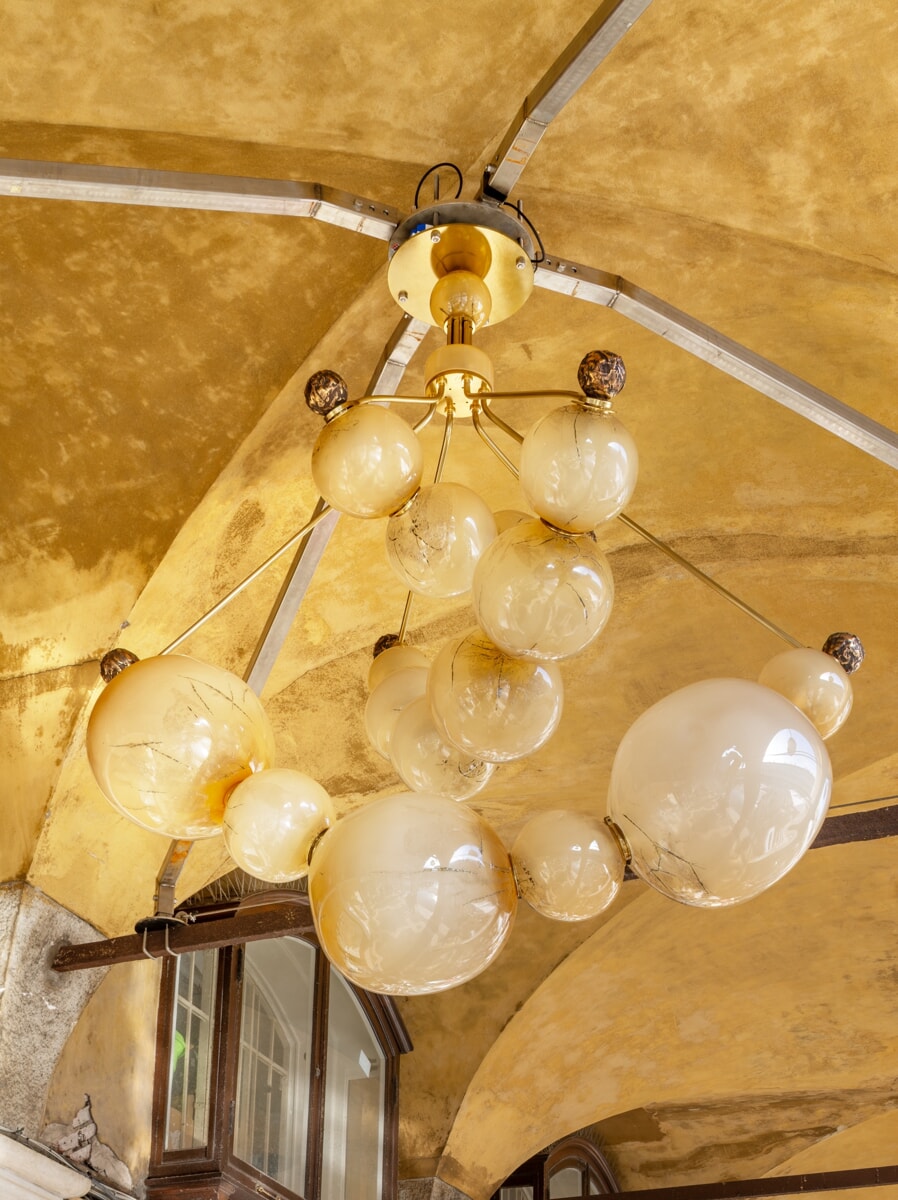
A closer look at those beautiful buds.Cuore Infinito (Infinite Heart) Joana Vasconcelos, with Berengo Studio, “transforms the chandelier into a pulsating organism… a luminous heart that vibrates with light and color, a monumental symbol of passione, resilience and transformation. The form, suspended between tension and harmony, reinterprets a domestic object into an emotional and universal icon.”Things appear to be calming down in this stretch. No more pulsating organisms.The Observatory Irene Cattaneo, with Lavorazioni artistiche of Fabiano Amadi. “With its eight handmade “moonlike” spheres, the chandelier is homage to the glassmaking master of Murano, where the classic technique of the submerged entanglement is expertly fused with the use of metallic powder to create a luminous and profound effect.”
Trama di Luce(Weave of Light) Michela Cattai, with Simone Cenedese. “It takes shape from the observation of the rhythms of the tides and the geometry of the islands of the lagoon by Murano, elements that define a fragile equilibrium and in continuous flux.”
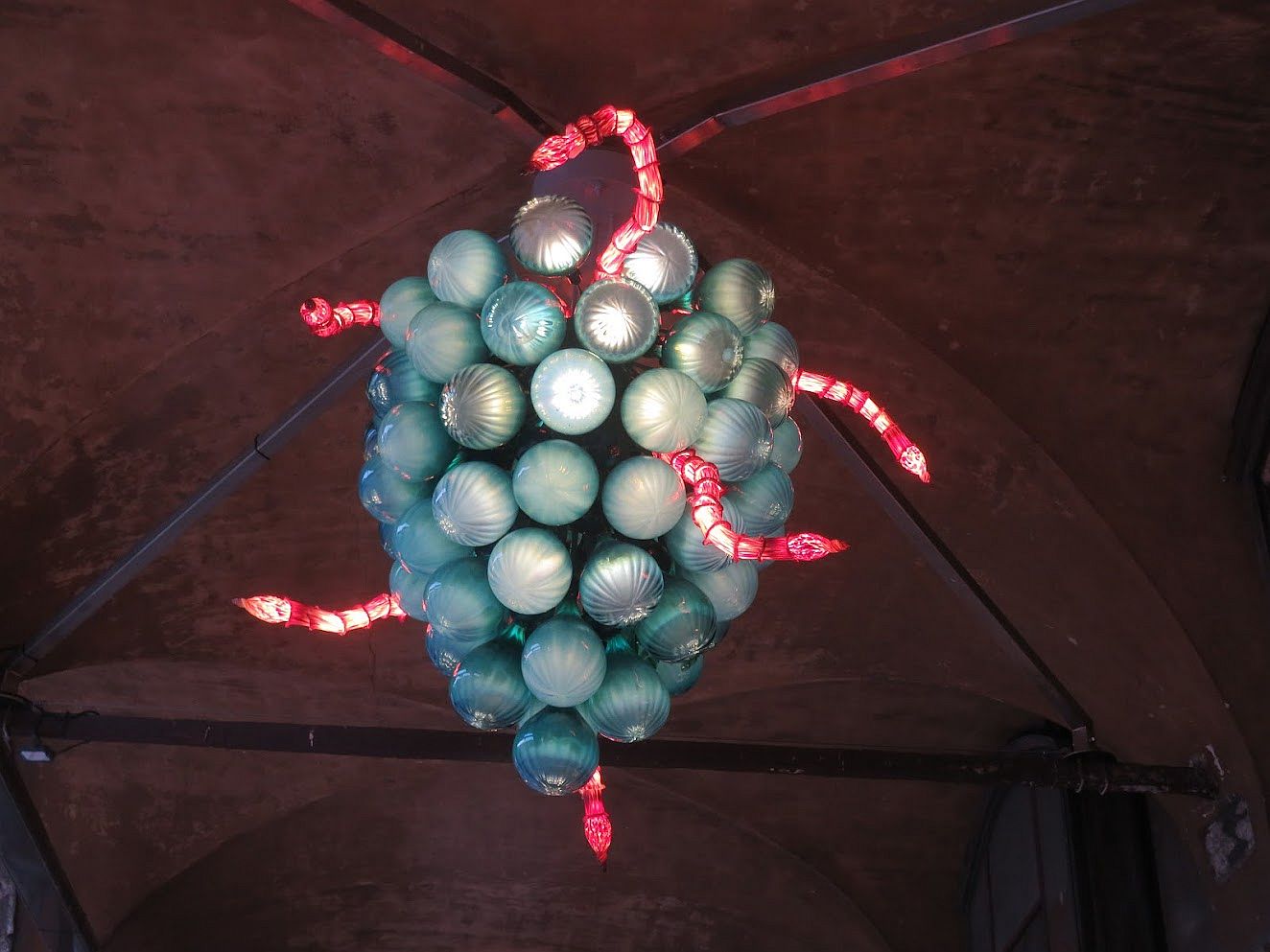
This is what the chandelier looks like when it gets up in the morning. “We must not let daylight in upon the magic” is the famous warning about British royalty that comes to mind. You mean that extraordinary lamp looks like any old ordinary lightbulb in during the day? (from VeneziaToday, not credited)The final section of the line-up.Calamaro (Squid) Massimo Micheluzzi, with Vetreria Anfora. “A chandelier in an organic form that evokes marine tentacles. The glass shapes the fluid movement of the water and the Venetian lagoon, transforming the chandelier into a creature that is poetic and alive, mirroring the material that breathes with the territory.”Profilo (Profile) Luca Nichetto, with Barovier & Toso, blends craftsmanship and technology in “A work that reinterprets in a contemporary key the silhouette of the classic chandelier, composed of 34 disks in centrifuged glass. Each disk conserves in the glass a delicate spiral motif, a trace of the gesture of the artisan. The light diffused by a central axis unites the forms in a hamonic dialogue between past and future, where centuries-old techniques meet innovative design.”Nature Rebirth Christian Pellizzari, with Salviati. “A suspended work composed of blown “eggs” and tentacles made with the technique of the ‘compasses’ of the Rezzonico chandeliers. The ancient material dialogues with an innovative system of micro-LED, celebrating the continuous rebirth of nature through light, fragility and strength.”
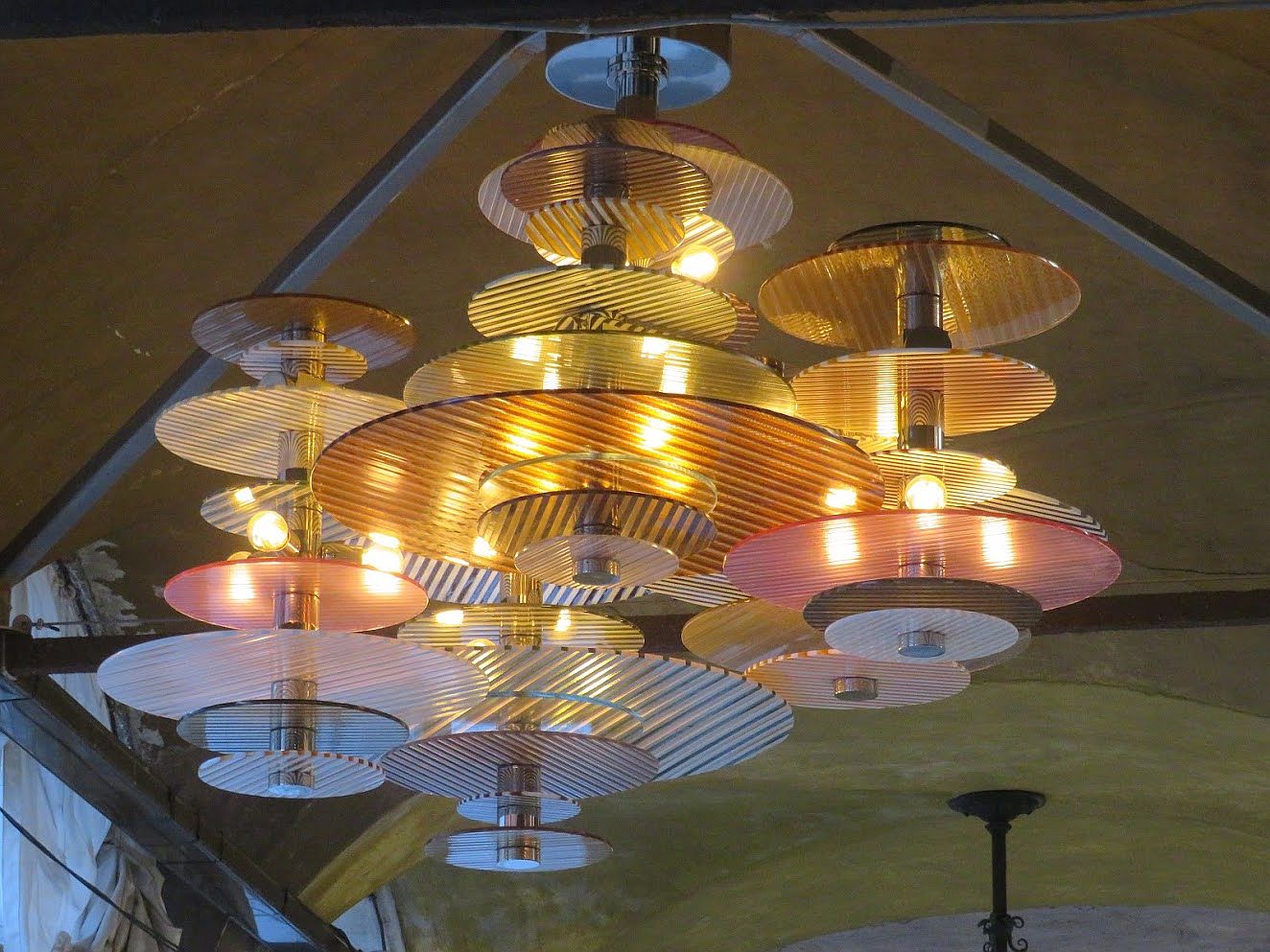
Acqua Rings Chahan Minassian, with Nicola Moretti Murano, “reinterprets one of his iconic designs: overlapping disks of glass dance in a tonality inspired by the Venetian lagoon, composing a chandelier that is minimalist but vibrant, where the circular movement evokes the fluidity and reflections of water.”
Thanks to everybody who cheered the flowers in my last post. You’ve cheered me up too.
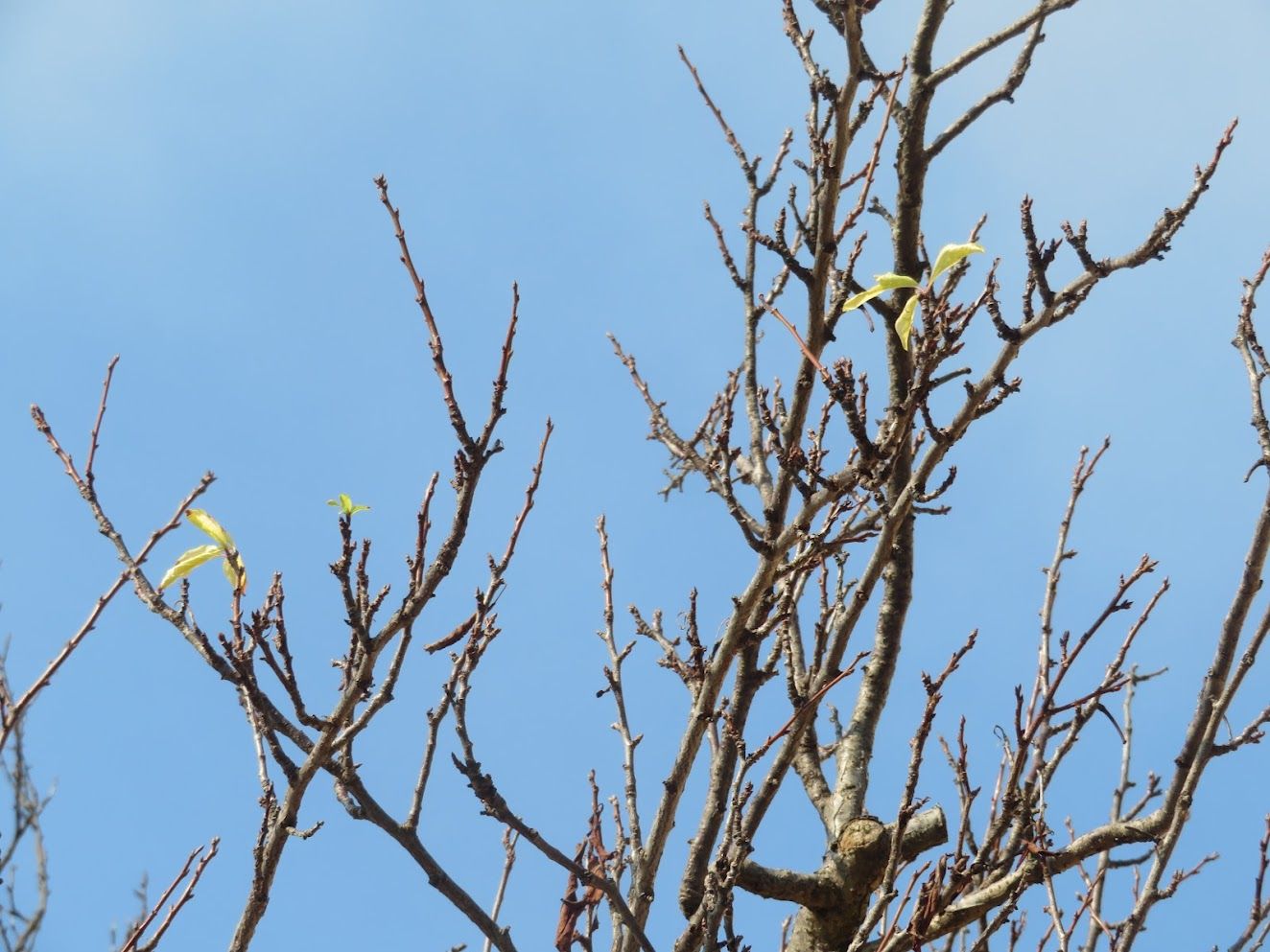
So as a bonus, here is a picture of faith and courage and hope delivered straight from the plum tree near the vaporetto stop at San Pietro di Castello. Emboldened by the sunshine yesterday, the somewhat reasonable temperature and no serious wind, this tree decided to throw caution overboard and just start putting out leaves. Lino says they’re flowers. We’ll say “greenery.” I wouldn’t ever have thought I’d wish I could be a like a plum tree, but today they have put new heart into me.
So I squash any negative “Hope it works out for you” thoughts directed by grinchy spirits at the end of January. And the comment that’s even worse (addressed to the tree): “I guess you know what you’re doing………” (in the classic undertone conveying “You have lost your last shred of sense or survival, don’t come crying to me when it all goes belly-up”).
Excelsior.
Prunus domestica. My hat is off to you. Why don’t you lead the charge, seeing as you’re so confident?
Contains information related to marketing campaigns of the user. These are shared with Google AdWords / Google Ads when the Google Ads and Google Analytics accounts are linked together.
90 days
__utma
ID used to identify users and sessions
2 years after last activity
__utmt
Used to monitor number of Google Analytics server requests
10 minutes
__utmb
Used to distinguish new sessions and visits. This cookie is set when the GA.js javascript library is loaded and there is no existing __utmb cookie. The cookie is updated every time data is sent to the Google Analytics server.
30 minutes after last activity
__utmc
Used only with old Urchin versions of Google Analytics and not with GA.js. Was used to distinguish between new sessions and visits at the end of a session.
End of session (browser)
__utmz
Contains information about the traffic source or campaign that directed user to the website. The cookie is set when the GA.js javascript is loaded and updated when data is sent to the Google Anaytics server
6 months after last activity
__utmv
Contains custom information set by the web developer via the _setCustomVar method in Google Analytics. This cookie is updated every time new data is sent to the Google Analytics server.
2 years after last activity
__utmx
Used to determine whether a user is included in an A / B or Multivariate test.
18 months
_ga
ID used to identify users
2 years
_gali
Used by Google Analytics to determine which links on a page are being clicked
30 seconds
_ga_
ID used to identify users
2 years
_gid
ID used to identify users for 24 hours after last activity
24 hours
_gat
Used to monitor number of Google Analytics server requests when using Google Tag Manager